The Day That Changed Everything
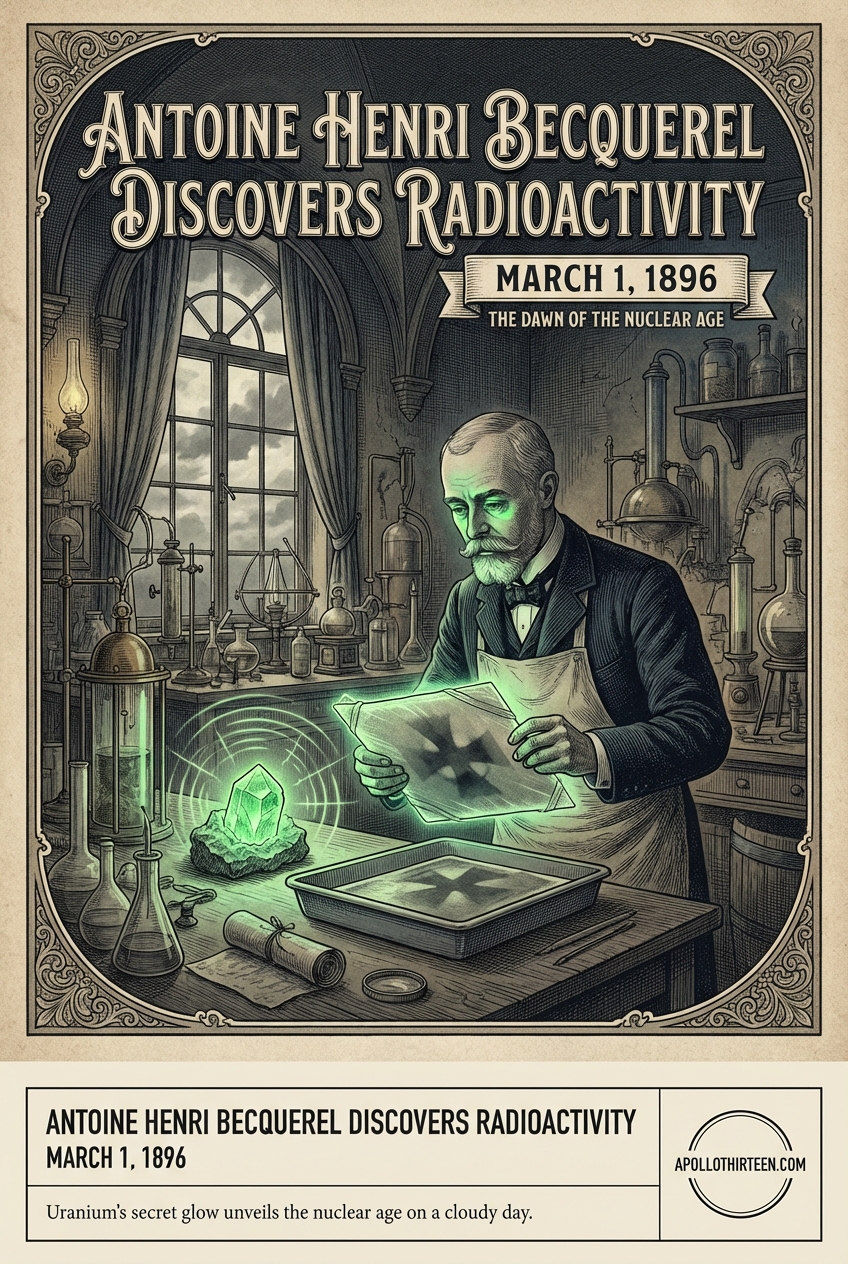
One gray Paris morning, 130 years ago today, a drawer was opened and the modern world took a tiny, invisible step into the nuclear age. The scene was not a dramatic laboratory explosion or a thunderous announcement from a government capital; it was a small, domestic moment of impatience and curiosity. Antoine Henri Becquerel had tucked away a handful of uranium salts and a bundle of photographic plates in a dark drawer because the city had been overcast for days. He expected nothing more than a few faint traces from residual effects. Instead, when he developed the plates on March 1, 1896, the wrapped emulsion revealed startling silhouettes—clear, crisp images of the uranium crystals themselves, printed as if by an invisible hand.
That strange, unexpected image was the first unmistakable proof that certain atoms were not immutable and inert, but emissive—sending out rays that could pass through paper and fog a photographic plate without any external light. The discovery did not happen with fanfare. It happened in a quiet laboratory in Paris, the sort of place where curiosity, family legacy, and bad weather conspired to overturn centuries of scientific certainty. It would take weeks, then months and years, for the full implications to be understood. But on that cloudy morning, the boundary between the visible and invisible was breached, and physics began to enter a new, unsettling, endlessly productive age.
What Actually Happened
Henri Becquerel was not hunting for anything like radioactivity. In the winter of 1896 his work revolved around phosphorescent minerals—substances that glow after exposure to light. The recent announcement, the previous November, of Wilhelm Röntgen’s discovery of X-rays had electrified Europe. X-rays seemed to be a new kind of light, invisible yet capable of penetrating opaque objects and producing photographic images. Becquerel wondered whether phosphorescent substances, when excited by sunlight, might themselves emit rays akin to Röntgen’s X-rays.
To test the idea he arranged a simple, elegant experiment. He wrapped photographic plates in black paper to shield them from light, placed on the paper small samples of potassium uranyl sulfate—uranyl salts known to glow after exposure to light—and then left them in sunlight. When the weather intervened and Paris was clouded for several days, Becquerel stored the prepared plates and samples in a drawer, intending to resume the work when the sun returned.
On March 1, expecting only weak or no effect, he developed the plates. What emerged in the darkroom was startling: clear, sharp shadows of the uranium crystals themselves. The images were far too strong to be the residue of phosphorescence—there had been no sustained sunlight that could have induced such a long-lived glow—and the plates had been wrapped. The radiation had passed through the paper and exposed the emulsion directly. That realization—that the uranium salts themselves were spontaneously producing a penetrating radiation—was the key insight.
Becquerel did not rest on that one plate. He repeated the test the next day and then publicly reported the finding to the French Academy of Sciences on March 2. He conducted control experiments to eliminate other explanations. He found that non-phosphorescent uranium compounds produced the same effect, that the emission did not require exposure to light, and that the darkening could be reduced by placing thick plates of lead between the sample and the photographic plate. He had discovered a previously unknown emission from uranium salts: radiation produced without external excitation.
In rapid succession over the next months he and others expanded the observation. By May he showed that uranium alone, not just particular salts, was responsible; thorium and some other elements also emitted similar rays. By the end of the year he had begun classifying these emissions: some rays were deflected one way in a magnetic field, some the other way, and some not at all. These were the first hints of what would become the identification of alpha, beta, and gamma radiation.
It was an accidental discovery in the literal sense—bad weather and an inquisitive scientist were essential ingredients. Yet it was also the product of a particular intellectual inheritance: Becquerel came from a family steeped in the study of light and electricity, and his tools, materials, and instincts were already aligned to recognize and interrogate the odd plate in his hand.
The People Behind It
Henri Becquerel, the man whose name would become attached to a unit of radioactivity, was a bridge between generations of 19th-century experimentalists. Born in Paris in 1852, he was the third in a line of scientists. His grandfather, Antoine César Becquerel, had been a pioneer of electrochemistry; his father, Alexandre-Edmond Becquerel, was known for work on phosphorescence and on photovoltaic phenomena. Henri inherited not just a laboratory and a place in Parisian scientific life, but literal samples—his father’s collection of minerals and salts that proved crucial to the March discovery.
By 1896 Henri was a respected physicist, a professor at the Muséum d'Histoire Naturelle and the École Polytechnique. He was methodical and empirically minded, an experimenter at ease with a darkroom, a drawer, a stack of plates. His family name opened doors, but his own curiosity and careful technique were what made the moment count.
The discovery does not belong to Becquerel alone. The intellectual climate—shaped by others—was critical. Wilhelm Röntgen’s revelation of X-rays in November 1895 had lit a fuse across laboratories in Europe. Photographers and physicists were eagerly testing the new rays; it was natural for someone studying glow-in-the-dark minerals to ask whether those materials could generate similar penetrative effects. Long before Becquerel, the photographer Abel Niépce de Saint-Victor had observed that uranium salts could darken photographic plates in the 1850s and 1860s, but he did not pursue a full explanation. His notes were a near miss, a ghost of the discovery waiting to be recovered.
And then there were the Curies: Marie and Pierre. News of Becquerel’s results reached them in early 1896 and ignited an obsession. They took Becquerel’s discovery further, methodically separating the chemical substances to search for the source of the emissions. In 1898, Marie and Pierre Curie announced the discovery of two new radioactive elements—polonium and radium—isolating radioactivity as a property tied to specific elements. For their collective work on radioactivity, Marie and Pierre and Becquerel shared the Nobel Prize in Physics in 1903.
The story that began in a drawer rippled outward quickly as other experimentalists chimed in. Ernest Rutherford later reinterpreted the emissions, showing that some were helium nuclei (alpha particles) and that radioactivity implied internal structure in the atom. Physicists and chemists—across Europe and eventually the world—lined up to poke, count, and measure the strange emissions. In the space of a single decade the implications of Becquerel’s discovery sprawled from chemical separations to telescoping models of atomic structure.
Why the World Reacted the Way It Did
What the world initially reacted to was less a popular panic and more professional curiosity and excitement. The preceding months had primed the public and the press for marvels. Röntgen’s X-rays had been front-page news: suddenly you could make an image of bones inside a living body. Photographs of broken bones and bullets in flesh captivated newspapers. Against that backdrop, Becquerel’s finding looked at first like another facet of the X-ray story. Scientific journals filled with rapid communications and experimental replications.
But the nature of Becquerel’s discovery—spontaneous emission from a substance with no external stimulus—had deeper philosophical implications. Nineteenth-century science had largely treated atoms as stable, eternal building blocks. That atoms could change, could emit energy and transmute, was a challenge to long-established views. The scientific community moved fast because the implications touched chemistry, geology, and the fundamental notion of matter.
For the public, the story became truly dramatic when Marie Curie’s painstaking work isolated radium and when radium’s luminous properties—and its apparent promise as a medical wonder—entered popular culture. In the years around the century’s turn radium was touted for everything from luminous paint for watch dials to speculative health treatments; it was a glamorous, if poorly understood, novelty. The French state and private benefactors funded the work of the Curies and others, reasonably seeing scientific advance as national prestige.
Politically, the discovery did not immediately provoke state-level anxiety. The Third Republic in France had institutions—academies, museums, universities—that supported experimental science as a matter of civic pride. It was not until decades later, after the chain of discoveries that led to nuclear fission, that radioactivity’s strategic and military significance would reshape politics.
There was, too, a darker undertow. Early users of X-rays and radium had little idea of the risks. People decorated watches with radium paint, patients received large, sometimes fatal doses of radiation in experimental therapies, and several pioneering scientists, including Marie Curie, accumulated radiation injuries. The public had a complicated relationship with the new rays: awe, medical hope, and, increasingly, unease.
All of which makes Becquerel’s quiet March morning feel like the hinge of a sweeping drama. For scientists it was a cascade of puzzles and experiments. For industry it suggested new products. For governments, decades later, it would point to unprecedented power.
What We Know Now
More than a century of work has turned Becquerel’s shadowy plate into a precise language. What he had observed was ionizing radiation: energetic particles and photons emitted when unstable atomic nuclei change to more stable forms. The word “radioactivity” describes that spontaneous emission. It is not a glow in the old sense; it is the release of energy from the nucleus—a core of protons and neutrons bound together by nuclear forces—that transforms the atom itself.
Uranium, the element at the heart of Becquerel’s experiment, has an isotope—uranium-238—that decays slowly, ejecting an alpha particle (two protons and two neutrons bound together: essentially a helium nucleus). That alpha emission leaves a daughter nucleus that, in turn, may be radioactive, emitting beta particles (electrons or positrons) or gamma rays (very energetic photons) as it seeks stability. Over time, a chain of decays leads to a stable element; in uranium’s case this chain ends at lead. Each step emits measurable energy.
The three types of emission hinted at by Becquerel’s early experiments are now well understood:
- Alpha particles: heavy, positively charged. They ionize material strongly but are stopped by a sheet of paper or the outer layer of human skin.
- Beta particles: lighter, negatively (or positively) charged electrons, which penetrate more deeply but are stopped by a few millimeters of metal.
- Gamma rays: high-energy photons with no charge, highly penetrating, requiring dense shielding like lead or thick concrete.
The fogging of a photographic plate is a simple physical effect: the emulsion is chemically sensitive to ionizing events. When an energetic particle or photon strikes the emulsion, it creates free electrons and ions that trigger a chemical change. In Becquerel’s case the radiation passed through wrapping paper and registered as an image of the crystals themselves.
The discovery also ushered in a new conception of the atom. If atoms could change, emit energy, and transmute into other elements, the solidity of matter required rethinking. Ernest Rutherford’s model of the atom—a dense nucleus surrounded by orbiting electrons—was a direct outgrowth of attempts to explain radioactive emissions. Quantum mechanics, and later the understanding of nuclear forces, would provide the theoretical framework for why and how nuclei decay.
Practical tools emerged too. Geologists use radioactive decay as a clock—radiometric dating—to determine the ages of rocks, leading to our modern understanding of Earth’s deep time. In medicine, controlled doses of radiation became tools for imaging and therapy: X-rays for diagnosis, radioactive tracers to study physiological processes, and radiotherapy to treat cancer. Nuclear reactors harness fission—splitting heavy nuclei like uranium—to generate power. And, in the most sobering realization, the same physics underpins nuclear weapons.
We have also learned to measure radioactivity with care. The becquerel (Bq), named after Henri Becquerel, is the SI unit corresponding to one disintegration per second. It is a practical measure for scientists and regulators. Equally important are exposure and dose units that quantify biological effects, guiding safety standards for workers, patients, and the public.
Legacy — How It Shaped Science Today
If a single line could be drawn from a fogged photographic plate to the modern world, it would run through laboratories and clinics, power stations and policy debates. Becquerel’s observation was the first empirical crack in the idea of immutable atoms; through that crack poured a torrent of discovery.
In fundamental science, radioactivity forced physicists to rethink matter and energy. Niels Bohr, Ernest Rutherford, and later quantum theorists built models that reimagined the atom and explained chemical behavior and nuclear processes. The realization that nuclei contained distinct energy scales and that particles could be emitted in quantized amounts led to the development of nuclear physics as a whole. That, in turn, fed into particle physics and the standard model of fundamental forces.
In practical terms, the impact is everywhere. Geology and archaeology use radioactive clocks to date the past—understanding the age of the Earth and the timeline of human history depends on these methods. In medicine, radioisotopes are both diagnostic tools and therapies. PET scans trace metabolic activity inside living tissue; radiotherapy targets tumors with carefully calculated doses that spare healthy tissue as much as possible. Industrial applications use radiation for imaging, sterilization, and material testing.
There is a darker, inescapable branch of the legacy. The same physics that powers medical isotopes and electricity can produce destructive weapons. Discovery of nuclear fission in 1938 and the subsequent wartime development of atomic bombs changed geopolitics and moral calculus. The mid-20th century saw science’s capacity to shift the world irrevocably, for better and worse—an arc of consequence that began quietly in a Parisian drawer.
And there is Becquerel’s human legacy. The unit of radioactivity that bears his name—one becquerel equals one nuclear decay per second—ensures that every discussion of radioactivity, from reactor output to background environmental readings, is threaded with his memory. His Nobel Prize, shared with Marie and Pierre Curie in 1903, recognized not just a single observation but a new field of inquiry.
Yet the legacy is not only technical and political. It is cultural: the glow of radium, the eerie images of bones and organs, the specter of invisible radiation—these images seeped into literature, advertising, public imagination. For a time radium was a glamorous elixir; for others it was a silent hazard. The story of radioactivity is a case study in scientific promise, societal enthusiasm, and the necessity of humility and caution.
A final piece of legacy is institutional and ethical. The tragedies and health effects experienced by early scientists and workers, made visible only later, drove the development of radiation protection standards and safety culture. Today’s regulatory frameworks, monitoring networks, and medical protocols trace their roots back to the early period when questions about harm were first raised. The science that Began in a drawer taught the world that discovery is not merely about knowledge—it is also about responsibility.
Fast Facts
- Date of discovery: March 1, 1896 — Becquerel develops photographic plates and finds images of uranium crystals despite no sunlight exposure.
- Public announcement: March 2, 1896 — Becquerel reports to the French Academy of Sciences.
- Element involved in initial experiments: Uranium (potassium uranyl sulfate used in plates).
- Early influences: Wilhelm Röntgen’s discovery of X-rays (November 1895); earlier photographic observations by Abel Niépce de Saint-Victor (1857–1861).
- Nobel Prize: 1903 — Henri Becquerel shares the Nobel Prize in Physics with Marie and Pierre Curie for work on radioactivity.
- Unit named for Becquerel: The becquerel (Bq) — SI unit of radioactivity, equal to one disintegration per second.
- Types of radiation identified early: Alpha, beta, and gamma emissions—distinguished by magnetic deflection and penetrating power.
- Becquerel’s age at discovery: 44 (born 1852).
- Immediate scientific consequence: Demonstration that certain atoms spontaneously emit penetrating radiation, challenging the notion of immutable atoms and kick-starting nuclear physics.
- Long-term consequences: Radiometric dating, medical imaging and therapy, nuclear power, nuclear weapons, and the development of radiation protection.
130 years ago today, on a poorly lit morning in a Parisian lab, a drawer yielded a photograph and, with it, a new view of matter. The image was small and quiet; the consequences were anything but. The discovery that certain atoms could emit energy from within opened a realm of science that transformed how we measure time, heal the sick, power cities, and threaten—and prevent—catastrophe. It taught scientists to look for the invisible and to take seriously the human consequences of wielding nature’s hidden forces.
Henri Becquerel did not set out to create a new era. He set out to test an idea about glows and lights. The clouds, the drawer, the plate, and the photograph were a reminder that science advances not just through bold theorizing but through the patient habit of noticing. On this 130th anniversary, looking back at that small, unexpected shadow, we can see how a single, quiet observation can bend the arc of history.



Comments
No comments yet. Be the first!