The Day That Changed Everything
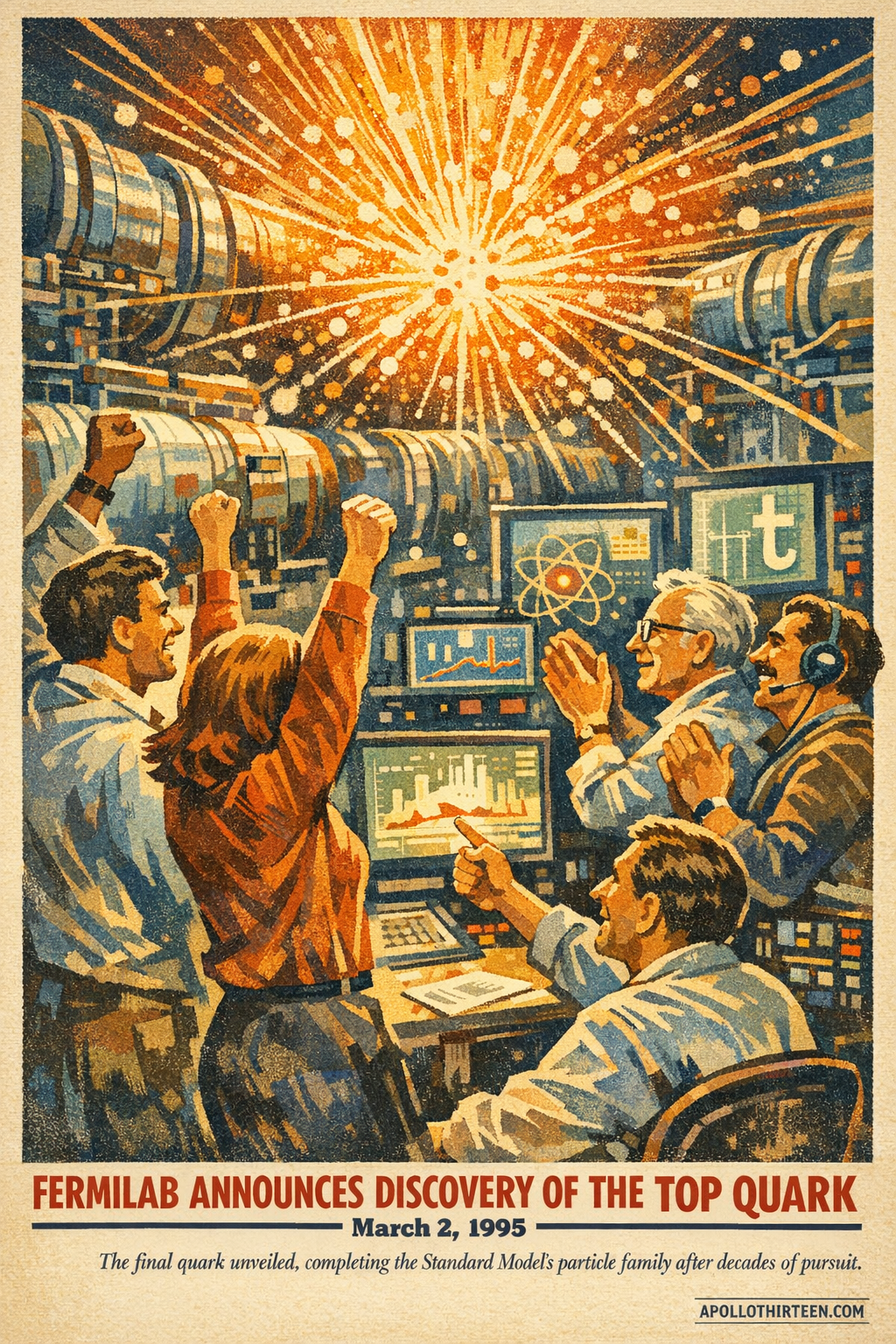
Thirty-one years ago today, a crowded auditorium at a laboratory outside Chicago fell silent, then erupted. The silence came because everyone in Ramsey Auditorium at Fermilab—scientists in rumpled jeans and lab coats, engineers with coffee-stained notebooks, visiting reporters, and a clutch of government officials—had spent months waiting for a single moment. The eruption came because that moment arrived: two rival teams, working with different detectors and different analysis methods, told the same story at the same time. They had found the last of nature’s quarks.
On March 2, 1995, the Collider Detector at Fermilab (CDF) and the DZero collaboration stepped to the microphones back-to-back and reported what particle physicists had spent nearly two decades hunting: the top quark. The final member of the six-quark family predicted by the Standard Model had been caught, not with a single flashy image, but through an avalanche of cold, hard statistics and the slow, painstaking reconstruction of debris thrown off by collisions in the Tevatron. For the assembled crowd, for the broader scientific community and for a fascinated public, the discovery read like closure—an end to a long mystery and the beginning of a new field of study.
That day did more than fill a missing entry in a table. It validated a framework that had become the lingua franca of particle physics, vindicated the immense investment in megascience, and propelled a generation of physicists into questions that still define the field. It was a triumph of patience and machinery, silicon chips and human persistence, of accelerator staff coaxing ever-higher intensities from the Tevatron and of analysts who could turn ten billion collisions into a handful of meaningful events. Looking back from today, the discovery of the top quark remains one of the clearest moments when experimental tenacity met theoretical prediction and the universe opened one more inch.
What Actually Happened
The story begins not in the auditorium but in a tunnel and a magnet-packed ring. The Tevatron, then the world’s highest-energy particle collider, smashed protons into antiprotons at energies never before routine. Each collision was a tiny, violent reenactment of conditions closer to the Big Bang than to Earthly life. Most collisions yielded unremarkable sprays of well-understood particles. Very rarely, however, the energy concentrated just right to materialize a top-antitop quark pair.
Detecting one of those rare pairs was the task of two massive, complementary detectors: CDF and DZero. Both were designed to catch the signatures left by decay products—the bottom quarks, energetic leptons, and missing energy from neutrinos—that betray the presence of the top. But the top quark itself lives so briefly—about 5 × 10^−25 seconds—that it vanishes before it can hadronize into bound states. That fleeting existence is a blessing; it means physicists could study properties of a “bare” quark, rather than the messy composites formed by its cousins.
The breakthrough came with Run Ib of the Tevatron, during which the accelerator delivered a dataset roughly three times larger than Run Ia. This was no small improvement. Top quark pair production was vanishingly rare—on the order of one top-pair event per 10 billion collisions—so the threefold increase moved a hint toward certainty. The teams had sharpened their detectors, improved their algorithms for b-tagging (identifying bottom quark jets), and refined their background estimates. CDF’s Silicon Vertex Detector—a high-resolution tracker designed and refined in part by engineers from Lawrence Berkeley National Laboratory—was crucial: it could pick out the tiny displaced tracks from bottom quark decays, a fingerprint of top decay.
On February 24, 1995, both collaborations submitted papers to Physical Review Letters detailing their observations. Then, on March 2, they presented the results publicly. CDF’s paper ran under the title “Observation of Top Quark Production in p anti-p Collisions with the Collider Detector at Fermilab,” and DZero’s as “Observation of the Top Quark.” The analyses converged on a top mass near 175 GeV/c^2—astonishingly heavy, roughly the mass of a gold atom packed into a pointlike particle—and production rates and decay patterns consistent with Standard Model predictions. The statistical significance in both experiments was sufficient to rule out background fluctuations as the cause of the signal.
When those results were printed in the April 3, 1995 issue of Physical Review Letters, the discovery became official. The months and years of indirect hints, of tantalizing yet inconclusive signals, of whispered speculation and careful skepticism, were at last superseded by clear, mutually confirming evidence. The Standard Model’s quark table had at last been filled.
The People Behind It
A discovery like this reads like an epic because it is the product of many lives and many kinds of expertise. There were the visible faces onstage: Fermilab director John Peoples, who oversaw the laboratory’s operations and the improvements to the Tevatron that made the data possible; CDF co-spokespersons William Carithers Jr. and Giorgio Bellettini, who shepherded their collaboration through hardware upgrades and political storms; and DZero co-spokespersons Paul Grannis and Hugh Montgomery, who represented their experiment’s stake in the claim. But behind and around them stood a cast of nearly a thousand scientists, technicians and engineers from around the world.
Some names denote the craft that turned raw collisions into physics. Daniela Bortoletto at Purdue, working with CDF, focused on the analysis of bottom-quark debris—crucial for separating top events from lookalikes. Dave Koltick at DZero helped ensure the mass measurements were consistent with theoretical expectations. Teams from Lawrence Berkeley National Laboratory built and optimized the CDF Silicon Vertex Detector and its readout electronics—the tiny microchips and sensors whose precision tracking was essential for b-tagging and hence for distinguishing top decay. If the detector was a camera, those chips were its sensitized film.
And there was an army of accelerator staff—physicists and engineers who toiled to push the Tevatron to record luminosities. They were the unsung heroes whose skill increased the number of useful collisions and, therefore, the chance of catching a top. Without their steady improvements, Run Ib’s tripled dataset would not have existed.
The human story contains quieter vignettes, too: nights spent refining algorithms until they squeezed one more sigma of significance out of the data; the last-minute decision to call simultaneous seminars, hastily arranged to avoid leaks; engineers fretting over radiation-tolerant upgrades to silicon modules that had to survive months of high-intensity running. The discovery was not a single stroke of genius but the inevitable product of thousands of smaller decisions and an institutional patience that allowed long-term projects to mature.
Why the World Reacted the Way It Did
The discovery didn’t just satisfy nerdish curiosity. It answered a central question about the fabric of matter and had political and symbolic weight. The Standard Model predicts classes of particles arranged into neat generations. By the mid-1970s, five quarks—up, down, strange, charm and bottom—had been found. If the model were correct, a sixth partner had to exist. Finding it was a test not only of a theory but of the methods and institutions that sustain big science.
The reaction was immediate and broad. Headlines around the world proclaimed the capture of the “elusive” or “heavy” top. For many people, what dazzled was the sheer mass: roughly equivalent to a gold atom condensed into a single pointlike particle. Such a thought is cinematic—a single fundamental particle carrying the heft of an atom evokes the universe’s capacity for extremes.
Politically, the discovery was seized upon as a victory for federal investment in fundamental science. U.S. Energy Secretary Hazel R. O’Leary hailed the finding as “powerful validation of federal support for science,” pointing to Fermilab’s role as a keystone national facility that could compete on the world stage. The ability of two independent collaborations to arrive at the same conclusion in quick succession bolstered public confidence. It signaled that the resources—money, human capital, enormous accelerators—were paying off by producing knowledge that had real, demonstrable value to physics.
Scientific peers were equally relieved and excited. Long-standing hints reported in earlier runs had fallen short of conclusive proof, and the field had been cautious. But the tripling of Run Ia’s data and the corroborating signals from two independent detectors quelled lingering skepticism. The discovery felt like closure to a mystery born after the discovery of the bottom quark in 1977, and it left a vivid legacy: the Standard Model, already a remarkably predictive framework, had passed yet another test.
It also catalyzed imagination. How could a particle be so heavy? What did that mass mean for the stability of the Higgs field, for the early universe, for the possibility of new physics beyond the Standard Model? The top’s discovery raised as many questions as it answered, and that is part of why the event resonated beyond the halls of Fermilab.
What We Know Now
In the three decades since that March afternoon, the top quark has gone from being a fleeting ghost in the data to an object of intense study. Subsequent runs at the Tevatron and later at CERN’s Large Hadron Collider refined the top’s mass measurement to roughly 173 GeV/c^2, and physicists have characterized its production mechanisms, decay modes, and intrinsic properties with steadily improving precision.
Two facts give the top special status in the particle pantheon. First, it is extraordinarily heavy for a fundamental particle. That heaviness implies a very large Yukawa coupling to the Higgs field—the interaction that gives particles mass in the Standard Model—so the top plays an outsized role in theoretical considerations about the stability of the vacuum and in loop corrections that influence other measurable quantities. Second, the top’s lifetime is so short that it decays before it can hadronize. Unlike lighter quarks that form bound mesons or baryons, the top’s decay products can, in principle, reveal information about a bare quark: its spin, its couplings, subtleties that would otherwise be washed out.
The top has thus become a precision tool. At the LHC, experiments measure spin correlations between top pairs, search for rare flavor-changing decays, and scrutinize the top-Higgs coupling. These measurements test the Standard Model in regimes where new physics might manifest subtly. So far, the top’s behavior has largely agreed with expectation, tightening constraints on many beyond-the-Standard-Model scenarios—from simple extensions like a heavier Z' boson to more elaborate proposals such as supersymmetry.
But the top also remains a beacon for discovery. Because it couples strongly to the Higgs, any new physics that affects electroweak symmetry breaking might leave signatures in top production or decay rates. Precision in the top sector improves global electroweak fits, which in turn constrain possibilities for new particles. In that sense the top is less an endpoint than a gateway: knowing it better sharpens our image of what could lie beyond.
Locally, the techniques developed around the top—advanced b-tagging, silicon tracking, pileup mitigation algorithms, and massive distributed computing for pattern recognition—became standard tools for the next generation of particle physics. The discovery forced the community to up its game in detector technology and data analysis. Those improvements paid dividends in the hunt for the Higgs boson and in ongoing searches for phenomena the Standard Model can’t explain.
Legacy — How It Shaped Science Today
The top quark’s discovery is now a chapter in a longer narrative about how big experiments transform both knowledge and practice. Its immediate legacy is instrumentational: the silicon detectors and readout electronics designed for CDF and DZero influenced detector design worldwide. The necessity of identifying a handful of signal events out of billions pushed analysts to develop robust statistical techniques, meticulous background modeling, and data-quality systems that would become indispensable at the LHC.
Institutionally, the discovery reinforced the value of large, collaborative science. Nearly a thousand researchers across dozens of institutions worked together, sharing data, code, and ideas. That model—large collaborations with distributed responsibilities—has become the template for particle physics and has influenced other fields where datasets and instruments are massive and complex.
Training-wise, the project was a crucible. PhD students, postdocs and early-career engineers cut their teeth on the top hunt. Many of them went on to lead detector efforts at CERN, to spin technology into industry, and to translate particle-physics methods into other domains such as data science and medical imaging. The top was, in short, a breeding ground for talent.
The discovery also helped steer the field’s priorities. A confirmed heavy top reinforced the importance of precision electroweak measurements and sharpened arguments for building next-generation colliders. It indirectly fed into the narrative that culminated in the search for and eventual discovery of the Higgs boson in 2012: the top’s properties were a crucial input to models of electroweak symmetry breaking and to planning for experiments capable of probing the Higgs sector.
Finally, there is a cultural legacy. The March 2, 1995 announcement was an exercise in humility and rigor: two independent groups presented converging evidence, and the community responded with a mixture of excitement and cautious verification. That collegial, evidence-first approach remains a hallmark of how big discoveries are made and accepted in physics.
Fast Facts
- Date of public announcement: March 2, 1995 (31 years ago today).
- Papers submitted: February 24, 1995, to Physical Review Letters; published in the April 3, 1995 issue.
- Experiments: Collider Detector at Fermilab (CDF) and DZero (D0).
- Detector upgrades: CDF’s Silicon Vertex Detector (precision b-tagging) and improvements at both experiments before Run Ib.
- Accelerator: Fermilab’s Tevatron, then the world’s highest-energy collider.
- Data: Run Ib dataset ≈ three times larger than Run Ia; on the order of one top-pair event per 10 billion collisions.
- Mass of the top quark at discovery: ≈ 175 GeV/c^2 (later refined to ≈ 173 GeV/c^2).
- Lifetime: ≈ 5 × 10^−25 seconds—short enough to decay before hadronizing.
- Collaborators: Nearly 1,000 scientists from around 70 institutions worldwide.
- Political reaction: U.S. Energy Secretary Hazel R. O’Leary called the discovery “powerful validation of federal support for science.”
Why It Still Matters Today
When the top quark was unveiled in a packed auditorium at Fermilab, it felt like the last piece of a jigsaw puzzle. That image is apt but incomplete. Completing the quark family was not a terminus but a point of departure. The top’s mass and behaviors feed into the hardest questions in particle physics: what stabilizes the Higgs field, why the electroweak scale is as it is, and whether there is new physics just beyond our reach. Each improved measurement of the top tightens the noose around possible extensions to the Standard Model. Each null result is information; each anomalous bump is a clue.
The machines and methods that caught the top have become the instruments of our current search. The accelerator upgrades, the silicon sensors and readout chips—many developed in the crucible of the 1990s Tevatron program—now operate at higher energies and rates at the LHC, and similar technologies are central to proposals for future colliders. The human networks forged at Fermilab—collaborators who learned how to coordinate large teams, manage massive datasets and keep complex hardware running—still animate every international physics project.
Above all, the top’s discovery is a story about what organized inquiry can accomplish. It required decades of incremental improvements: better magnets, more reliable vacuum systems, silicon chips designed to survive intense radiation, and algorithms tuned to pull signals from noise. It required funding structures willing to plant money in long-term projects, and a culture that valued meticulous cross-checks over premature claims. Thirty-one years later, those lessons remain vital.
If you walk the now-quiet halls of Ramsey Auditorium—or, for that matter, the cavernous experimental halls at CERN—you can still feel the residue of that day in 1995: the hush before a key sentence, the thrill when data tip a scale, the collective intake of breath when a missing piece slides into place. The top quark’s discovery closed a chapter and opened another. It completed the Standard Model’s quark family, yes, but in doing so it revealed the edges of our ignorance and set the stage for everything that came after. That is why, today, we remember not just a particle but a practice—the patient, communal work that advances our understanding of the universe, one collision at a time.



Comments
No comments yet. Be the first!