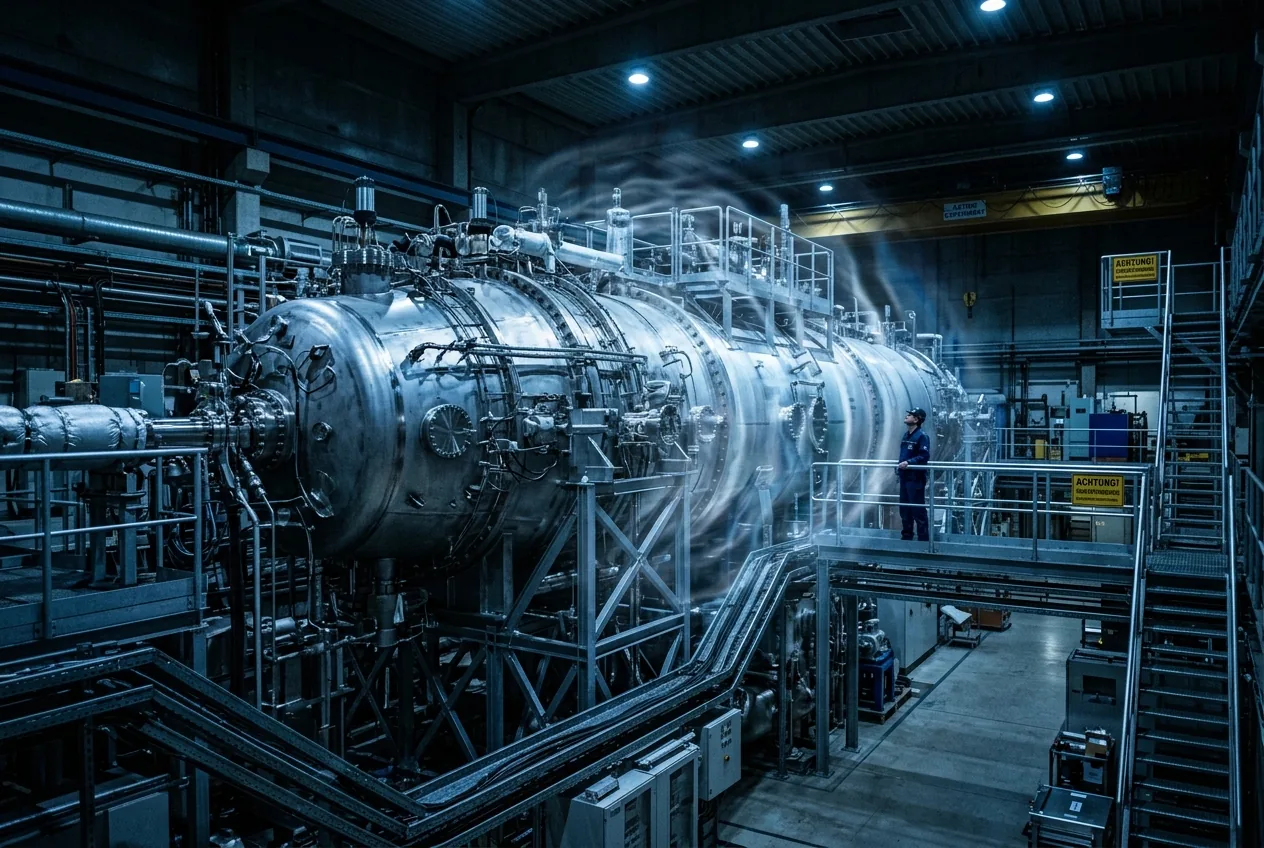
In a massive, stainless-steel hall in Karlsruhe, Germany, sits a 200-tonne vacuum vessel that looks less like a laboratory instrument and more like a discarded hull of a Soviet submarine. This is the main spectrometer of the KATRIN experiment (Karlsruhe Tritium Neutrino Experiment). Its job is remarkably specific and maddeningly difficult: it is a scale designed to weigh the neutrino, a particle so light and elusive that billions of them pass through your thumbnail every second without leaving a trace. For years, the KATRIN team has been narrowing down the mass of these "ghost particles," but the numbers keep pointing toward a hole in our reality. If the mass doesn't add up in the three dimensions we can see, it might be because the rest of it is leaking into a fourth spatial dimension we cannot.
The stakes of this measurement go beyond mere bookkeeping. For decades, the Standard Model of particle physics has served as the bedrock of our understanding of the universe, yet it is currently failing its most basic audits. It cannot explain dark matter, it cannot reconcile gravity with quantum mechanics, and it cannot explain why gravity is so absurdly weak compared to the other fundamental forces. Physicists call this the "hierarchy problem." To fix it, a growing cohort of researchers from Istanbul to Madrid is suggesting that we stop trying to cram the universe into a four-dimensional box. New mathematical models and experimental anomalies suggest that "effective dimensions" might fluctuate based on the curvature of spacetime itself, effectively opening portals to a fifth dimension whenever gravity gets heavy enough.
The Istanbul Protocol for Warped Realities
The beauty of the Istanbul model lies in its bureaucratic efficiency. Usually, when physicists want to explain why a galaxy is spinning too fast or why the Big Bang happened the way it did, they have to invent a new particle—a dark matter candidate or an "inflaton." Each new particle comes with a dozen new parameters that must be fine-tuned. The Yıldız model does away with this. It suggests that the "extra" gravity or energy we observe is simply the result of spacetime warping so severely that it gains a new dimension of freedom. It is the physics equivalent of finding extra storage space in a house by folding the walls differently rather than building an extension.
Crucially for the more skeptical observer, this model plays well with General Relativity. When the curvature of space is low—say, in our solar system—the equations move toward zero, and we are left with the familiar four dimensions. It is only at the edge cases, where the math of the Standard Model usually breaks, that the fifth dimension becomes an "effective" reality. It is a solution that appeals to the European preference for industrial-policy logic: use the existing infrastructure (General Relativity) to solve the new problem (Dark Matter) without adding unnecessary complexity to the supply chain of universal constants.
Why Karlsruhe Is Weighing Ghosts
While the theorists in Istanbul move the goalposts of reality on paper, the engineers in Karlsruhe are trying to find the physical evidence. The KATRIN experiment represents the peak of German precision engineering applied to a problem that borders on the metaphysical. If neutrinos possess mass—which we know they do, thanks to the Nobel-winning discovery of neutrino oscillations—that mass must come from somewhere. However, the "left-handed" neutrinos we observe in our 4D world shouldn't technically have mass under the strictest interpretation of the Standard Model.
One leading theory, often discussed in the context of the Randall-Sundrum models, is that neutrinos are "bulk" particles. While the rest of us—atoms, light, the smell of Cologne’s breweries—are stuck on a three-dimensional membrane (a "brane"), neutrinos might be able to drift into the "bulk" of a fifth dimension. If they are spending part of their time in another dimension, it would explain why their mass appears so vanishingly small to us. We are only seeing a three-dimensional shadow of their true weight.
The Fifth Dimension as a Dark Matter Portal
The conversation around extra dimensions has taken on a new urgency with the failure of the Large Hadron Collider (LHC) to find WIMPs (Weakly Interacting Massive Particles). For twenty years, WIMPs were the preferred answer to the dark matter problem. Their absence has forced a pivot toward more exotic explanations, including the idea of a "dark dimension." In this scenario, dark matter isn't a particle at all, but the gravitational signature of matter existing in a fifth dimension, mere millimeters away from us but unreachable except through gravity.
Recent studies from researchers in Spain and Germany have posited the existence of a specific fermion—a type of subatomic particle—that acts as a portal between our world and this fifth dimension. This particle would be heavy, far heavier than anything the LHC has reliably produced, and it would interact with both the Higgs boson and the dark matter residing in the "bulk." From a regulatory and funding perspective, this is a nightmare. How does the European Research Council (ERC) justify billions in funding for a "portal" that might not even be made of matter as we define it?
Yet, the industrial policy angle is clear. The quest for the fifth dimension is driving a new arms race in quantum sensors and detector technology. If we are to detect a particle that only reveals itself via a fifth-dimensional portal, we need sensors that can detect gravitational variations at the sub-atomic scale. This is where the German semiconductor and optics industries (think Zeiss and Infineon) find their long-term R&D pipelines. The hunt for the fifth dimension is, in many ways, a massive subsidy for the next generation of precision manufacturing.
The Hierarchy Problem and the Weakness of Gravity
To understand why physicists are so desperate for a fifth dimension, one must confront the embarrassment that is gravity. If you pick up a paperclip with a tiny refrigerator magnet, you are successfully defying the gravitational pull of the entire Earth. Gravity is roughly 10^40 times weaker than electromagnetism. This makes no sense in a unified universe.
In Brussels, where industrial strategy is often a balance of competing national interests, the pursuit of these theories is seen through the lens of "Strategic Autonomy." While the US focuses on private-sector space flight and China on quantum encryption, Europe has carved out a niche in fundamental high-energy physics. The European Strategy for Particle Physics, updated every few years, increasingly looks at these "hidden sectors" as the next frontier. If the universe has an extra dimension, the first country to develop the sensors to "see" into it will control the most fundamental data set in history.
A Reality That Doesn't Fit the Slide Deck
Despite the mathematical elegance of the Istanbul model and the shiny hardware in Karlsruhe, there remains a healthy skepticism among the rank-and-file engineers. There is a saying in German labs: "If the theory is too beautiful to be wrong, it probably hasn't been tested yet." The history of physics is littered with "extra dimension" theories that were eventually crushed by better data. Kaluza-Klein theory, which first proposed a fifth dimension in the 1920s to unite gravity and light, was a masterpiece of math that ultimately went nowhere because it couldn't account for the electron.
Today’s researchers are more cautious. They aren't promising a "Interstellar"-style bookshelf portal. They are promising a more accurate way to calculate the mass of a neutrino or the rotation curve of a galaxy. They are looking for the "effective" dimensions that appear when the universe gets crowded. It is a pragmatic, almost blue-collar approach to the infinite. We aren't discovering a new world; we are just finding the missing decimal points in our current one.
The tension between the abstract 5D math and the 4D reality of funding cycles is where the real story lies. The Horizon Europe program continues to pour millions into fundamental research, even as critics argue the money would be better spent on domestic battery production or AI. But as any physicist will tell you, you cannot build the future on a broken map. If the Standard Model is incomplete—and it clearly is—then we are essentially trying to navigate the global economy with a compass that ignores the North Pole.
We are currently in a holding pattern. The next generation of upgrades at the LHC and the final data releases from KATRIN will either confirm that the neutrino mass is leaking into a hidden dimension or they will force us back to the drawing board. If the extra dimension exists, it won't be a dramatic reveal with fanfare and a ribbon-cutting ceremony. It will be a quiet adjustment to a spreadsheet in a windowless office in Geneva or Karlsruhe. The universe has a fifth dimension. We just haven't decided which EU member state gets to tax it.



Kommentare
Noch keine Kommentare. Seien Sie der Erste!