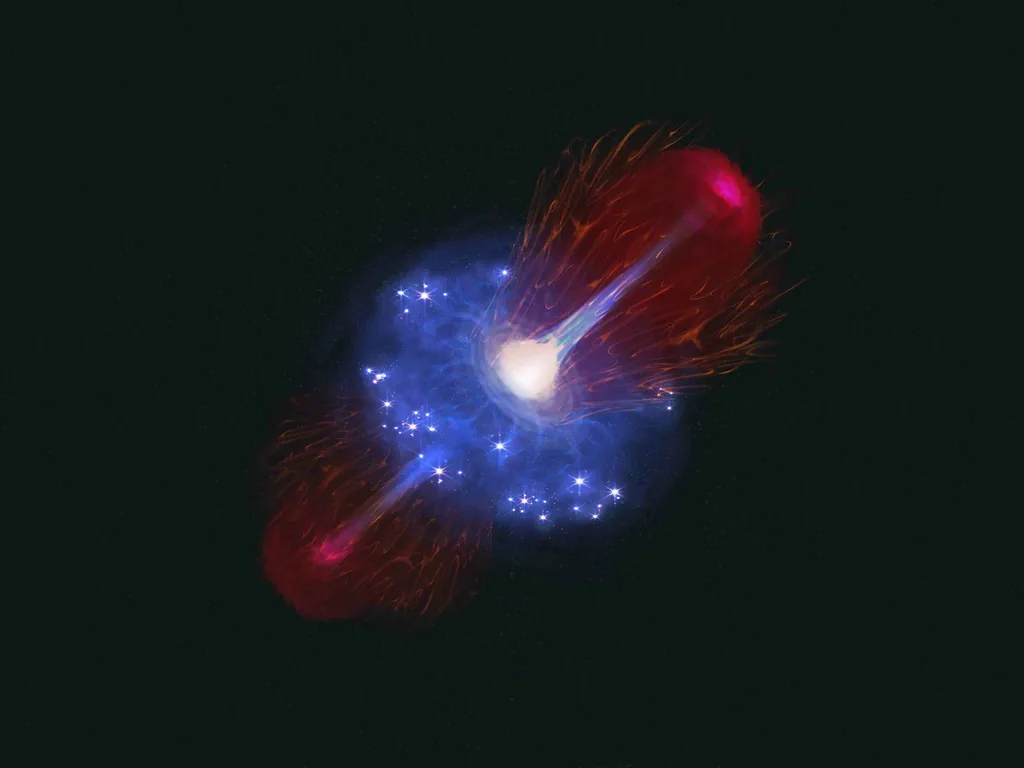
Black hole devoured a star from within, producing the longest gamma-ray burst on record

Space
Black hole devoured a star from within, producing the longest gamma-ray burst on record
GRB 250702B, detected July 2, 2025, produced gamma-ray emission lasting roughly seven hours. Observations rule out known burst progenitors and point to a helium‑merger scenario in which a stellar‑mass black hole spiraled into a companion's helium core.

On July 2, 2025, NASA's Fermi Gamma-ray Burst Monitor detected an extraordinary event: GRB 250702B, a gamma‑ray burst whose emission continued for about 25,000 seconds, roughly seven hours. A team of more than fifty researchers analyzed the data and published their results on the arXiv preprint server, concluding that the burst cannot be explained by any previously confirmed progenitor model.

Key observations

The burst showed several extreme properties:

  • Duration of about 25,000 seconds, far longer than the previous record of roughly 15,000 seconds.
  • A very hard spectrum and high peak energy, with rest-frame photons exceeding 10 MeV.
  • Subsecond variability combined with high total emitted energy, characteristics normally associated with ultrarelativistic jets from a compact, rapidly spinning central engine.

Why standard models fail

The research team systematically evaluated known gamma‑ray burst progenitors and found them inconsistent with the observations:

The helium merger explanation

To account for the extreme duration, spectral hardness, and rapid variability, the team proposes a helium merger scenario. In this model, a binary system contains a stellar‑mass black hole and a companion star that evolves and expands. As the companion grows, it engulfs the black hole. The black hole then spirals inward through the companion's envelope, losing orbital energy via friction and tidal interactions until it reaches the dense helium core.

When the black hole reaches the core, the system's high angular momentum drives accretion through a disk rather than direct infall. That disk can produce strong magnetic fields and power ultrarelativistic jets while viscous processes drive powerful winds. The combination of jets and an accompanying supernova‑like explosion can produce prolonged, high‑energy gamma‑ray emission consistent with the observations of GRB 250702B.

Implications

The helium merger model links binary evolution, unusual supernovae, and long‑duration gamma‑ray bursts in a single framework. It also suggests potential connections between such events and gravitational‑wave sources, because the dynamics involve compact objects interacting deeply with stellar companions.

Data and publication

Mattias Risberg

Mattias Risberg

Cologne-based science & technology reporter tracking semiconductors, space policy and data-driven investigations.

University of Cologne (Universität zu Köln) • Cologne, Germany

Readers

Readers Questions Answered

Q What is GRB 250702B and how long did its gamma-ray emission last?
A GRB 250702B is a gamma-ray burst detected on July 2, 2025 by NASA's Fermi Gamma-ray Burst Monitor. Its gamma-ray emission persisted for about 25,000 seconds, roughly seven hours, far longer than prior records. A team of more than fifty researchers analyzed the data and concluded that none of the previously confirmed progenitors can explain the event.
Q Why can't standard gamma-ray burst progenitors explain GRB 250702B?
A Standard gamma-ray burst progenitors fail to explain GRB 250702B because the observed duration, spectral hardness and variability do not match known models. The team systematically evaluated established progenitors and found them inconsistent with the data, noting subsecond variability and very high total energy typically tied to ultrarelativistic jets from a compact, rapidly spinning central engine, while the burst remains unexplained by those models.
Q What is the helium-merger scenario proposed to explain the event?
A To account for the extreme duration and spectrum, the authors propose a helium merger scenario in which a stellar-mass black hole spirals into its companion’s helium core. The black hole moves inward through the envelope, then accretes via a disk in the dense core, generating strong magnetic fields, ultrarelativistic jets and winds that together explain the prolonged gamma-ray emission.
Q What are the broader implications of the helium-merger model?
A If correct, the helium-merger model ties binary evolution to unusual supernovae and long-duration gamma-ray bursts within a single framework. It also hints at connections to gravitational-wave sources, since the dynamics involve compact objects interacting deeply with stellar companions, offering a potential overlap between electromagnetic gamma-ray observations and future gravitational-wave detections.

Have a question about this article?

Questions are reviewed before publishing. We'll answer the best ones!

Comments

No comments yet. Be the first!