Wenn die fehlende Masse als Rätsel erscheint
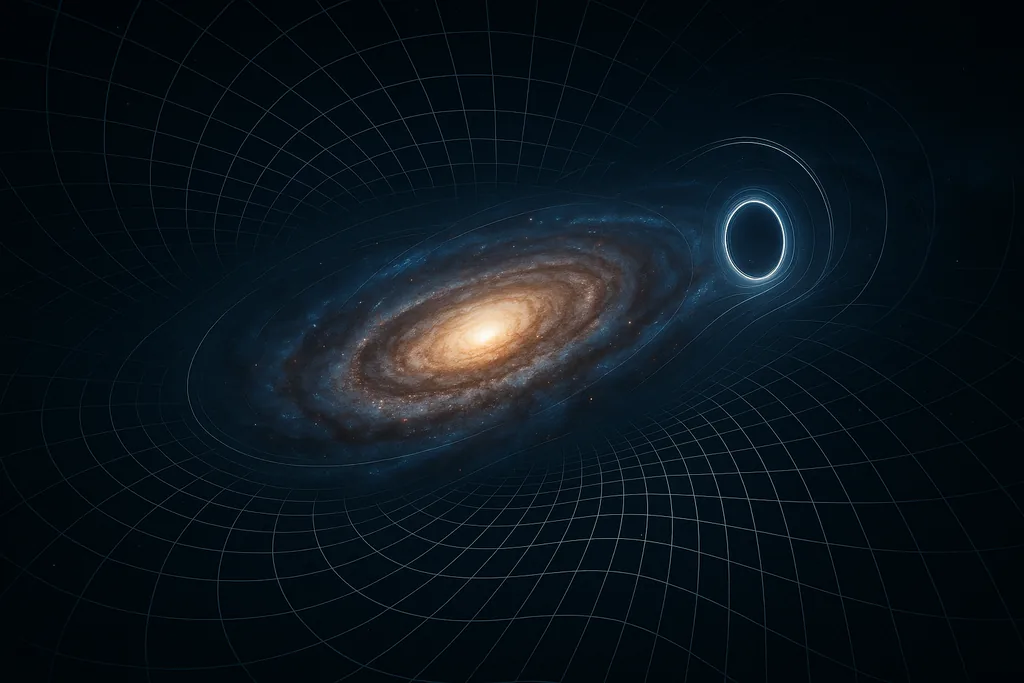
Am 7. Februar 2026 rückte eine Welle der Berichterstattung und ein neuer technischer Vorschlag eine alte Frage wieder in die Schlagzeilen: Ist Dunkle Materie real? Theorie – könnten die Effekte, die wir einer riesigen unsichtbaren Teilchenpopulation zuschreiben, stattdessen durch eine Gravitation erzeugt werden, die sich auf großen Skalen seltsam verhält? Die neue Idee ist eine zeitgemäße Überarbeitung des Ansatzes der modifizierten Gravitation sowie einer separaten Forschungsrichtung, die eine „gekrümmte“ fünfte Dimension nutzt, um Fermionen vor unseren Detektoren zu verbergen; beide Ansätze erzwingen eine schonungslose Neuauswertung der Daten, die Dunkle Materie überhaupt erst zum Standardmodell gemacht haben.
Dunkle Materie real? Theorie: Eine gravitationsbasierte Alternative
Der empirische Ausgangspunkt ist einfach und hartnäckig. Angefangen bei Vera Rubins Messungen der Galaxienrotation bis hin zu Präzisionskarten des kosmischen Mikrowellenhintergrunds zeigen mehrere unabhängige Beobachtungen eine stärkere Gravitationswirkung, als durch gewöhnliche Atome erklärt werden kann. Die übliche Antwort – und der seit vier Jahrzehnten bestehende Mainstream-Konsens – ist Dunkle Materie: eine nicht leuchtende Substanz, die das Materiebudget des Universums dominiert.
Dennoch bieten Vorschläge zur modifizierten Gravitation, die kollektiv als Alternativen zur Teilchen-Dunklen-Materie beschrieben werden, einen anderen Weg. Die bekannteste davon ist die Modifizierte Newtonsche Dynamik (MOND), die die Beziehung zwischen Beschleunigung und Kraft bei extrem niedrigen Beschleunigungen anpasst und die flachen Rotationskurven vieler Spiralgalaxien mit weniger freien Parametern reproduzieren kann als naive Anpassungen an die Dunkle Materie. Modelle im MOND-Stil sind auf der Ebene einzelner Galaxien erfolgreich, stoßen aber bei anderen Beobachtungen auf Probleme – insbesondere bei der Massenverteilung in Galaxienhaufen, dem detaillierten Muster der akustischen Gipfel des kosmischen Mikrowellenhintergrunds (CMB) und der Bildung großräumiger Strukturen.
Befürworter wiederbelebter gravitationsbasierter Ansätze argumentieren, dass diese Schwierigkeiten nicht zwingend alle Modifikationen der Gravitation ausschließen. Neue theoretische Rahmenwerke versuchen, die Stärke oder Form der Gravitation auf bestimmten Längenskalen zu verändern oder zusätzliche gravitative Freiheitsgrade hinzuzufügen, die das Clustering-Verhalten der Dunklen Materie nachahmen, ohne neue Teilchenarten heranzuziehen. Diese Modelle müssen so abgestimmt sein, dass sie die Erfolge der Allgemeinen Relativitätstheorie auf der Ebene des Sonnensystems reproduzieren und nur dort abweichen, wo die Daten eine Diskrepanz nahelegen – eine harte Einschränkung, aber keine unmögliche.
Dunkle Materie real? Theorie vs. Teilchenmodelle
Die Alternative auf der anderen Seite der Bilanz ist die Teilchenhypothese: Dunkle Materie besteht aus einer oder mehreren neuen Arten von Teilchen, die nur sehr schwach mit Licht und gewöhnlicher Materie wechselwirken. Dieses Rahmenwerk erklärt eine breite Palette von Phänomenen mit einem einzigen konzeptionellen Schritt: zusätzliche Masse in Galaxien und Clustern, die von uns beobachteten Gravitationslinsenmuster sowie die im CMB und im Strukturwachstum eingeprägten Signaturen. Es eröffnet zudem klare experimentelle Wege – den direkten Nachweis in Untergrundlaboren, den indirekten Nachweis über Zerfalls- oder Annihilationssignale und Produktionsversuche in Teilchenbeschleunigern.
Bisher haben diese direkten Suchen und Beschleunigerkampagnen keinen entscheidenden Nachweis erbracht, was die Tür für Alternativen offen hält. Die jüngsten theoretischen Arbeiten, die in dem Paket behandelt werden, optimieren nicht bloß die Gravitation: Ein anderer Strang lässt eine Version der Randall-Sundrum-Modelle aus den späten 1990er Jahren wiederaufleben, in der ein dunkler Sektor in einer gekrümmten Zusatzdimension untergebracht ist. In diesem Szenario – beschrieben in einer aktuellen Forschungsarbeit und von einigen Medien für ein breiteres Publikum übersetzt – können gewöhnliche Fermionen Bulk-Massen erwerben, die als langlebige Relikte in der Zusatzdimension erscheinen. Aus unserer vierdimensionalen Perspektive verhalten sich diese Relikte wie Dunkle Materie, aber ihr zugrunde liegender Ursprung ist eher geometrisch als ein neues stabiles Teilchen in den drei räumlichen Dimensionen des Standardmodells.
Was die Daten derzeit bevorzugen
Verschiedene Beobachtungsreihen fallen unterschiedlich ins Gewicht. Galaxienrotationskurven und die interne Dynamik einiger Zwerggalaxien sind die Bereiche, in denen die modifizierte Gravitation ihre größten Erfolge feiert. Andererseits liefern der Bullet-Cluster und andere kollidierende Galaxienhaufen einen sehr starken visuellen Test: In diesen gewaltigen Kollisionen wird der Großteil des sichtbaren Gases (das Röntgenstrahlung aussendet) abgebremst, während das durch schwache Gravitationslinseneffekte nachgewiesene Gravitationspotenzial gegenüber der baryonischen Materie versetzt erscheint. Diese Verschiebung lässt sich natürlich erklären, wenn der Großteil der Masse aus kollisionsfreien Teilchen besteht, die durcheinander hindurchfliegen – genau das, was Teilchen-Dunkle-Materie tun würde – und ist mit einer einzigen, einfachen Modifikation der Gravitation nur schwer zu reproduzieren.
Wie eine gekrümmte Zusatzdimension die Debatte verändert
Der Vorschlag der gekrümmten Zusatzdimension (Warped Extra-Dimension, WED) verschmilzt Elemente der Teilchen-Dunklen-Materie und der modifizierten Gravitation. Er behandelt den dunklen Sektor als physisch real, jedoch lokalisiert in einer extradimensionalen Tasche, in der seine Dynamik anderen Regeln unterliegt. Diese Architektur kann effektives Dunkle-Materie-Verhalten in unserem beobachtbaren Universum erzeugen und gleichzeitig einige Nullresultate direkter Suchen umgehen, da die dunklen Relikte nicht auf die übliche Weise an unsere Detektoren koppeln. Wichtig ist, dass die Autoren der WED-Vorschläge auf Gravitationswellendetektoren und kommende präzisionskosmologische Durchmusterungen als vielversprechendste Wege hinweisen, um die Idee zu falsifizieren oder zu bestätigen: Die extradimensionalen Relikte würden die Strukturbildung beeinflussen und möglicherweise Signaturen im stochastischen Gravitationswellenhintergrund oder in der Linsenstatistik auf bestimmten Skalen hinterlassen.
Wie Experimente entscheiden könnten, ob Dunkle Materie ein Teilchen oder modifizierte Gravitation ist
Es gibt mehrere Beobachtungsstrategien, die zusammen die Hypothesen voneinander trennen können.
- Kollisionstests auf Cluster-Skalen: Weitere kollidierende Haufen wie der Bullet-Cluster, beobachtet mit tieferer Röntgenkartierung und hochwertiger Rekonstruktion des schwachen Gravitationslinseneffekts, helfen zu klären, ob das Gravitationspotenzial sauber von Baryonen getrennt werden kann – ein starkes Unterscheidungsmerkmal gegen einfache Erklärungen durch modifizierte Gravitation.
- Präzisionskosmologie: Die CMB-Polarisation und Galaxien-Surveys der nächsten Generation bestimmen den Zeitpunkt und die Rate des Strukturwachstums. Teilchen-Dunkle-Materie sagt eine bestimmte Wachstumsgeschichte voraus; viele Modelle der modifizierten Gravitation sagen ein unterschiedliches skalenabhängiges Wachstum voraus, das getestet werden kann.
- Direkter und indirekter Nachweis: Sollten Untergrunddetektoren oder Gammastrahlenteleskope ein eindeutiges Signal eines Dunkle-Materie-Teilchens finden, wäre die Debatte beendet. Umgekehrt beweist eine lange Folge von Nullresultaten nicht, dass die Gravitation falsch ist, treibt die Theoretiker im Parameterraum jedoch weg von Teilchenmodellen.
- Gravitationswellen und Linsenstatistik: Die WED-Vorschläge heben Gravitationswellenhintergründe und subtile Linsenanomalien als potenzielle „Smoking Guns“ hervor. LIGO/Virgo/KAGRA und zukünftige Detektoren werden zusammen mit weiträumigen Linsendurchmusterungen diese Signaturen untersuchen.
Wo modifizierte Gravitation noch immer Schwierigkeiten hat
Die meisten Rahmenwerke für modifizierte Gravitation müssen erweitert oder komplexer gestaltet werden, um Einschränkungen auf mehreren Skalen gleichzeitig zu erfüllen. Sie erfordern oft neue Felder oder Screening-Mechanismen, um Abweichungen im Sonnensystem zu reduzieren, während sie auf galaktischen Skalen große Effekte erzeugen. Jede zusätzliche Komponente birgt das Risiko, die Vorhersagekraft der Theorie zu schwächen. Aus diesem Grund bleiben viele Kosmologen vorsichtig, die Teilchen-Dunkle-Materie ohne robuste, unabhängige Beweise für das Gegenteil aufzugeben.
Warum die Debatte über Begrifflichkeiten hinaus von Bedeutung ist
Dies ist nicht nur akademische Haarspalterei. Das Ergebnis bestimmt den experimentellen Fahrplan und die grundlegende Physik, die wir über fundamentale Kräfte, Zusatzdimensionen und das frühe Universum ableiten. Wenn Dunkle Materie ein Teilchen ist, deutet dies auf neue Mikrophysik jenseits des Standardmodells hin. Wenn es sich um einen emergenten Effekt der Gravitation oder der extradimensionalen Geometrie handelt, impliziert dies, dass die Allgemeine Relativitätstheorie auf eine spezifische, testbare Weise unvollständig ist – und das würde die theoretische Physik tiefgreifend verändern.
Vorerst ist die sicherste wissenschaftliche Position eine pluralistische: die Suche nach Teilchen fortsetzen, während gleichzeitig alternative Gravitationstheorien entwickelt und getestet werden. Das kommende Jahrzehnt wird hochauflösendere Linsenkarten, umfassendere Cluster-Kataloge, Gravitationswellenhintergründe und empfindlichere Instrumente zum direkten Nachweis bringen – deren Kombination die möglichen Erklärungen erheblich eingrenzen dürfte.
Quellen
- European Physical Journal C (Forschungsarbeit über gekrümmte Zusatzdimensionen und fermionische Dunkle Materie)
- Randall-Sundrum (ursprüngliches Modell der gekrümmten Zusatzdimensionen, 1999)
- Planck Collaboration (Beobachtungen des kosmischen Mikrowellenhintergrunds)
- LIGO/Virgo/KAGRA-Kollaborationen (Gravitationswellendetektoren)
- Institutionen und Forschungsgruppen in Spanien und Deutschland, die an der jüngsten WED-Studie beteiligt sind




Kommentare
Noch keine Kommentare. Seien Sie der Erste!