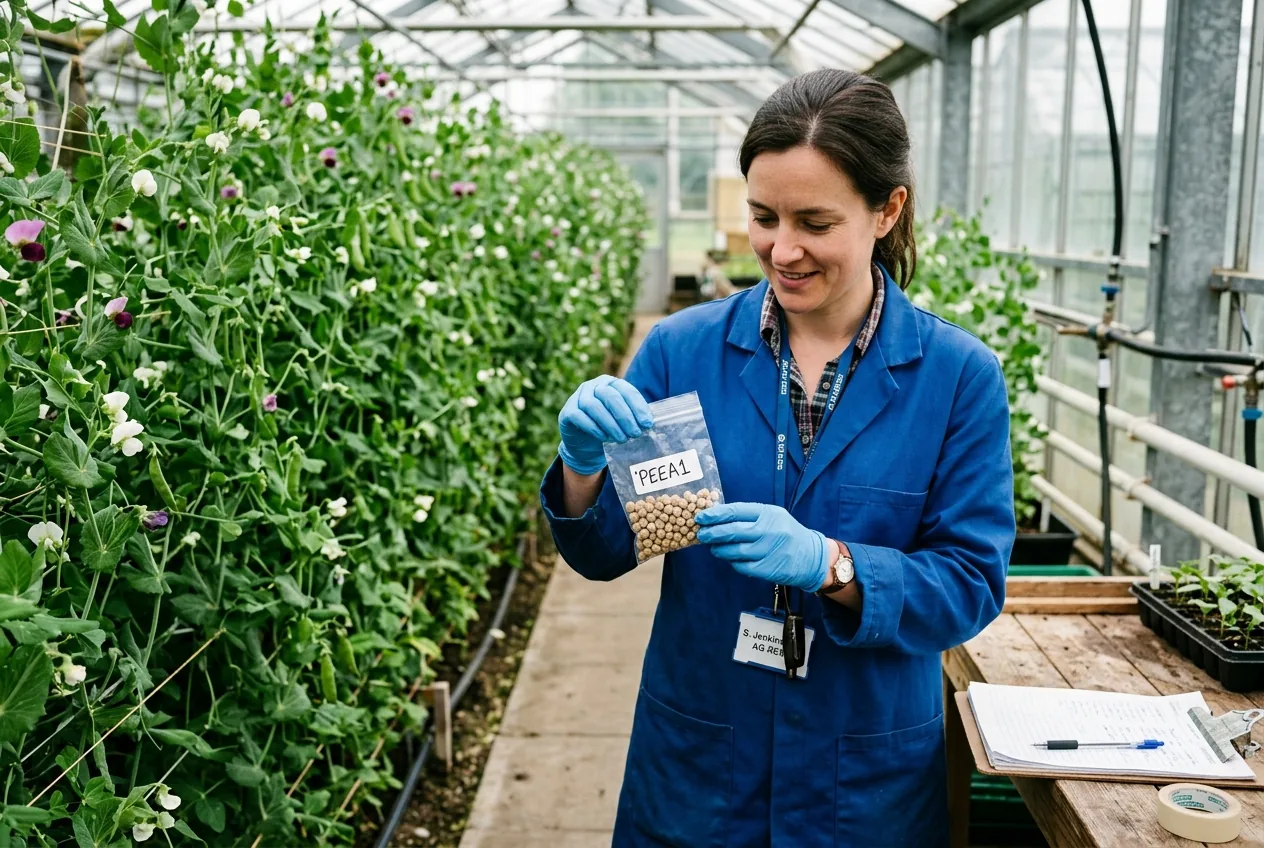
A row of ordinary pea pods turned into a regulatory headline
In a fenced US field this spring, agronomists harvested peas that, on paper, contained a protein taken straight from cattle muscle. The detail — a stable, generational expression of bovine myoglobin inside pea seeds — is the kind of sentence that usually lives in a lab notebook. For molecular farming pioneer moolec it became a public moment: the company announced PEEA1, its pea variety engineered to carry iron-rich bovine myoglobin, and within months the US Department of Agriculture’s APHIS concluded the crop posed no increased plant pest risk.
The consequence is not merely scientific showmanship. The nut graf is blunt: tens of millions of people suffer iron deficiency worldwide, Moolec pitches an ingredient that could deliver heme iron at scale, and regulators have split the path — APHIS says plant movement is cleared; the Food and Drug Administration still has the decisive say on food-sale safety and labelling. That regulatory split, combined with Moolec’s recent corporate turbulence, creates the central tension of this story: a technological milestone exported into an uncertain commercial and legal theatre.
Regulatory torque for molecular farming pioneer moolec
But APHIS territory is narrow; it evaluates plant pest risk, not the safety of consuming animal proteins produced in plants. For commercialisation Moolec must engage with the FDA. The company has stated it is in consultations and is targeting a 2028 launch for PEEA1, but the FDA’s food-safety review can surface issues — from allergenicity to processing standards — that APHIS never touches. The split leaves the moment half-celebratory, half-conditional.
There is another regulatory wrinkle: markets outside the US. Even with APHIS clearance, Moolec will face separate dossiers and public debates in Europe, parts of Asia, and other markets where genetically engineered crops and novel food ingredients invite broader political scrutiny. That means the path from field to factory to grocery shelf is littered with differing technical standards and social battlegrounds.
A field result, a corporate backstory and a financial contradiction
It is tempting to treat the pea breakthrough as a straightforward technology win. But Moolec’s corporate context complicates that narrative. The company completed a merger into a larger group that included Argentina’s Bioceres and other partners, only to see that relationship fray months later when Bioceres entered bankruptcy proceedings. Moolec was granted an extension by Nasdaq to regain compliance with stockholders’ equity requirements, highlighting liquidity and governance pressure on a company that also touts a long product pipeline.
Inside the company, executives framed the pea result as validation of platform flexibility. CEO statements emphasise pipeline-building rather than one-off products. The market, however, will ask a different question: can Moolec convert an engineered seed trait into reproducible, economically viable ingredients while navigating debt, merger fallout and the slow drumbeat of food-safety reviews?
Nutrition and market logic behind the pea play
Moolec’s public case is pragmatic. Myoglobin is a heme protein that contributes iron and the colour associated with meat. The company points to global anaemia statistics — a recent Lancet review cited nearly a quarter of the world’s population with anaemia in 2021 — framing PEEA1 as a way to deliver bioavailable iron through an agricultural route rather than conventional animal farming or industrial fermentation.
Peas are an intentional choice. They are globally cultivated, have established supply chains, and are already traded in large volumes. For Moolec the pitch is simple: embed high-value, animal-origin proteins inside a commodity crop to lower the per-gram production cost compared with bioreactors or cell-culture systems, then sell the pea meal or flours with the protein ‘embedded’ in the matrix rather than pursing expensive purification.
That commercial logic brings trade-offs. Embedding saves on purification but hands processors a composite ingredient with mixed functionalities, potential novel allergen profiles, and a need for clear labelling. Food manufacturers will weigh the price advantage against formulation complexity and regulatory clarity, especially when selling into markets with conservative consumer sentiment about genetically engineered foods.
Science floor notes without the lab-textbook voice
Observers in the alt-protein and agri-biotech world are watching two technical claims closely: expression levels and genetic stability. Moolec reports "high yields" of bovine myoglobin in pea seeds and stable inheritance across generations — the sort of detail that changes conversations about scale. Stable, seed-borne expression means the crop itself becomes the production vessel, not just green biomass to be harvested for proteins immediately after growth.
Those claims are the heart of the business model. If expression can be maintained through the seed supply chain and survive the industrial crushing and heat treatments of commodity processing, the economics shift. But each step — seed multiplication, agronomic performance under commercial conditions, downstream recovery or retention in food matrices — is another point where lab success can falter against industrial realities.
Competitors in the molecular farming space are watching closely; a handful of startups are targeting casein in soybeans, egg proteins in potatoes and other crossovers. If Moolec’s pea approach scales, it reshapes the competitive map; if it doesn’t, the industry will point to one more example of a technology that looked promising until the market pressure test.
Practical questions consumers and regulators will ask
There are immediate, practical questions that go beyond headline-grabbing descriptions. How will the ingredient be labelled? Will products carrying embedded bovine myoglobin be acceptable to vegetarians or people avoiding red meat for religious reasons? What about pet food and taurine needs for cats, which Moolec has referenced? The FDA’s food-safety review will ask these kinds of use-case and labelling questions as a matter of course.
Moolec also frames PEEA1 as complementary to its other ingredients — GLASO oil and Piggy Sooy soybeans — forming a product ladder that includes oils, embedded proteins and future yeast-derived supplements. That roadmap increases the company’s optionality but raises the regulatory and marketing complexity: different ingredients, different approvals, different audiences.
Where this could tip the market — and what others miss
One overlooked implication is on supply-chain geography. If legume crops can carry high-value animal proteins, commodity crushing and oilseed processing nodes gain new leverage: an oilseed mill becomes a potential factory for protein-embedded flours with nutritional premiums. That changes the calculus for processors, farmers and large food companies that already control crushing capacity.
Another tacit risk is reputational: even fully authorised ingredients can face consumer backlash if marketing looks opaque. Early adopters in B2B ingredient markets — processed-meat makers or pet food companies — may be less sensitive to consumer narratives, but once proteins move into direct-to-consumer products, narrative and trust matter. Moolec knows this and has joined industry stewardship efforts, but stewardship programs have limited power against well-organised public opposition in some regions.
For now, the scene is this: a fenced trial harvested peas that pass a plant-health test, a company that sees a multi-ingredient future, and regulators still holding the decisive keys for food sales. That combination is what makes Moolec’s pea moment both consequential and fragile.
Sources
- Moolec Science press materials and regulatory statements
- US Department of Agriculture, Animal and Plant Health Inspection Service (APHIS) regulatory review letter
- Bioceres Group corporate filings and merger disclosures
- The Lancet (review on global anaemia and iron deficiency)




Comments
No comments yet. Be the first!