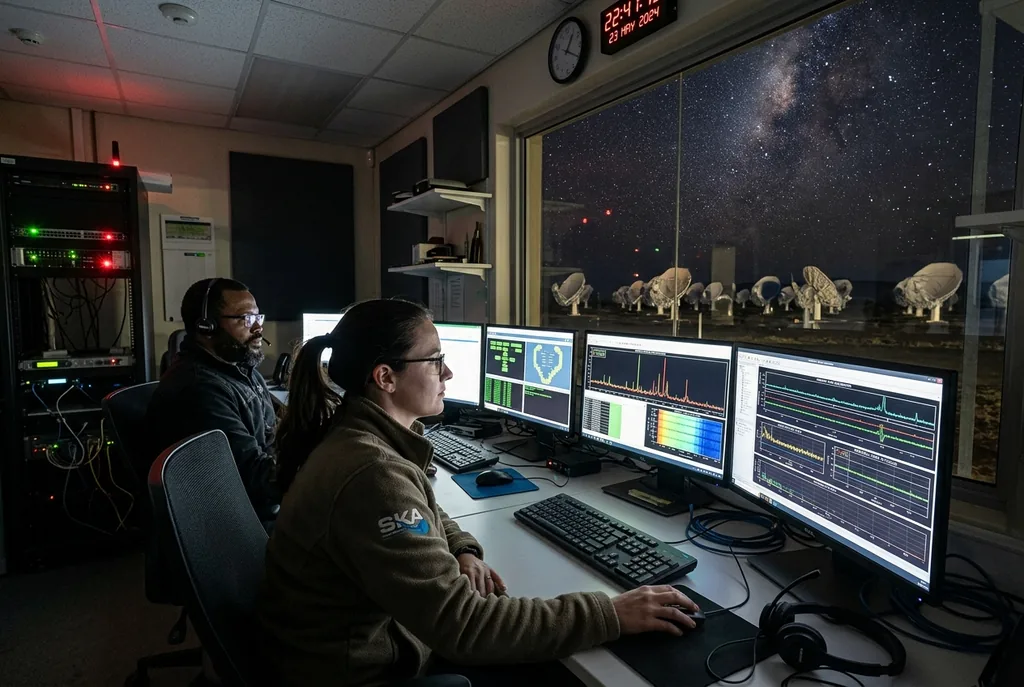
Captain's‑room tension: a sudden, very bright blip on MeerKAT's screens
When the array operators in South Africa watched the data stream, a single, intense radio flash stood out like a flare on a black display — ten seconds of signal bright enough to make automatic alarms blink. The phrase humanity receives mysterious 'mega-laser' ricocheted through social feeds within hours, but inside the control room the mood was narrower and more clinical: a rare detection, an odd spectrum and a puzzle that demanded verification.
The moment mattered because the team was looking at something unusually bright and distant. MeerKAT's 64 dishes had picked up emission coming from a system catalogued as HATLAS J142935.3–002836, more than eight billion light‑years away. That combination — an intense radio flash at extreme distance — is precisely the sort of observation that forces astronomers to pause between public hyperbole and measured confirmation.
humanity receives mysterious 'mega-laser' — what MeerKAT actually saw
Technical notes from the group show the signal contains multiple spectral components — four distinct peaks — which suggest emission from several regions within the merging galaxy system rather than a single, narrow transmitter. At least two of those components appear strongly magnified by a foreground galaxy acting as a gravitational lens, boosting the brightness by an order of magnitude. That magnification is why MeerKAT, despite being Earthbound, could register a source normally far too faint to detect.
In interviews and preliminary notes the team point to the possibility that this is not merely a megamaser but possibly a gigamaser — a nomenclature hinting at extraordinary luminosity. The discovery sits at the intersection of sensitivity, luck and cosmic geometry: a powerful radio source, a rare alignment with a lensing galaxy, and one of the world's most sensitive radio arrays turned in the right direction at the right time.
humanity receives mysterious 'mega-laser' — scientists flag a natural origin, fast
The public rush to an alien explanation encountered a bloc of sober caveats from the researchers within hours. Hydroxyl megamasers are a known class of astronomical objects: they arise in the messy environments of colliding, gas‑rich galaxies where certain molecules amplify radio emission. The MeerKAT team identifies hydroxyl emission lines in the spectrum, and that identification steers the interpretation toward a natural astrophysical process rather than an engineered beacon.
"We are seeing the radio equivalent of a laser halfway across the universe," Manamela said, and then emphasised the chain of natural circumstances — merging galaxies, abundant hydroxyl molecules, and an interposed lens — that together produced the exceptional signal. That string of coincidences is precisely what the team argues explains the apparent oddness: extraordinarily luminous yet naturally generated, then further brightened by a cosmic magnifier.
That does not make the detection trivial. Finding hydroxyl megamasers at such distances pushes the limits of surveys and carries implications for how we map star formation and molecular gas in the early universe. But it does blunt sensational narratives that leap from an attractive metaphor — "mega‑laser" — to claims of intelligent origin.
How astronomers separate cosmic fireworks from a purported alien beacon
Alarm bells about extraterrestrial intelligence often accompany unusual radio detections, so the second part of the story is procedural and deliberately dull: cross‑checks. Teams run the same data through independent pipelines, compare simultaneous observations from other facilities where possible, and search for terrestrial interference in the timestamps. They also examine the spectral fingerprints — hydroxyl molecules imprint a recognisable set of lines — and look for multi‑component structure that fits astrophysical models.
Verification steps therefore include re‑observing the field, scrutinising archival data, coordinating follow‑ups at optical and infrared wavelengths to characterise the lensing galaxy, and modelling how the lens should affect the apparent positions and brightness of the emission. Until those follow‑ups are complete, the team is careful to call the detection extraordinary rather than conclusive of any exotic explanation.
What the discovery reveals — and what it obscures
There are two different, equally interesting stories in this detection. One is technological: MeerKAT's sensitivity and survey strategy are catching faint and rare phenomena that were effectively invisible a decade ago. Seeing molecular maser emission from a system when the universe was less than half its current age opens doors to studying the chemistry and dynamics of distant mergers.
There is also a reputational trade: dramatic language like "mega‑laser" helps headlines but distorts public understanding. The team’s own language — "hydroxyl megamaser," "gigamaser candidate," and references to lensing — is narrower and less clickable, yet it carries the careful uncertainty that good science requires.
Unexpected implications and the next observing steps
There are also broader consequences for search strategies. Bright, lensed megamasers could act as cosmic beacons for studying molecular gas at high redshift — if we can build enough statistics. But building that census requires long observational campaigns and careful lens modelling, an effort that demands telescope time and funding at a moment when both are scarce.
At a human level the episode is a reminder of how quickly a single, ten‑second blip can migrate from a technical detection to a cultural headline. Scientists urge patience; the observation team has already published a first report and is mobilising follow‑ups. For the public, the story neatly folds a sexy phrase — humanity receives mysterious 'mega-laser' — into an empirical chain that points toward a rare, natural phenomenon amplified by geometry rather than intelligence.
Sources
- South African Radio Astronomy Observatory (MeerKAT observing team)
- University of Pretoria (Dr Thato Manamela and collaborators)
- Herschel‑ATLAS (HATLAS) survey catalogue




Comments
No comments yet. Be the first!