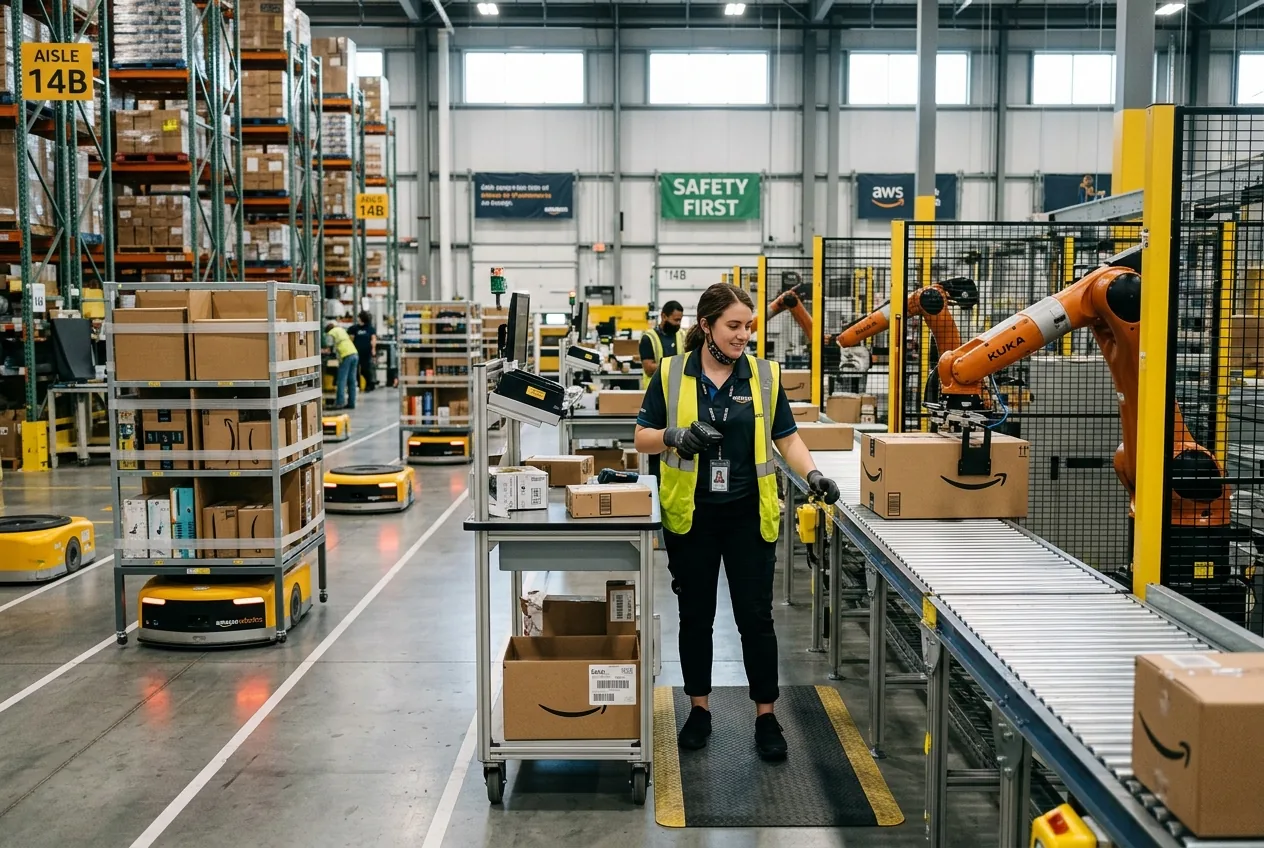
Inside a conference hall in Lisbon last month, Amazon's robotics chief spoke bluntly about a goal that has since become a political and industrial flashpoint: shrink the menial and repetitive parts of warehouse jobs with machines. The phrase floating across headlines — that amazon wants replace hundreds of thousands of workers — traces back to internal strategy documents and to a string of product announcements for new robotic arms and AI coordination systems. Amazon disputes simplistic readings of those documents, but the numbers inside them and the new robots on demo floors are enough to make mayors, unions and investors sit up.
How "amazon wants replace hundreds" appears in strategy documents and company announcements
The phrase in the public debate condenses two threads: what internal memos say about avoiding future hires, and what Amazon's robotics division is actually building. Reported internal projections suggest executives see automation as a lever to process vastly more items with fewer additional people — a projection that combines operational modelling (items per hour, cost per item) with capex plans. In parallel, Amazon has unveiled systems such as Blue Jay — a coordinated array of robotic arms — and Project Eluna, an operations AI designed to surface bottlenecks and recommend actions in real time.
Those two streams produce different headlines. The memos talk about avoided hires — essentially a forecast about future headcount needs if automation scales as planned. The product announcements are narrower: new equipment that can pick, pack or consolidate tasks at a single station. Amazon also emphasizes technician and engineering roles that support robots; the company tells investors and the public that many new roles are specialist, not seasonal pickers. Taken together, the documents and demos explain why the claim amazon wants replace hundreds is both plausible as a future scenario and contested as a present policy.
If "amazon wants replace hundreds", which jobs will vanish or simply change?
The short answer to whether Amazon will replace hundreds of thousands of workers with machines is: not overnight, and not uniformly. Automation tends to substitute for specific repetitive tasks — pick-and-pack, long walking routes inside warehouses, repetitive sorting — rather than entire professions overnight. Internal projections mentioned in reporting estimated Amazon could avoid hiring roughly 160,000 U.S. workers by 2027 in some scenarios, and as many as 600,000 by 2033 if automation scales and sales double. Those numbers are headline-grabbing, but they are forecasts tied to assumptions about item types, robot throughput, and how broadly the firm replicates advanced sites.
Economists and labour advocates warn the transitional pain is real. Seasonal hiring — Amazon says it will hire about 250,000 people for peak periods this year — can mask longer-term headcount trends. Unions and politicians are pushing for binding retraining guarantees or local transition funds because the jobs that vanish are concentrated in specific communities; even well-paid technician positions do not map one-to-one onto displaced pickers in the same town.
Robots on the floor: Blue Jay, Vulcan, Project Eluna and the automation stack
Amazon’s recent demos and announcements make clear the company is not building a single humanoid but an ecosystem. Blue Jay is a coordinated system of robotic arms that can pick, put-away and consolidate items that previously required several human stations. Vulcan-style robots introduce tactile sensing to handle a broader range of items. Project Eluna is the software layer: an AI model that aims to predict bottlenecks and recommend managerial actions in near-real time. Together they are an attempt to automate entire micro-tasks — not replace judgment but reduce repetitive manual labour.
What kinds of robots is Amazon using in its fulfillment centres? The range includes stationary and mobile robotic arms, conveyor automation and so-called cobots (collaborative robots) designed to work alongside humans. Amazon also uses autonomous mobile robots to move shelves and pallets — a lineage that stretches back to its acquisition of Kiva Systems in 2012 — and it sells many of the design lessons back into its supply chain and product announcements. The practical effect is incremental: more items handled by machines, fewer manual cycles per order, and a different set of safety and maintenance challenges for real workplaces.
When did Amazon start rolling out large-scale automation and what does it involve? The company’s robotics programme accelerated after the Kiva buyout over a decade ago and has iterated through generations of hardware and software. The current push is distinct because generative AI and advanced coordination software promise to broaden the range of items robots can handle — moving from simple, uniform SKUs to the mixed inventory Amazon actually stores.
Europe and Germany: regulation, social bargaining and industrial supply chains
Amazon’s automation strategy will not play out the same way in Europe as it does in the U.S. Labour laws, works councils and stronger social protections in Germany and much of the EU create a higher bar for unilateral change in large employers. That political economy difference matters because it shapes negotiations over redeployment, co-determination and retraining budgets in places where Amazon opens advanced sites.
At the same time, Europe — and Germany in particular — hosts a deep industrial base for robotics and machine tools. That means the physical robots and specialist technicians Amazon needs can often be sourced from European suppliers, even as Brussels debates industrial subsidies and AI governance. For Brussels, the question is both economic and reputational: support industrial competitiveness without creating mass local job displacement that politicians will have to answer for. As one dry observation puts it: Germany has the machinery; Brussels has the paperwork; someone else may have to do the social smoothing.
From a policy perspective, European regulators and trade ministries can influence the tempo of automation through procurement, funding programs for upskilling (Horizon-style or national schemes) and stricter rules on workplace consultation. Companies that move faster than local bargaining norms run political risk; Amazon’s public messaging about technician roles and local community outreach shows the company is aware of that dynamic and is trying to shape the narrative before the hardware lands.
Money, politics and what companies promise — and rarely deliver — on retraining
Money amplifies the controversy. Reports of Bezos courting huge funds to accelerate manufacturing automation and of Amazon planning multi-hundred-billion-dollar capex on AI inflame political reactions from lawmakers such as Senator Bernie Sanders, who frames the push as a "war against the working class." Amazon has pledged multi-billion-dollar retraining programmes — Fox Business covered a $2.5 billion pledge over five years — but retraining outcomes are mixed in practice unless tied to local labour market demand and credible placement guarantees.
Will Amazon replace hundreds of thousands of workers with robots? The honest answer is: possibly in scenarios that assume full replication of advanced automation across the network, but not in a single stroke. How many jobs could be automated in practice depends on throughput gains per robot, product mix, and whether Amazon chooses to scale its most advanced sites widely rather than concentrate them. Political pressure, union activity and regulation will all shape those choices. For communities, the wrenching part is that automation does not just change jobs; it changes which towns capture the new, higher-skilled work.
There is no single villain in this story — automation is both an operational efficiency and a social shock — but corporate scale means the social consequences are large. Expect more local deals, political fights and a growth in hybrid jobs that sit between old-fashioned picking and new robotics maintenance. The technical promise is real; the social contract around it is not yet written.
Sources
- Amazon press materials (AboutAmazon robotics announcements and product pages)
- Amazon SEC filings (workforce figures and capital expenditure guidance)
- Internal Amazon strategy documents and company memos reported in investigative coverage




Comments
No comments yet. Be the first!