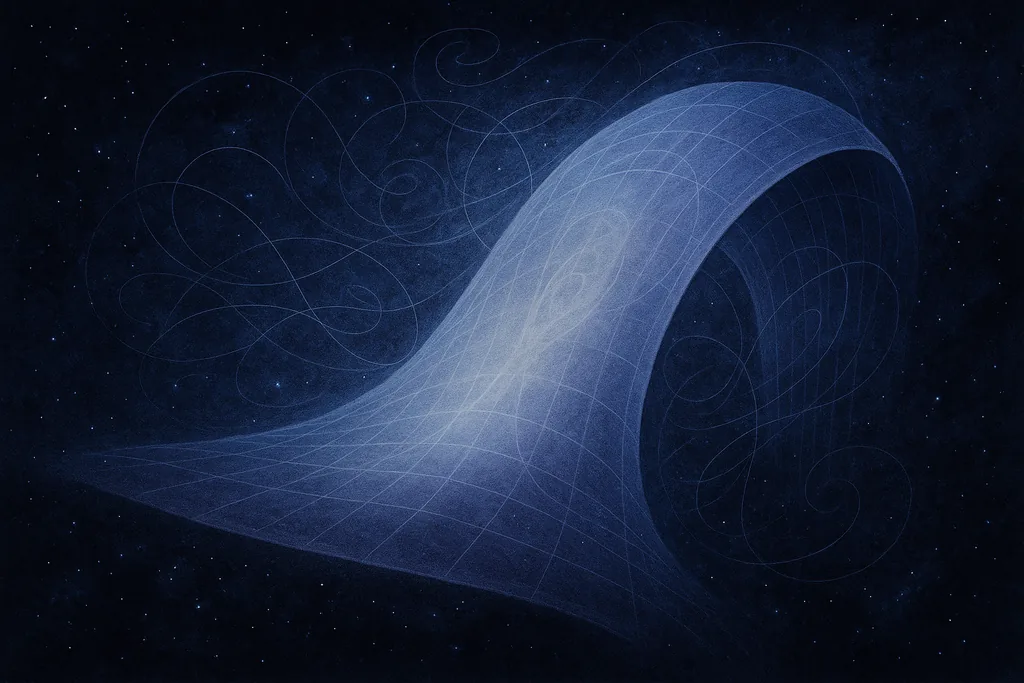
Over the past week a spate of headlines proclaimed a world‑first: scientists have discovered a "portal" to a fifth dimension that explains dark matter. The most sensational pieces collapse a technical theoretical model into a literal gateway image. In reality, the work being discussed is a mathematically consistent proposal that uses an extra spatial dimension to create a plausible dark‑matter candidate — an idea that remains firmly in the realm of theory, not laboratory proof.
The researchers formulated and analysed an extension of existing extra‑dimension frameworks. Their calculations describe how a new, Z2‑odd scalar field propagating across a warped fifth dimension mixes with the Higgs and produces a tower of heavier states — the Kaluza‑Klein modes — that can act as mediators between visible matter and a dark fermion sector. The math shows how the observed relic abundance of dark matter could, under certain conditions, arise naturally from this setup without upsetting known collider and cosmological constraints. But those are theoretical results derived from equations and numerical estimates, not an empirical measurement.
What the word "portal" really means here
In popular coverage, "portal" conjures doors and wormholes. In particle‑physics jargon it typically denotes an interaction channel — a field or particle that links two otherwise separate sectors. In this case the portal is a scalar mediator: a field whose quantum excitations connect Standard Model fields (like the Higgs) to fermions that are allowed to access the extra dimension. Those connections are described by well‑defined Lagrangians and boundary conditions in five‑dimensional calculus; they are not an instruction manual for building a literal doorway between dimensions.
How this fits into a long tradition of extra‑dimensional ideas
The notion of extra spatial dimensions is almost a century old — the Kaluza–Klein idea added a fifth dimension to unify gravity and electromagnetism — and later warped extra‑dimension models were developed to tackle the hierarchy problem. The recent work sits inside that lineage: it repurposes a warped geometry to create a dark sector that is naturally hard to detect in ordinary experiments. Those older frameworks already showed how higher dimensions produce towers of heavier particle states (Kaluza‑Klein modes) and how geometry can control particle masses; the new proposal uses the same mechanism to craft a specific dark‑matter candidate.
What would count as evidence?
Why the headlines oversell
- The difference between theory and discovery. A peer‑reviewed theoretical model can show that something is mathematically plausible — that it is consistent with known data and with internal constraints — but it does not by itself reveal the real universe’s behaviour. That requires experimental confirmation.
- "Portal" sells copy. Translating a scalar mediator into a human‑friendly image of a portal makes for eye‑catching headlines, but it also amplifies readers’ expectations. The work proposes mechanisms that would make a fifth dimension relevant to dark matter, not evidence that humans have observed or traversed an extra dimension.
- Many viable hypotheses remain. The physics community continues to explore multiple candidate explanations for dark matter — from weakly interacting massive particles and axions to primordial black holes and higher‑dimensional fermions. A credible theoretical model raises interest and guides searches, but by itself it doesn't settle the question.
What to watch next
The value of this kind of theoretical work is practical as much as conceptual: it identifies concrete signatures experiments can target. Over the next few years, look for precision measurements of Higgs couplings, targeted searches for heavy mediator resonances at colliders, improved direct‑detection experiments, and proposed searches for characteristic gravitational‑wave or cosmological signals that would be hard to reconcile with other models. If any of those observables move off zero in a way that matches the model’s predictions, the community will take a closer look. Until then, the idea is an intriguing — not a confirmed — route to explaining dark matter.
Bottom line
The coverage that framed this development as the discovery of a portal to a new dimension overreached. What has re‑appeared in the headlines is a thoughtful and technically detailed theoretical proposal that uses a warped fifth dimension and a scalar 'portal' to produce viable dark‑matter candidates. It's a productive direction for research and a clear example of how theory can open new experimental possibilities — but it is not an experimental milestone that resolves the dark‑matter mystery. For that, we will need data: a smoking‑gun signal from colliders, detectors, or the cosmos that cannot be explained any other way.




Comments
No comments yet. Be the first!