Why does NASA chief Jared Isaacman say America is 'absolutely back' — can the US beat China to the Moon?

Space
Why does NASA chief Jared Isaacman say America is 'absolutely back' — can the US beat China to the Moon?
NASA Administrator Jared Isaacman has declared that "America is absolutely back" in the space race as Artemis accelerates. A closer look at the technical, political and industrial trade-offs that will decide whether the US actually reaches the lunar surface before China.

On a crowded launch pad and a national pitch: the moment that framed the boast

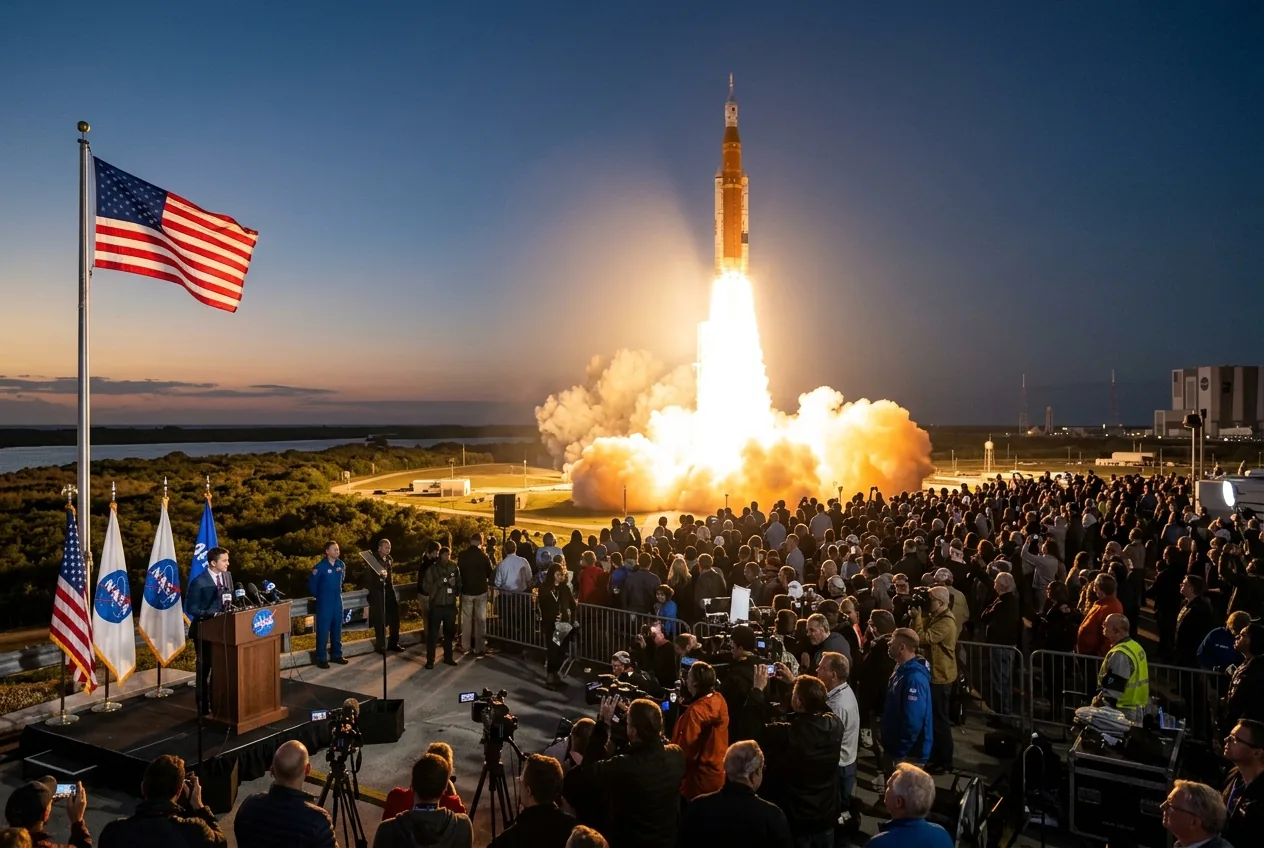
The recent roar of the Space Launch System and the sight of Orion clearing the pad gave Jared Isaacman the stage he needed. When the NASA administrator said, in televised interviews over the weekend, that "America is absolutely back" in the space race, he did so with an image of Artemis II still warm in the public mind and the political machinery behind him asking for a faster cadence of lunar missions. That phrase — "nasa chief declares america" — is as much a political slogan as it is a programme update, a shorthand for an agency trying to convert a high-profile launch into a sustained industrial effort.

The line landed at a moment when the United States has a visible accomplishment to show: a crewed lunar flyby that marked a return to deep-space human missions after half a century. But the announcement is also a claim about the future — one that depends on rockets that have leaked hydrogen during tests, commercial landers that are still being matured, international suppliers and a complicated web of politics in Washington, Brussels and corporate boardrooms. Isaacman’s confidence is real, but the rest of the story is where the race will be won or lost.

nasa chief declares america: what Isaacman meant — politics, policy and pacing

When a senior official says "we are absolutely on an achievable path now," that is shorthand for three distinct commitments: a political mandate, budget promises and schedule reprogramming. Isaacman pointed to the Trump-era revival of Artemis and the administration’s demand to convert short, symbolic returns to the Moon into a sustained presence — robotic precursor landings, a near-monthly cadence of deliveries beginning in 2027, and eventually a surface architecture intended to be permanent rather than ceremonial. That is the policy part.

The political part is equally important. Declaring "America is back" is intended to frame the mission as a national competition and to mobilise domestic support — for Congress, for contractors, and for allied partners. It’s an appeal to momentum: after Artemis II’s success, the administration wants to compress schedules to show tangible progress before 2030. This political momentum can unlock budgets and expedite approvals, but it cannot eliminate engineering realities.

Finally, pacing. Isaacman’s version of "back" is not just a single launch; it is a promise of a rhythm of robotic and crewed missions, of rapid learning on surface systems and in‑situ resource experiments. The ask now is for NASA and its commercial partners to convert one successful mission into a supply chain and operations tempo that survive the inevitable technical slips.

nasa chief declares america and the timeline to beat China

Beating China to a crewed surface landing is the explicit political frame being used in Washington. China has publicly signalled ambitions to land astronauts on the Moon around 2030, while NASA—after adjustments and an accelerated plan—has pushed lander demonstration and docking practice earlier, with surface landings targeted within a window that reaches into the late 2020s. The arithmetic is not as simple as calendar dates, though. The United States is aiming to couple a landing with infrastructure — a sequence of robotic deliveries, power and navigation demonstrations, and in‑situ resource experiments — that will make a visit sustainable instead of brief.

That approach gives the US two advantages and two vulnerabilities. Advantage one is industrial depth: a broad network of contractors, commercial launch and a political willingness to fund expensive systems. Advantage two is international partnership: hardware and services shared with allies can multiply capacity. Vulnerabilities include the SLS rocket’s recurring hydrogen leaks, cost overruns, and the still‑unproven commercial lunar landers that must perform flawlessly on their first surface missions. So, can the US beat China? It could — but only if schedule optimism turns into reliable deliveries and if technical headwinds don’t cascade into multi-year delays.

In short: a plausible path exists, but a promise still needs engineering and a steady procurement pipeline to match the rhetoric.

Hardware reality: SLS, Orion and the messy middle of engineering

Artemis II’s successful flyby did more than deliver a headline; it stressed the SLS and Orion stack through real operational shakedowns. Engineers solved last-minute problems such as battery sensors and flight-termination command issues, and they managed a notoriously fragile hydrogen loading process without a repeat of earlier leaks. Yet the mission also exposed familiar fragilities — the toilet malfunction that became a memed anecdote, and the unresolved questions about how often a 32‑story expendable rocket can be flown at tempo without spiralling costs.

Beyond the rocket, the mission architecture depends on landers and surface systems that are either late-stage prototypes or still designs on a drawing board. Those systems must integrate power, navigation, crew mobility and in‑situ resource manufacturing — the pieces Isaacman mentioned as being "paramount" for Mars. Each of these is a separate development programme with its own schedule risk and budget appetite. The gap between a flyby and a sustained presence is measured in not just launches but in delicate systems engineering across many suppliers.

That means the US programme’s success will depend on turning single demonstrations into reliable, repeatable hardware chains: a manufacturing problem as much as a scientific one.

Europe’s role and the industrial-policy angle from Cologne to Brussels

If Europe matters in this race, it is because of hardware and procurement culture. The European Space Agency already contributed the European Service Module for Orion in earlier Artemis missions — a concrete industrial contribution that demonstrates how transatlantic partnerships can spread cost and technical risk. But actors in Europe move differently: procurement tends to be consensus-driven, funding is spread across national interests and export controls complicate high-tech transfers. That matters when you need fast turnarounds on avionics, semiconductors and cryogenic systems.

From a German and EU industrial-policy viewpoint, the question is familiar: Brussels can underwrite programs, Berlin can supply precision manufacturing, yet getting programs from order to launch requires a political compact. Programs like IPCEI-style funding can help, but the EU’s machinery is slow compared with the urgency projected in Washington. So Europe offers capability, but the tempo Isaacman promises hinges on political alignment and faster procurement than traditional European practice tends to allow.

Put another way: Germany has the machine tools; Brussels has the paperwork; the race requires both to move in the same direction at uncommon speed.

What competition with China actually looks like — cooperation, contest and capability

Talking about beating China simplifies a broader strategic picture. China’s lunar ambitions are real and focused; Beijing aims to demonstrate human landing capability in the early 2030s and is building its own logistics and robotic infrastructure. The contest is not only about flags and timelines; it is about standards, norms and whether the Moon becomes a field of cooperative science or a theatre of strategic competition.

NASA’s answer is two-fold: accelerate a cadence of robotic precursors and demonstrate the industrial base for a sustainable presence. That strategy leans heavily on commercial suppliers, international partners and a sequence of technological stepping stones: frequent deliveries, surface mobility testing and in‑situ resource experiments that would reduce the mass a crewed mission must carry from Earth. If those steps work, the United States will have more than a landing — it will have a logistics backbone. If they fail, a symbolic landing will be easier for a rival to replicate.

So competition with China will probably be messy: partial successes, public posturing, and a mixture of collaboration in scientific areas even as geopolitical rivalry intensifies. The U.S. plan to compete is therefore as much diplomatic and industrial as it is engineering.

A cautious forecast and a dry punchline

Isaacman’s declaration that "America is absolutely back" is rhetorically useful and politically resonant. It captures a renewed emphasis on lunar infrastructure and a timeline that has been compressed by design. But whether the United States actually lands humans before China will be decided in hardware acceptance tests, manufacturing lines and a parade of otherwise small failures and fixes that rarely make the headlines. The Artemis programme’s success will be judged not by a single moment of splashdown but by whether launches, landers and surface systems can be produced at the cadence policy-makers now demand.

Europe can help with modules and manufacturing; commercial companies can provide agility; Washington can provide money and political urgency. The uncomfortable truth is procedural: technology is rarely beaten by slogans. For now, the claim that "America is absolutely back" is a useful wager on the future — one the agency and its industrial partners must still win in the workshop, not the podium.

Sources

  • NASA (Artemis programme press briefings and mission materials)
  • NASA technical documentation on the Space Launch System and Orion capsule
  • European Space Agency (contributions to Artemis and the European Service Module)
Mattias Risberg

Mattias Risberg

Cologne-based science & technology reporter tracking semiconductors, space policy and data-driven investigations.

University of Cologne (Universität zu Köln) • Cologne, Germany

Readers

Readers Questions Answered

Q What did NASA mean by 'America is absolutely back' in space?
A I cannot provide a complete answer to this question based on the available search results. The search result provided is a YouTube video description about former NASA astronaut Jerry Linenger discussing the Artemis II mission, but it does not contain the specific article or quotes from NASA chief Jared Isaacman about America being 'absolutely back' in space.
Q Can the United States really beat China to the Moon?
A I cannot answer this question based on the available search results. The provided search result does not contain information comparing US and Chinese lunar capabilities or timelines for reaching the Moon.
Q What is NASA's Artemis program and what is its timeline for returning to the Moon?
A I cannot provide a detailed answer based on the available search results. While the search result mentions the Artemis II mission, it does not include information about the Artemis program's goals, structure, or timeline for returning to the Moon.
Q When is the next lunar landing planned under NASA's program?
A I cannot answer this question based on the available search results. The search result references Artemis II but does not specify when the next lunar landing is planned under NASA's program.
Q How does NASA plan to compete with China's lunar program on the Moon?
A I cannot answer this question based on the available search results. The provided search result does not contain information about NASA's competitive strategy with China's lunar program.

Have a question about this article?

Questions are reviewed before publishing. We'll answer the best ones!

Comments

No comments yet. Be the first!