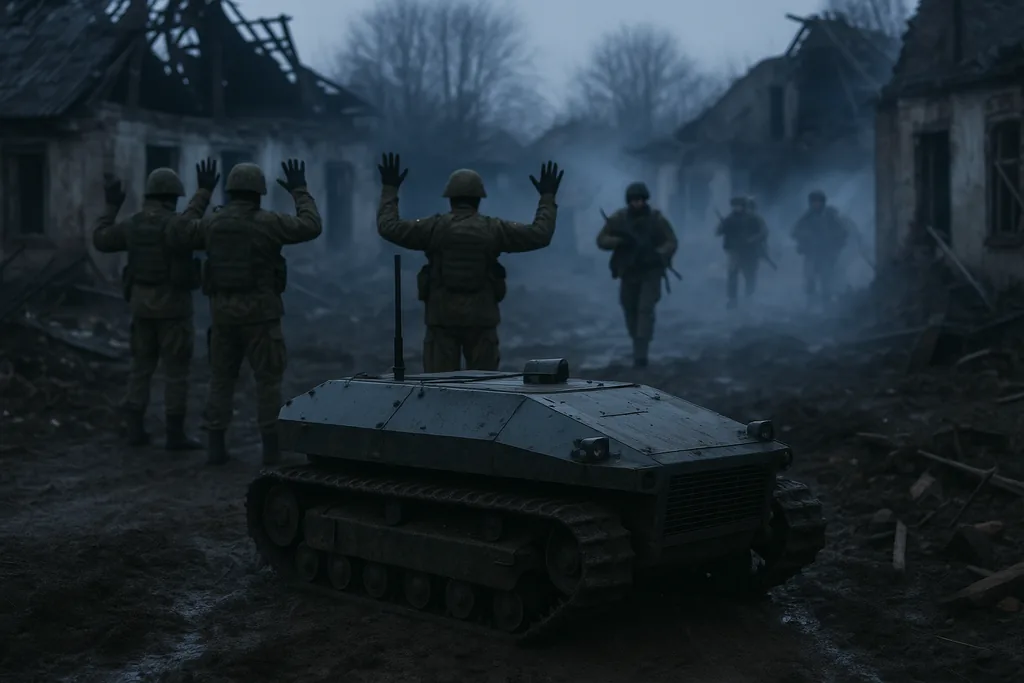
Russians surrendered to Ukrainian robot in Huliaipole on 8 March 2026
In a short, stark episode on 8 March 2026, on the Huliaipole axis of the front, a group of Russian fighters laid down their weapons and moved into captivity after hearing a nearby machine gun and coming under fire control — only later did Ukrainian forces realise the shooter had been a ground robotic complex. Accounts published by Ukrainian defence sources and a later company video describe troops hearing automatic fire, assessing they were outgunned, and surrendering. The incident, described by the combat training lead of a Ukrainian reconnaissance battalion this week, is the latest example of how unmanned ground vehicles and drone‑carrying platforms are reshaping contact operations along the frontline.
russians surrendered ukrainian robot: the Huliaipole incident and what happened
The Huliaipole episode was reported as a clearing operation where human scouts worked in concert with a robotic complex. According to Ukrainian field statements, a robotic platform moved with a patrol ahead of infantry; when a Russian position was reached, automatic fire was encountered and the enemy — hearing sustained suppressed or directed fire and seeing a combat presence — decided to surrender. In this case the attackers only recognised that the immediate threat was an unmanned system after Ukrainian soldiers closed in and took the prisoners under control. That detail matters: the captives did not so much 'deceive' as respond to a clear, immediate combat signal — the sound and effect of machine‑gun fire — and the tactical situation pushed them to the rational choice of surrender.
russians surrendered ukrainian robot: Droid TW-7.62, Hnom-ND and battlefield platforms
The surrender described this week sits alongside several recent, better‑documented cases. In late January 2026 a manufacturer released footage showing three Russian soldiers approaching and surrendering to a reconnaissance‑strike robot identified as the Droid TW‑7.62, built on a modular NUMO chassis and armed with a 7.62‑millimetre machine gun and on‑board ballistic computation. Earlier in March, industry sources highlighted a different class of ground robot — the Hnom‑ND — a wheeled‑tracked carrier that delivers and launches FPV (first‑person view) strike drones from concealed positions. Together these examples show two distinct roles: autonomous direct‑fire platforms that can suppress and hold ground, and delivery platforms that extend drone reach deep into enemy rear areas.
How the robots influence soldiers' decisions on the ground
The Psychological mechanics are simple and operationally powerful. Combatants make fast cost‑benefit calculations under stress: if a nearby position is delivering accurate automatic fire and they perceive no immediate human backup, the probability of survival drops fast. An unmanned turret that accurately detects and tracks targets using thermal or electro‑optical sensors, or a drone launched from a hidden ground carrier, produces the same operational effect — suppression, targeted damage and the impression of concentrated force — that used to require dismounted infantry or armoured vehicles. The recorded cases show that soldiers will surrender to a machine when it produces credible, sustained lethal threat and the human option to resist looks hopeless.
How Ukraine builds and fields these ground robots
Ukraine's industry and battlefield experience have created an unusually fast innovation loop. A mix of private companies and military programmes has produced a wide range of UGVs — from logistics carriers that move supplies and medevac capsules, to armed turrets and sacrificial kamikaze vehicles. Firms and brigades test and iterate on the front, integrating night vision, thermal imaging, ballistic computers and semi‑autonomous target recognition. Production has scaled: analysts and defence sources describe hundreds of models in service and plans to field tens of thousands of unmanned systems over the next year as the technology shifts from bespoke prototypes into mass‑produced battlefield tools. That volume matters because it changes not only tactics but the economics of attrition: losing a ground robot is cheaper than losing a crewed tank or a squad of soldiers.
Communications, autonomy and the limits of deception
Technically, these systems vary in their autonomy. Some platforms — like the reported Droid series — use AI‑assisted detection to point, track and stabilise fire while a human operator authorises engagement; others operate as remote launch points for FPV drones that are flown by human pilots. The commonly reported 'deception' effect usually comes from two factors: a robot's ability to remain concealed until it fires, and the realistic sensory cues it creates (noise, muzzle flash, trajectory effects). There is no sophisticated mimetic deception required — the machine simply creates the same immediate battlefield signals a human gunner would. Equally important are the vulnerabilities: ground robots depend on communications links, local sensors and mobility. Bad terrain, mines, and electronic‑warfare jamming remain real constraints, and tracked designs are preferred where shell‑pocked ground would trap wheeled vehicles.
Rules of war, ethics and a new capture dynamic
These incidents raise clear legal and ethical questions. International humanitarian law does not ban unmanned weapons per se; it focuses on the ability to discriminate between combatants and civilians and to take precautions against unnecessary suffering. But robots that operate with increasing autonomy complicate responsibility: who is accountable when an automated system threatens, wounds or compels surrender? Commanders, manufacturers and remote operators all share parts of that chain, and the law will need clearer practice and possibly stricter doctrine about human control over lethal decisions. Ethically, the capture of combatants by a machine also changes detention procedures: prisoners taken after automated engagements still require humane treatment and processing by human forces, but the initial contact raises questions about how evidence is recorded, how intent is judged, and how to verify compliance with the law of armed conflict.
What this means for Russian forces and future frontline tactics
For Russian units operating in contested areas, the message is tactical and strategic. Rear areas and positions once considered relatively safe are now exposed to small, inexpensive robotic platforms that can plant and launch FPV attacks or deliver suppressive fire from unexpected directions. That forces changes in movement discipline, reconnaissance, and counter‑robot tactics: electronic countermeasures, wider use of concealment and dispersion, and new doctrine about when to stand and when to withdraw. For Ukraine, scalable robot fleets reduce risk to personnel, free up soldiers for complex tasks, and create a persistent layer of attrition and deterrence across a wider battlefield footprint.
Documented cases and the broader trend
This week’s Huliaipole report is part of a pattern that began to crystallise publicly in late 2025 and early 2026: media and industry releases have shown robots holding positions for weeks, conducting medevac under fire, and in several cases prompting enemy surrender without close infantry contact. These episodes are reported from multiple units and company releases and are consistent with analyses that identify Ukraine as a leading innovator in unmanned ground vehicles. That combination of industrial scale and combat experience is what makes the recent surrenders more than isolated curiosities — they are early signs of an operational shift.
Sources
- Jamestown Foundation (Eurasia Daily Monitor analysis: Ukraine and unmanned ground vehicles)
- Ukrainian Ministry of Defense statements and field reports
- DevDroid press materials and video release on the Droid TW‑7.62 system
- Temerland product materials on the Hnom‑ND ground drone carrier




Comments
No comments yet. Be the first!