march 17, 1958: vanguard lifts off into history
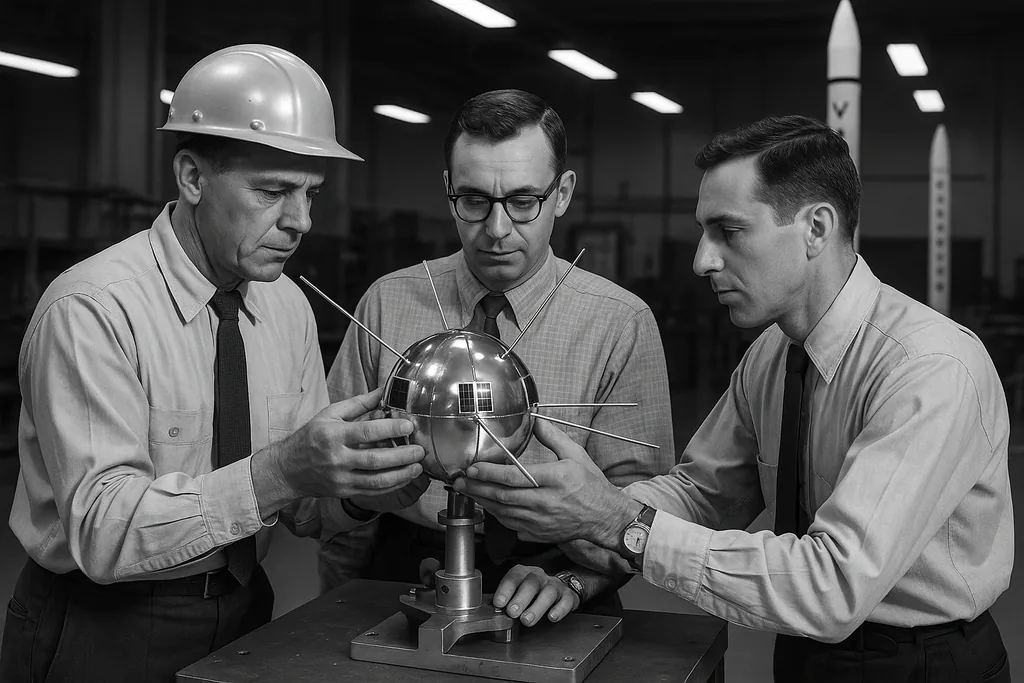
On March 17, 1958 — St. Patrick's Day — a small, gleaming metal sphere cleared the launch pad and climbed into space under the flag of the U.S. Navy. The mission, catalogued in contemporary bulletins simply as Vanguard 1, was America's second satellite and the first to run on sunlight rather than batteries. Although it weighed only about 3 pounds (1.5 kilograms) and measured 6.5 inches (16.5 centimeters) across, Vanguard 1 carried a program-sized ambition: to test a new launch vehicle, probe how the upper atmosphere affects satellites, and provide precise tracking targets that would let scientists learn more about Earth's shape and gravity.
march 17, 1958: vanguard — a tiny satellite with big ambitions
Design, launch vehicle and technical specifications
Vanguard 1's hardware was deliberately simple. The satellite was a smooth aluminum sphere about 16.5 centimeters in diameter, housing a small radio transmitter and topped with six matchbox-sized solar panels that powered the transmitter — the first solar-powered spacecraft to reach orbit. Its mass, roughly 1.5 kilograms, and compact shape minimized surface area and helped it survive in high-altitude orbits. The launch vehicle, also named Vanguard, was a three-stage rocket developed by the Navy for these scientific flights. The vehicle's higher initial orbit, compared with some earlier launches that rode smaller rockets, was part of the reason Vanguard 1 achieved such long-term survival in space.
march 17, 1958: vanguard's orbit and surprising longevity
Vanguard 1's orbit took it far enough from the dense lower atmosphere that early analysts expected the small satellite to remain aloft for centuries — originally some team members estimated as long as 2,000 years. Continued tracking refined those models: as scientists measured the satellite's slow orbital decay, they recognized that real atmospheric drag at high altitudes—plus subtle perturbations from Earth's asymmetric mass distribution—would erode the orbit faster than first hoped. Today Vanguard 1 remains in orbit and is officially the oldest human-made object still circling Earth, though researchers later revised lifespan estimates to on the order of a few centuries rather than millennia. By contrast, earlier satellites placed into lower trajectories, such as Sputnik 1 and Sputnik 2, reentered much sooner; Explorer 1 — America's first satellite — stayed in orbit longer than Sputnik but returned to the atmosphere within about a dozen years.
Tracking, perturbations and contributions to geophysics
Although Vanguard 1 was tiny and carried only a simple transmitter, its scientific value came from being a clean, well-tracked probe. Radar and optical tracking of the satellite registered tiny departures from an ideal Keplerian orbit. Those departures contained information: they revealed the Earth's equatorial bulge, the way mass is distributed unevenly across the planet, and the structure of gravitational harmonics beyond the simple spherical model. Analysts used the measured perturbations to improve models of Earth's oblateness and to map regional variations in gravity, which helped refine geodesy — the science of Earth's size and shape. Equally important, the way Vanguard's orbit changed over time provided a practical measure of residual atmospheric density at altitudes above the conventional atmosphere, forcing researchers to update models of the upper atmosphere and of orbital drag.
Context in the early space race and engineering lessons
Vanguard 1 launched into a world already in the grip of the space race. The Soviet Union's Sputniks had demonstrated that artificial satellites were straightforward to place into orbit; the U.S. program responded with a series of projects, among them Project Vanguard. The small US Navy-built satellite performed different functions than the earlier Soviet machines and America's Explorer 1, which carried a scientific instrument that discovered the Van Allen radiation belts. Vanguard's higher, longer-lived orbit proved the value of matching launch vehicle capability to mission goals: a higher insertion altitude reduces atmospheric drag and can preserve a spacecraft for decades. The Vanguard program also seeded expertise; many Navy researchers and engineers who worked on the project would move into the newly formed NASA and help establish facilities such as Goddard Space Flight Center, carrying lessons about small-satellite design, tracking and the utility of solar power into the broader U.S. space effort.
Why Vanguard still matters to students of spaceflight
Vanguard 1's significance is both technical and symbolic. Technically, it was the first demonstration that sunlight could power an operating spacecraft in orbit, and it supplied years of precise tracking data that sharpened scientists' picture of Earth's gravitational field and upper atmosphere. Symbolically, the satellite — small enough that Soviet leader Nikita Khrushchev mockingly called it the "grapefruit satellite" — represents a transition from the ad hoc hardware of the earliest launches to a more methodical, science-driven approach to space exploration. Its long survival in orbit is a reminder that even modest instruments can produce outsized scientific returns when combined with careful measurement and analysis.
Vanguard's technical specs and the mission in brief
To recap the essential facts: Vanguard 1 launched on March 17, 1958 from Cape Canaveral under U.S. Navy auspices as part of Project Vanguard during the International Geophysical Year. The satellite was a 6.5-inch (16.5 cm) aluminum sphere weighing about 3 pounds (1.5 kg) and powered by six small solar panels. Its mission combined an engineering demonstration of a three-stage launch vehicle and solar-powered systems with scientific goals: serve as a well-characterized tracking target to probe Earth's shape, gravity field and the drag exerted by the upper atmosphere. Although early lifetime predictions were optimistic, Vanguard 1's orbit decayed more quickly than the first estimates predicted, reflecting a more complex upper atmosphere and its impact on even tiny satellites.
More than six decades after it left the pad, Vanguard 1 endures as a piece of living history overhead. Its silent orbit continues to link modern satellite engineering to the earliest days of space science, a compact object whose modest instruments produced lasting insights about our planet.
Sources
- U.S. Naval Research Laboratory historical archives
- NASA / Goddard Space Flight Center historical records
- International Geophysical Year (IGY) program documentation
- National Space Science Data Center (NSSDC) mission summaries



Comments
No comments yet. Be the first!