this day history: seventh — A new world appears
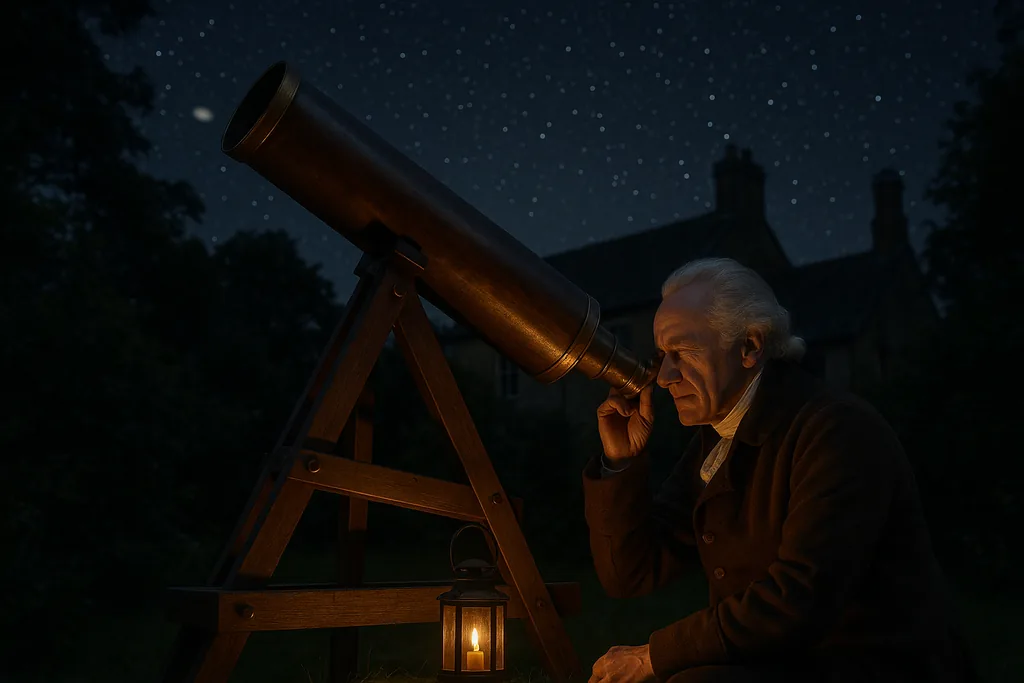
On March 13, 1781, an observer working from a garden in Bath, England noticed an object that refused to behave like a star. Today’s remembrance — this day history: seventh — marks the night William Herschel first recorded what he initially thought might be a comet, only to find that the object followed a steady, planetary path around the Sun. That night changed the way astronomers counted the solar system: an entirely new body had been added to the familiar roster that ran Sun, Mercury, Venus, Earth, Mars, Jupiter and Saturn.
this day history: seventh — Herschel’s observation in Bath
William Herschel, a German-born musician turned amateur astronomer, was systematically surveying the sky with a reflecting telescope he had built. While sweeping star fields with an instrument unusually large and sharp for the time, he noted a small, diffuse disk that did not have the pinpoint shape of a star. Herschel recorded his observation in a notebook and reported it to the Royal Society, describing his object as a comet because it appeared as a nebulous patch and moved slowly against the background stars.
That short account contains the direct answers to several common questions: who discovered Uranus (William Herschel) and in what year was it discovered (1781). Herschel’s method was simple in description but technically demanding in practice — a careful telescopic survey and repeated observations to track motion. The equipment and observing discipline required to spot a faint, slow-moving planet marked a turning point: it was the first planet found by telescope rather than by naked-eye observation.
this day history: seventh — Why it became the seventh planet
When astronomers talk about Uranus as the seventh planet, they are counting outward from the Sun. The list — Mercury, Venus, Earth, Mars, Jupiter, Saturn — dates back to classical observations and centuries of naked-eye astronomy. Uranus sits beyond Saturn in a much wider orbit, so once its planetary nature was confirmed by orbital calculations, it was slotted into that position as the seventh planet from the Sun.
That simple ordering carries a deeper implication: the solar system, as understood in the 18th century, was no longer complete. Before 1781, the known planets were those visible without instruments. Herschel’s discovery extended the range of the known system and demonstrated that telescopes could reveal whole new classes of planetary bodies. The reordering from six known planets to seven reshaped both the language and the practice of astronomy.
A misidentified body and the naming controversy
Herschel’s first public characterization of the object as a comet reflected the observational challenges of the era. The body was faint and its motion across the sky was slow; both traits made it easy to mistake for cometary fuzz. Only after mathematical work by several continental astronomers — using repeated positional measures to determine an orbit — was it recognized that the object followed a nearly circular path typical of planets rather than the highly elliptical tracks associated with comets.
Naming the new planet sparked national and scientific squabbles. Herschel, who had patrons at the British court and hoped to honor them, proposed the name "Georgium Sidus" — the Georgian planet — after King George III. That suggestion found favor in Britain but raised hackles elsewhere. Other astronomers argued for mythological names consistent with classical practice; the name Uranus, chosen to reflect the ancient Greek deity of the sky and to follow the genealogical logic (Uranus was the father of Saturn), eventually became the international standard, promoted by figures such as Johann Bode.
Astronomical significance and early challenges
Herschel’s discovery mattered technically and conceptually. It was the first time an observatory-grade instrument had revealed a planet beyond those known to antiquity, proving the practical value of telescopic surveys for charting the solar system. The find forced astronomers to turn to celestial mechanics to compute an orbit — work undertaken by mathematicians and astronomers across Europe — and confirmed that careful measurement plus mathematical analysis could separate comets from planets.
But the recognition of Uranus as a planet was not instantaneous or straightforward. Early observers struggled with the limitations of their telescopes, the faintness of the object and its slow motion. The faint disk could be masked by poor seeing or confused with double stars; only systematic follow-up over weeks and months permitted the curve of an orbit to emerge from the noisy background of star positions. These observational constraints, and the fact that different nations preferred different names, meant acceptance by the broader astronomical community took time.
Legacy: telescopes, surveys and the expanding solar system
The discovery of Uranus set off a chain of scientific developments. It spurred instrument makers to build larger and more precise telescopes, encouraged more systematic sky surveys, and directly led to new mathematical work in orbital prediction. The most consequential long-term effect was that irregularities in Uranus’s motion would later convince astronomers that another, more distant planet might be perturbing its orbit — a line of reasoning that culminated in the prediction and discovery of Neptune in 1846.
Uranus’s detection also altered the cultural map of astronomy. It demonstrated that discovery was no longer the preserve of naked-eye observers and underscored the role of skilled amateurs and instrument builders in extending scientific knowledge. The episode illustrated how observation, instrumentation and international scientific exchange together rearranged the perceived scale of the solar system.
What the discovery tells us about scientific practice
The story of Uranus’s discovery is a compact lesson in how science advances. A careful observer with a better tool spotted an anomaly, he reported it to peers, and then a broader community of mathematicians and astronomers tested and refined the claim. The initial misclassification as a comet, the naming disputes and the need for precise orbital calculation are all evidence of science as a social and technical process: claims require verification, instruments constrain what can be seen, and naming reflects more than strict taxonomy — it carries political and cultural freight.
Two and a half centuries on, the discovery remains a touchstone: a moment when technology — a homemade reflecting telescope — altered centuries-old cosmological bookkeeping. The night Herschel recorded that odd, slow-moving object opened the door to modern planetary astronomy and, in time, to the realization that the solar system reaches far beyond what the naked eye alone can reveal.
Sources
- Royal Society (Herschel correspondence and 1781 notices)
- Royal Astronomical Society (historical records on planetary discovery)
- Royal Observatory, Greenwich archives



Comments
No comments yet. Be the first!