The Day That Changed Everything
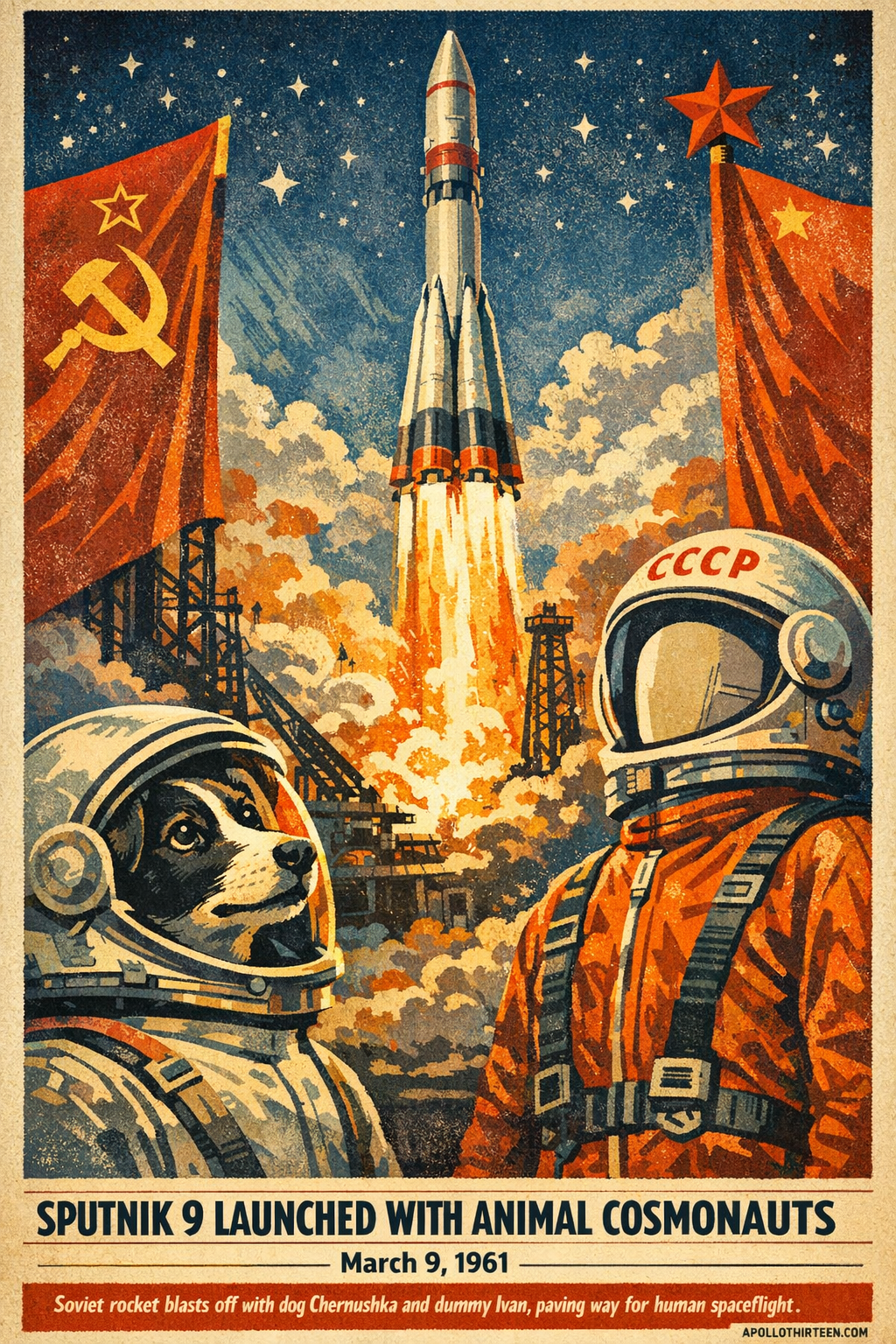
Sixty-five years ago today, before most of the world had finished its coffee on a thin March morning, a Soviet rocket punched a pale hole through the Kazakh sky and carried a small, trembling passenger into history. It was not a man. It was a dog named Chernushka and a mannequin—stiff, painted, and improbably human—who together rode the newest Vostok into orbit and back. They came down alive.
The scene at Baikonur that morning—cold, hard, bureaucratic and electric—was the odd mix that makes great leaps possible. Engineers in fur hats huddled near clipboards, technicians in grease-speckled overalls checked gauges for the hundredth time, and a kennel of handlers made the final fuss over a black, quiet dog who had been through as much training as any soldier. At 06:29 UTC, the rocket lifted. In 89 minutes it had done what men had not yet done: prove to a nervous, ideological superpower that a human could survive the violent bookends of spaceflight—launch and re-entry.
That single success, certified in a telegram of terse Soviet understatement—mission complete, animal recovered—did not make global headlines as much as Sputnik 1 had four years earlier, but it proved an invisible threshold had been crossed. It demonstrated, with biological evidence and mechanical choreography, that technology and physiology could be married well enough to put a human life at stake and win. Weeks later, Yuri Gagarin would take that wager. But on March 9, 1961, the payload was Chernushka and a painted mannequin called Ivan Ivanovich. Their return marked the moment when test and theory became lived certainty and the race for orbit moved from rehearsal to the main act.
What Actually Happened
On March 9, 1961 at 06:29 UTC, a Vostok-K rocket lifted off from Site 1/5 at Baikonur carrying the spacecraft cataloged in the West as Sputnik 9 but known to the Soviets as Korabl-Sputnik 4. This was the first flight of the improved Vostok-3KA design—the exact configuration intended to carry a human into orbit. The payload mass was substantial: roughly 4,700 kilograms of life-support systems, structural weight, instrumentation and recovery gear.
On board were three classes of "crew": a single dog, Chernushka, fitted with sensors and a snug harness; a mannequin painted to look like a Soviet cosmonaut, strapped into an ejection seat and nicknamed Ivan Ivanovich; and a collection of biological specimens to give physiologists more data on how living tissue responds to brief spaceflight. The plan was surgical in its simplicity. The rocket would place the capsule into a single orbit, validate all systems for launch, weightlessness and re-entry, and then bring everything back to Earth under parachutes. Critically, the program also needed to test the ejection seat: the logic of Vostok's design was that, in the event of a successful flight but a hard landing, the occupant would eject at altitude and parachute to the ground. The mannequin would simulate this step.
Everything went according to script. Telemetry indicated normal acceleration and orbital insertion. Once in space, the biological sensors registered the brief onset of microgravity; the dog experienced weightlessness and—within the short flight window—did not show catastrophic physiological stress. After approximately one orbit, the descent sequence began. Re-entry generated the terrifying heat and aerodynamic forces that melt hubris to useful data, and the capsule's heat shield and structure performed as designed. During descent, the mannequin was mechanically ejected. It separated from the atmospheric buffet, unfurled its parachute, and came down under canopy several kilometers from the main capsule. The life-carrying descent module followed its own parachute to the Kazakh steppe, and Chernushka, still alive and relatively unflustered, was recovered. The mission was a complete success.
The mission validated several critical things at once: the structural integrity of the Vostok reentry module, the effectiveness of the parachute and recovery systems, and the physiological resilience of a mammal to the stresses of a quick orbital flight. Crucially, the working of the ejection seat mechanism with a mannequin was proof that a human could be ejected and recovered safely during descent—one of the essential fail-safes in Vostok's architecture.
The People Behind It
Spaceflight is always less a single stroke of genius than the result of armies—literal and figurative—of people laboring in a narrow groove of time. The Vostok program was no exception.
At the center, in the way that matter orbits a greater gravitation, stood Sergei Korolev, the chief designer whose name was a state secret in his lifetime. Korolev was the indispensable architect of Soviet rocketry: a cunning manager, a brilliant engineer and a man who could marshal scarce resources and blunt political will. Under his leadership, designs evolved not by grand theory alone but by iteration—test, fail or succeed, learn, and then test again. Korolev's team turned a series of animal flights into a disciplined ladder of proof that springboarded humans into orbit.
On the biological side were physiologists and veterinarians who tended to the animal cosmonauts and translated twitching telemetry into human-safe engineering. Oleg Gazenko, one of the scientists most associated with the Soviet animal program, played a major role in designing experiments and caring for the dogs. These were people who combined compassion and coldly practical science; they trained animals to tolerate confinement, sudden accelerations, and the disorienting experience of weightlessness. Their task was to strip away as many uncertainties as possible before the state authorized a human.
Then there were the technicians on the steppe—men and women who wired sensors, manifolded parachutes, and checked each rivet in sub-zero hangars. They were the unsung heroes who made launch windows into successful missions. The people who chased parachutes across the Kazakh plains after descent—recovery units who could move quickly in harsh conditions—were often the last line between a successful test and a tragic loss.
Finally, there was the political chain: designers and scientists had to answer to military and party committees who demanded results on political timetables. The pressure was enormous. Each successful unmanned or animal flight reduced political fear and increased pressure to put a human on top. The victory of Sputnik 9 came not only from rockets and biology but from the steely nerve of thousands facing an unforgiving calendar.
Chernushka herself—though she could not speak—was, in her way, a star. Like most dogs selected for Soviet missions, she likely came from a line of strays accustomed to hardship and quick adaptation. The handlers who brought her out, measured her heartbeats, and trained her to stay calm during acceleration knew a creature they loved and also used as a living instrument in a national gamble. That mix of care, science, and utilitarian coldness is the human story threaded through the mission.
Why the World Reacted the Way It Did
To understand how a dog and a mannequin could unsettle and galvanize the world requires the Cold War frame. The space race was never merely about science; it was theatre for an existential argument about political and technological superiority. The USSR's Sputnik 1 had startled the globe in 1957, and by 1961 the two superpowers were measuring national nerve in orbital payloads and launch windows.
Sputnik 9 landed in the global consciousness as hard evidence that the Soviet program was on the verge of human spaceflight. American observers noted the similarity of the Vostok capsule to the U.S. Mercury capsule and called Korabl-Sputnik "the equivalent of our Mercury capsule." The successful recovery of a live dog and the effective ejection and parachute sequence for the mannequin convinced analysts around the world that the Soviets were not merely demonstrating incremental engineering prowess—they were rehearsing for a human.
For policymakers and the public, this was unnerving. In Washington, NASA and military analysts reassessed timelines. If the Soviets were ready for human orbital flight, the symbolic shock of a man in orbit would be a public-relations blow with political consequences. American urgency, already high, sharpened; programs that had seemed long-term tasks were suddenly immediate. The psychological effect was profound: the space race was a contest of narratives as much as technology, and nothing tells a story of national technical dominance like putting a human face—literally—into orbit.
Within the Soviet Union, the reaction was more controlled but no less electric. Success was cataloged and became currency in internal politics that rewarded results. Scientists won a measure of freedom and resources; Korolev's choices gained weight. For the engineers, the validation of months and years of testing was vindication. For the families who had lost earlier flights or who had anxiously watched their colleagues risk everything, the recovery of a live animal was relief.
There was also unease and a rising ethical conversation. The memory of Laika—the dog launched into orbit in 1957 who died in space—was fresh. Some scientists later reflected that Laika's death had been avoidable and that the moral calculus of sending animals into unknown environments was agonizing. By contrast, Chernushka's recovery offered a cleaner moral ledger: a living animal returned, a mannequin ejected as planned. Yet even this neat outcome could not completely quiet the unease critics felt about the instrumental use of animals in national competition.
What We Know Now
From our vantage decades later, the technical arc is clear: Sputnik 9 was a dress rehearsal that checked off essential boxes for human missions. But the specificities of what the flight taught engineers and physiologists are worth unpacking.
First, the Vostok-3KA spacecraft was an evolutionary leap. Earlier spacecraft had proven orbital insertion and basic life-support systems in controlled contexts, but Vostok-3KA married more robust structural design with redundant life-support systems, improved heat shielding and a working shock-absorbing parachute system. Re-entry is brutal: the capsule faces temperatures of thousands of degrees, violent deceleration, and unstable aerodynamics. The heat shield must ablate in a controlled way while the capsule maintains its integrity. Sputnik 9 confirmed that the shield and the structural shell could survive the thermal and mechanical stresses of at least one orbit and a descent through the atmosphere.
Second, the successful ejection of the mannequin validated the ejection seat sequence—mechanically straightforward in idea but complex in execution. The Vostok capsule was not designed to land gently with a solid human occupant like later capsules. Instead, the occupant was supposed to eject at an altitude where aerodynamic forces had dropped to survivable levels and then descend under a personal parachute. Acoustic and acceleration sensors in Sputnik 9's mannequin recorded the timing and forces the ejection system would have to handle. The data showed that a human could survive that specific sequence without catastrophic injury.
Third, and perhaps most consequential for human spaceflight, was the biological data. Telemetry from Chernushka's sensors—heartbeat, respiration, temperature and basic movement—showed that mammals could tolerate immediate weightlessness and return to normal physiology over the short span of the mission. This did not prove safety over long flights, but it did show that a human would not face immediate, lethal physiological breakdown during the phases most feared by engineers.
In the decades since, the scientific community has built a nuanced understanding of what space does to the body. For short-duration flights like early Vostok missions, the primary problems were related to acceleration forces and re-entry dynamics rather than microgravity's prolonged effects such as bone loss and muscle atrophy, which become significant over months. The Vostok tests were therefore ideally targeted at the specific risks posed by the mission architecture of the time.
We also know, with the benefit of hindsight and ethical reflection, that the use of animals in early spaceflight was a moral compromise shaped by the available science and political pressures. Modern research practices and animal welfare standards would make many of the early tests unacceptable without rigorous justification and oversight. But the data those animals provided—painful as that reality may be—accelerated understanding and probably saved human lives by reducing unknowns before crewed flights.
Technologically, Sputnik 9 sits in a direct lineage to later spacecraft. The Vostok's basic lessons fed into the Soyuz design that has operated with iterative upgrades for decades and continues to ferry humans to orbit. The parachute technologies, reentry analysis, and life-support testing that were validated then are ancestors of contemporary systems that now routinely carry humans and biological payloads into low Earth orbit and beyond.
Finally, the mission sharpened telemetry practice. Early animal flights taught engineers what signals to trust, how to pack robust sensors into cramped cabins, and how to interpret noisy physiological data during extreme events. That investment in instrumentation remains a throughline to modern biosensing and remote health monitoring technologies used both in space and on Earth.
Legacy — How It Shaped Science Today
In the architecture of space history, Sputnik 9 is a hinge. It is not the most glamorous hinge—no single human raised a fist from a Vostok window on March 9—but it is the mechanical, noisy hinge without which the window could not have opened.
By proving that the Vostok-3KA design could keep a living creature alive through launch, orbit and return, the flight shortened the timetable to crewed missions and underpinned the confidence required to authorize them. It is reasonable to draw a direct line from Chernushka’s safe recovery to Yuri Gagarin’s brave, historic orbit on April 12, 1961. The success eased political nerves and gave engineers the empirical backing to move forward.
Technically, the mission's legacy endures. The data and methods matured in those early flights still inform human-rated spacecraft design: redundancy, escape systems, reentry protection and the packing of life-support into the smallest possible volume. The Vostok design philosophy—do the simplest thing that works, test it iteratively with living proxies, and trust the data—has echoes in successful space programs from that era through today.
There is also a cultural and ethical legacy. Sputnik 9 sits in the uneasy lineage of animal research that propelled humanity into space. The story forced scientists and the public to reckon with life as an instrument of progress. The remorse voiced later by some scientists about Laika’s death and the guarded pride in recovering other animals pushed conversations about welfare into the open. That conversation matured into stricter standards and oversight for animal research in many countries, and it also contributed to a stronger public appetite for transparency in how science is conducted.
Finally, the flight shaped the narrative stakes of the space age. It turned a handful of engineers’ private confidence into public inevitability. For the Soviets, it vindicated a strategy of stealthy, progressive testing that would yield headlines and geopolitical advantage. For the rest of the world, it forced a recalculation of timelines and aspirations. In that way, a dog and a mannequin did more than prove a machine; they moved geopolitics, politics that sent men to the moon and, later, sent instruments beyond the solar system.
Today, when we watch astronauts float on the International Space Station or see private companies prepare for new kinds of crewed missions, we stand on the shoulders of a long line of tests and small triumphs. The care of life-support systems, the choreography of launch, the choreography of reentry—these are modern rituals built on trials like Sputnik 9. The moral and technical questions raised then continue to inform ethics boards, engineers and policymakers planning to send humans farther and stay longer.
One other legacy is more intimate and human. Those who tended the animals—veterinarians, handlers, technicians—carry a quiet, often unspoken pride. They did an ugly kind of hard work: cleaning up after rockets, training animals to tolerate fear, sitting through telemetry, running across steppe to reach a parachute. Their labor made the human flights possible.
Fast Facts
- Date and time: March 9, 1961, 06:29 UTC.
- Launch site: Baikonur Cosmodrome, Site 1/5, Kazakhstan.
- Rocket: Vostok-K (a variant of the R-7 family).
- Spacecraft: Korabl-Sputnik 4 (known in the West as Sputnik 9), first flight of the Vostok-3KA design.
- Crew: Chernushka (dog), Ivan Ivanovich (mannequin), plus biological specimens.
- Mass: Approximately 4,700 kilograms.
- Orbits completed: One.
- Recovery: Ejection seat for the mannequin functioned and parachuted separately; Chernushka and the capsule were recovered alive under parachute.
- Significance: Validated ejection and recovery systems and life-support for a human-rated spacecraft; direct precursor to the first human orbit on April 12, 1961.
Sixty-five years ago today, that black dog and a painted dummy did what they had been trained to do: they turned uncertainty into data and ceremony into proof. They made the leap from guessing to knowing. In the modern architecture of spaceflight—where private companies and international consortia dream of Mars and beyond—the memory of those small, frail pioneers remains. They were not the heroes we sing about in monuments. They were the technicians, the animals, the mannequins and the engineers who, together, bore the burden of being the first to test limits. Their legacy is every human who has since looked out at Earth and known, with a reliability earned through trial, that a return was possible.



Comments
No comments yet. Be the first!