The Day That Changed Everything
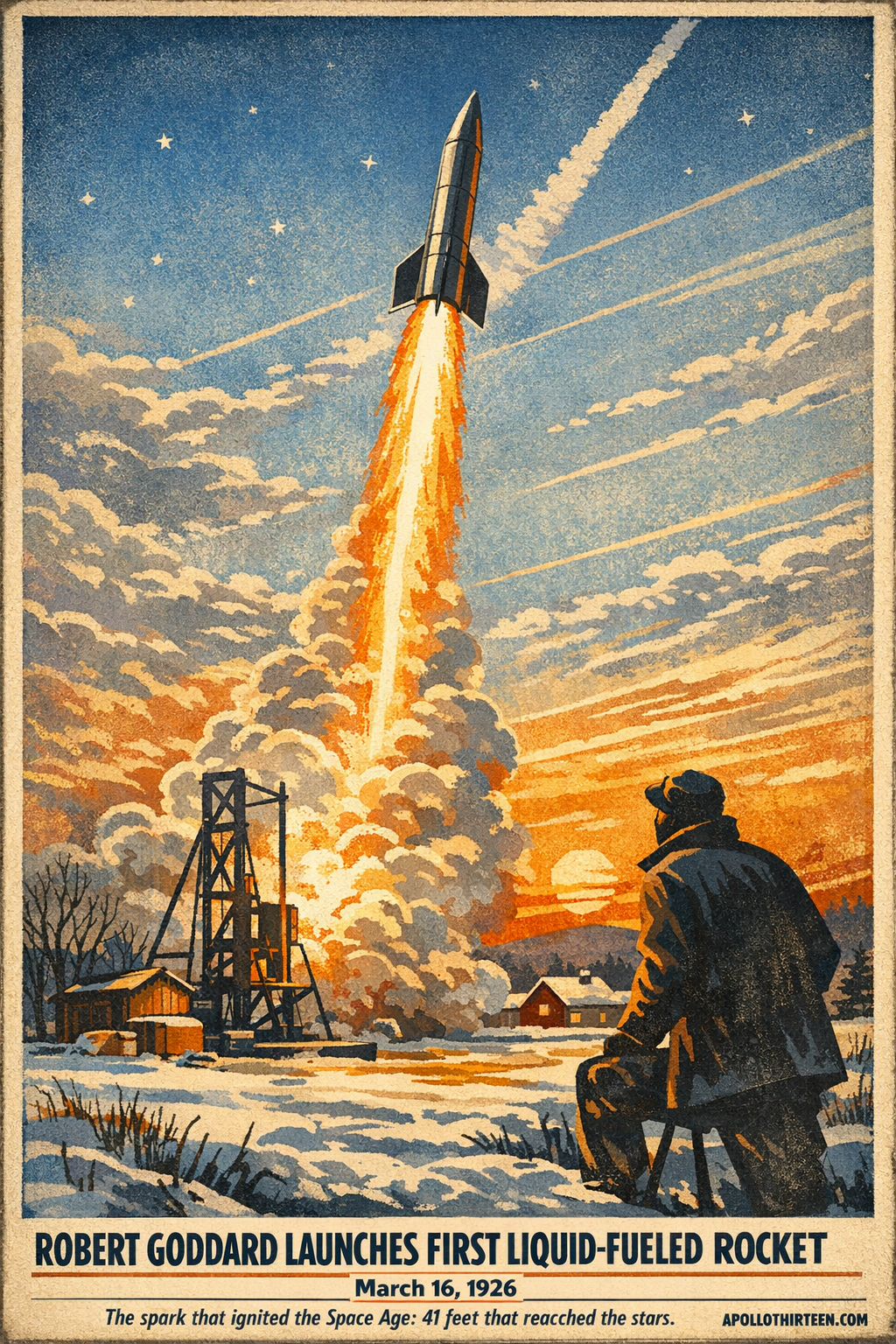
One chilly March afternoon, 100 years ago today, a small, smoking column rose from a cabbage field on the edge of a sleepy New England town and altered the course of human history. It lasted only two and a half seconds. It climbed to no more than 41 feet. It landed in a pile of flattened soil and metal and was destroyed on impact. And yet, in that brief, awkward arc, something that had long lived in the realm of myth and speculation—man-made flight beyond the atmosphere—moved from fanciful idea to practical possibility.
The scene was not a launchpad with cheering crowds and blaring horns but Aunt Effie Ward’s farm in Auburn, Massachusetts: a patchwork of thawing fields, rutted lanes, and an audience of four. The vehicle that rose from the earth was a ten-foot cylinder, a rough-hewn contraption of steel and pipe that looked less like a machine of the future than a backyard experiment. Robert H. Goddard, the engineer and physicist who built it, later called the flight modestly: a test. But that modesty belied the breadth of what he had proven—liquid propellants, properly combined and harnessed, could produce controlled thrust sufficient to lift a vehicle through the air. It was the spark that would, in time, ignite the Space Age.
If you stand at the site today, the surrounding world is unimaginably changed—the Moon has been walked upon, probes have traversed the outer planets, satellites lace the sky. One hundred years ago, those were dreams scribbled at the margins of speculative fiction. Goddard’s rocket barely left the ground. Yet in its soot and noise and brief flight lay the kernel of a technological revolution.
What Actually Happened
On March 16, 1926, at roughly 2:30 p.m., Robert Goddard and three witnesses—his wife Esther, his crew chief Henry Sachs, and Percy Roope, a colleague from Clark University—prepared to fire the first successful liquid-fueled rocket. The vehicle, which Goddard later referred to in notes as "Nell," was a ten-foot-long steel cylinder, fitted with a combustion chamber and nozzle, two small tanks of fuel and oxidizer, and a simple launch cradle on the farm. The propellants were gasoline and liquid oxygen—an energetic pair that required care; liquid oxygen, being extremely cold, meant that handling carried both danger and engineering challenge.
Goddard had already performed static tests; in December 1925 he had run an engine on a firing stand at Clark University that lifted its own weight during a 27-second burn. But a flight test posed new uncertainties: ignition, balance, control, and the interaction of flame and structure in a real-world, windy field.
When the mechanism released, the rocket did not leap immediately. Flames erupted from the nozzle and a steady roar filled the air; for an instant the craft seemed pinned to its cradle. Then it came away, rising slowly, at first, then accelerating until, as Goddard later wrote, it moved with "express train speed." It curved slightly to the left, reached an altitude of about 41 feet, and landed some 184 feet downrange. The impact destroyed the rocket, but the experiment had succeeded: liquid propellants could be used to propel a vehicle.
The flight lasted only 2.5 seconds, but every element mattered. Goddard’s engine had produced a controlled burn; the nozzle directed exhaust; the vehicle had separated from the cradle without catastrophic failure. In a diary entry the next day he recorded the sequence—the roar, the flame, the trajectory—with a scientist’s economy and the quiet thrill of a man who had just proved a stubborn idea true.
There was, however, no instant coronation. No newspapers trailed him, no delegations arrived. The experiment was, in its moment, a modest, almost private triumph—a brilliant candle struck in a barnyard. In truth, it would take years for the wider world to grasp the implications.
The People Behind It
Robert H. Goddard has become a totemic figure in the story of spaceflight: solitary, meticulous, often misunderstood, and tireless. Born in 1882 in Worcester, Massachusetts, he was a quiet child who devoured science and literature alike. By adulthood he had become obsessed with rockets—how they worked, how they might work better, and how they might carry humankind beyond Earth. He was a theoretician and an inventor. As early as 1914 he filed patents for multi-stage rockets and rockets powered by liquid fuels. In 1917, he received a modest grant from the Smithsonian—permission and a little money to keep experimenting.
But Goddard was not a lone genius living in a vacuum. His experiments were supported and enabled by a small band of people who never got the limelight they deserved. Esther Goddard, his wife, was there on that March day and was a constant pillar throughout his years of work: a practical, unflinching partner who handled logistics, paperwork, and the quieter burdens of a life spent on the ragged vanguard of new technology. She kept records, measured results, and shouldered the social consequences of his eccentric pursuits.
Henry Sachs, his crew chief, and Percy Roope, an assistant professor who witnessed the launch, were the other eyewitnesses—men who helped prepare the vehicle, tended the fuel and launch gear, and stood with Goddard in the field as the little rocket rose and fell. Their presence underscores how very small and human the origin story is: four people on a farm, doing the work that would eventually lead to machines that ferry people to orbit and probes to other worlds.
In later decades, other figures would be crucial to the broader adoption of Goddard’s ideas. Charles Lindbergh, newly famous after his 1927 transatlantic flight, was one of the few public figures who recognized the potential in Goddard’s engineering. Lindbergh used his influence to secure support from the Guggenheim family, opening the door to better funding, facilities in Roswell, New Mexico, and a string of experiments that pushed Goddard’s rockets farther and faster. Daniel and Florence Guggenheim, the philanthropists who backed early aviation and rocketry, were less visible in the cabbage field that day but essential to turning one man’s private work into a semi-public program.
And there are the many who followed in Goddard’s wake—engineers, technicians, test pilots, and astronauts—whose lives and careers were shaped by the path he opened. Jim Lovell, who would later fly to the Moon and back, reflected on Goddard’s influence: long before NASA existed, Goddard believed that reaching the stars was not merely fanciful but inevitable. That belief, painstakingly proven in a series of small, tenacious steps, inspired the generations that turned possibility into hardware.
Why the World Reacted the Way It Did
It is tempting now to imagine the flight as an obvious precursor to Apollo rockets and GPS satellites. It was not. In the 1920s, rocketry percolated on the fringes of science and public imagination, at once associated with children’s fireworks, danger, and fanciful fiction. The scientific establishment and the mass media had little appetite for what seemed, to many, a quixotic tinkerer’s hobby.
There were practical reasons for indifference and even derision. Rockets were loud, messy, and unpredictable. Solid propellants—black powder, gunpowder—had centuries of history in fireworks and primitive weapons, but they offered poor efficiency and limited control. The idea of burning a cryogenic oxidizer like liquid oxygen in the open air added complexity and hazard. The equipment required to handle these materials—insulated tanks, valves, cryogenics—seemed extravagant for ambitions that many thought fanciful.
There were also intellectual blind spots. A famous editorial in a prominent newspaper ridiculed the notion that rockets could work in the vacuum of space, declaring it a violation of basic physics. That dismissal was not merely an intellectual error—it stoked a public narrative that rockets belonged more to fantasy than to physics. Goddard, a recluse who preferred meticulous experimentation to publicity, did little to counter the caricatures. He worked quietly, published sparingly, and thus missed opportunities to sway opinion. When he did seek recognition, the response sometimes ranged from indifference to active skepticism.
The limited publicity around the March 1926 launch exemplifies that wider cultural inertia. Local papers showed no interest. The four witnesses went home without parades. Goddard continued his experiments with the same quiet persistence. It would take the intervention of respected figures like Lindbergh and the accumulation of test data over years to change minds.
And yet, the slow crawl of time and the steady accumulation of evidence have vindicated Goddard. The same newspapers that once mocked the possibility of rockets in a vacuum would later issue a correction—after humans had walked on the Moon—admitting error with the crisp line: "It is now definitely established that a rocket can function in a vacuum as well as in an atmosphere. The Times regrets the error." The correction was late, but it underscored how cultural and institutional skepticism can lag behind engineering proof.
What We Know Now
One hundred years on, the science that Goddard pursued is straightforward to explain but born of subtle truths. A rocket produces thrust by expelling mass at high speed; action and reaction, Newton’s third law, do the rest. What Goddard demonstrated was not the abstractness of the law but the practical engineering: that liquid propellants could be stored, fed to a combustion chamber, and burned in a controlled way to produce reliable thrust.
Why liquid? Compared with solid propellants, liquids offer higher specific impulse—the efficiency of converting propellant mass into thrust. They can be throttled, started and stopped, and, in some designs, restarted during flight. Liquid oxygen paired with a hydrocarbon like gasoline (or, in later designs, kerosene or a mix of liquid hydrogen) provides a much greater energy density and control than packed solid propellant. The downside is complexity: pumps, valves, cryogenics, and plumbing introduce potential points of failure.
Goddard’s earliest designs were pressure-fed—simpler than turbo-pumped systems that came later—using pressurized gas to force propellants into the combustion chamber. In March 1926 he used gravity and pressure in a basic configuration; his intent was demonstration and validation, not optimization. He also employed an engine placed above the tanks—an odd configuration by later standards. The modern practice of placing the engine beneath the fuel tanks, which Goddard adopted after the first flights, improves stability: it keeps the thrust aligned with the vehicle’s center of mass and makes control simpler.
Goddard’s later innovations presaged practical solutions to flight stability and control. He developed movable vanes that sat in the rocket’s exhaust to vector thrust, and he experimented with gyroscopes and guidance devices to stabilize flight. These are the same kinds of solutions that would be refined over decades into the complex guidance systems of modern rockets.
By the 1930s, in Roswell, New Mexico, under the sponsorship that Lindbergh and the Guggenheims helped arrange, Goddard launched rockets that reached high speeds, tested different fuels and engine configurations, and demonstrated principles still in use today. His patents—on multi-stage rockets, specific engine designs, and fueling systems—became foundational intellectual property for later American rocket development.
The fundamental physics—engines expelling mass to produce thrust—has not been overturned. What has changed is mastery: we learned how to control combustion, how to pump propellants at extreme pressure, how to guide vehicles past the atmosphere, and how to stitch multiple stages together so that one engine can hand off to another efficiently. Goddard’s small, smoky rocket was an early stitch in that tapestry.
Legacy — How It Shaped Science Today
The image of a ten-foot steel rocket rising from a cabbage field is almost quaint against the backdrop of today’s launches: massive, multi-stage vehicles roaring skyward to deliver satellites, cargo, and humans to orbit and beyond. Yet the lineage is direct. Nearly every modern liquid-fueled rocket can trace an ancestry back to the decisions Goddard tested in the 1920s: use of liquid oxidizers, separate fuel and oxidizer tanks, the combustion chamber and nozzle, and the idea that rockets were not toys or nonsense but tools for conveying mass through empty space.
Goddard’s work also shaped the culture of aerospace engineering: meticulous testing, careful documentation, and incremental refinement. He taught a generation of engineers by example that progress in rocketry required patience, repeated trials, and an acceptance of failure as data. The later successes of intercontinental ballistic missiles, orbital launch vehicles, and crewed spacecraft owe less to mythic leaps and more to a series of small proofs that gradually solved one engineering challenge after another.
There is an irony in how Goddard’s contributions were recognized. He died in 1945, the year rockets were moving from experimental rarities to strategic technology. Much of his legacy gained wider appreciation only after the war, when rocketry’s military and then peaceful applications became evident. In 1966, the Auburn launch site at Asa Ward Farm was designated a National Historic Landmark, a belated nod to the quiet demonstration that had taken place there four decades earlier. Artifacts from those early days, including a nozzle believed to be from the March 1926 program, made their way to institutional collections and museums, where they stand as humble relics of an epochal idea’s infancy.
Beyond hardware and museums, Goddard’s influence is also moral and intellectual. His conviction that rigorous engineering could turn fantasy into fact inspired the human spaceflight generation. Astronauts like Jim Lovell and countless engineers have cited that early work as part of the chain that led to rockets capable of lifting humans to the Moon and probes to the outer planets. The seeds sown in a cabbage field came to bloom across the solar system.
And the story of Goddard reminds us of a broader lesson: transformative technology often begins in obscurity. Brilliant, world-changing ideas may be greeted with indifference or scorn, and timing, funding, exposure, and the temperament of their champions determine how quickly they move from fringes to center stage. Goddard combined stubbornness with meticulous craft, and in doing so created space—literally and metaphorically—for others to follow.
Fast Facts
- Date of launch: March 16, 1926 (100 years ago today).
- Location: Asa Ward Farm (Aunt Effie’s farm), Auburn, Massachusetts.
- Rocket nickname: "Nell" (Goddard’s informal reference).
- Vehicle size: Approximately 10 feet long.
- Propellants: Gasoline (fuel) and liquid oxygen (oxidizer).
- Flight duration: About 2.5 seconds.
- Maximum altitude reached: ≈ 41 feet (12.5 meters).
- Downrange distance: ≈ 184 feet (56 meters).
- Witnesses: Robert H. Goddard, Esther Goddard, Henry Sachs, Percy Roope.
- Later developments: From 1930–1935 Goddard conducted extensive testing in Roswell, New Mexico, with faster flights; his work later supported U.S. rocket development.
- Historical honors: The launch site was designated a National Historic Landmark in 1966.
- Artifact: A nozzle believed to be from the early 1926 rockets was donated to the Smithsonian in 1950 by the Daniel and Florence Guggenheim Foundation.
- Notable quote: After Apollo 11’s success, a major newspaper issued a correction: "It is now definitely established that a rocket can function in a vacuum as well as in an atmosphere. The Times regrets the error."
A hundred years later, the artifacts and formal accolades matter. But the truest measure of March 16, 1926, is less in plaques than in possibility. From that cabbage patch launch grew a century of discovery: satellites that knit the globe, probes that sailed past the outer planets, and human voyages to another world. The machine that rose for 2.5 seconds did not merely pierce a few dozen feet of air; it pierced an intellectual barrier, proof that the practical was possible and the poetic could be engineered.
When Robert Goddard watched his ten-foot rocket stumble and then climb, he was testing an idea. He hardly imagined the scale of what he set in motion. Today, as rockets of hundreds of feet loft payloads into orbit on pad complexes across the globe, and as private companies and public agencies reach for Mars and beyond, there is a persistent echo of that odd little flight in Auburn: small beginnings, careful handwork, stubborn faith in an idea that the world needed time to understand.
The arc that began over a farm field a century ago continues. Each launch now carries with it that history—the long lineage from a gasoline-fed nozzle to cryogenic stages and reusable boosters. Every satellite and every astronaut owes something to the man who lit a flame in a cabbage field and then watched, as if for the first time, the sky opening up.



Comments
No comments yet. Be the first!