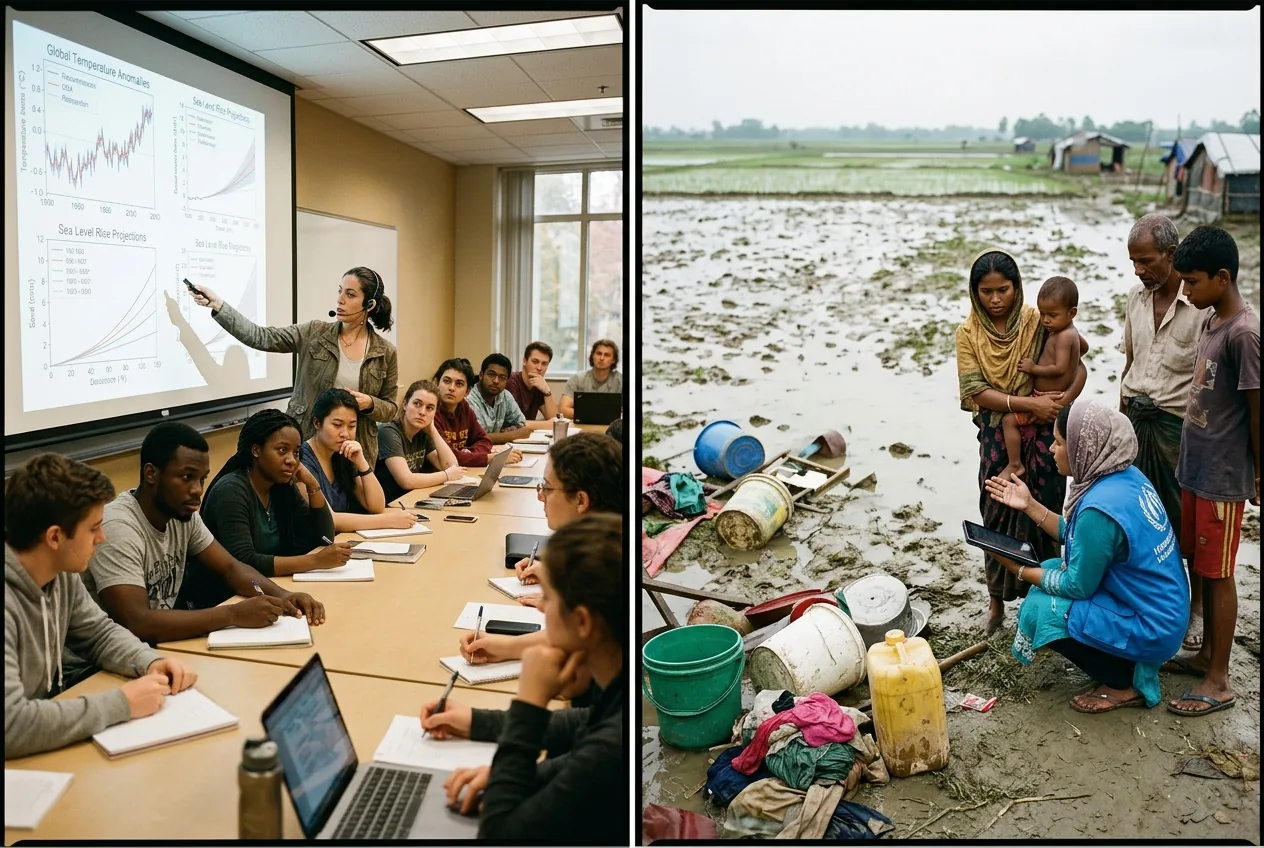
The moment: a number, a classroom, a flooded field
On a conference call this spring, psychologists who run a large international youth survey read out a figure that has been repeating across studies: roughly 75% of respondents say the future feels frightening. That single number has become shorthand for what clinicians and community workers are now calling the climate anxiety crisis: climate worries that are no longer private rumination but a public-health signal. In classrooms from Taipei to Lahore, and in disaster-ruined villages along Pakistan's river plains, teachers and psychiatrists report the same pattern — young people who are aware, often highly informed, and in many cases emotionally overwhelmed.
Why this matters now: shifting harms and stacked risks
The evidence has moved past anecdote. Peer-reviewed surveys and large-scale studies — including a nearly 10,000-person international poll and national academic investigations — show elevated rates of sadness, helplessness, and functional impairment linked to climate concern in the 16–24 age group. At the same time, real-world shocks such as the 2022 and 2025 floods in Pakistan, repeated heatwaves worldwide, and worsening urban heat islands are producing acute trauma, displacement, and disrupted schooling. The result is a layered problem: direct psychiatric consequences from disasters sitting on top of a pervasive, anticipatory dread that changes how a generation plans for work, family and civic life.
Climate anxiety crisis: climate and the new youth morbidity
What is climate anxiety? Clinicians describe it as a mix of eco-grief, anticipatory worry, and trauma symptoms that can include insomnia, intrusive thoughts, panic, and avoidance. It is not a single diagnostic category but a syndrome that surfaces as reactive depression, anxiety disorders, or post-traumatic stress after extreme events. Young people are especially vulnerable because many core mental-health disorders first emerge before age 24; a plastic, learning-focused brain is also an impressionable one. Published work in journals such as The Lancet and PNAS documents both the prevalence and the ways those feelings impair daily functioning — from concentration at school to decisions about having children.
Frontline toll in Pakistan and South Asia
Reporting from Pakistan makes these abstract metrics concrete. Clinicians and aid organisations who worked in Khyber Pakhtunkhwa and other flood-affected districts after the 2022 and 2025 monsoons describe a pattern of prolonged distress: people who cannot sleep because they relive rushing water, parents who fear for their children’s safety, and households pushed into chronic uncertainty by lost harvests and damaged homes. With roughly one psychiatrist for hundreds of thousands of people and mental-health services concentrated in cities, the gap between need and care is enormous. Community-based models — mobile psychosocial teams, trained local counsellors, and telepsychiatry pilots that link remote clinics to specialist hubs — have shown promise, but they remain isolated pilots rather than national capacity.
Taiwan’s quiet disengagement and what it reveals
Not all places show the same emotional profile. Interviews with academics and conservationists in Taiwan reveal high awareness of climate risks alongside a surprising emotional detachment in many young people. Several university professors said students know about rising seas and extreme heat but are often more focused on immediate concerns like exams, jobs and urban life. The reasons are sociological: information overload, a political culture that prioritises economic development, and a sense that big institutions will absorb responsibility. That relative emotional disengagement is not evidence of resilience so much as a different stress pathway: knowledge without political or institutional avenues for meaningful action can calcify into apathy or cynicism.
Climate anxiety crisis: climate, weather shocks and delayed care
There is a temporal dimension to the problem. Studies tracking adolescents after disasters show that mental-distress spikes in the two years following a shock and remains elevated for years in some communities. Heat, drought, and flooding produce immediate trauma and longer-term chronic stress through loss of livelihood and increased poverty. When public budgets are tight, disaster recovery focuses on shelter and infrastructure while psychosocial needs are pushed to the margins. That policy lag matters because delayed care turns anguish into chronic disorders that are harder and costlier to treat later on.
Why young people are uniquely vulnerable — and yet uniquely mobilised
Several mechanisms make youth both more exposed and more reactive. First, biological timing: a large share of lifetime mental-health conditions manifest in adolescence or young adulthood. Second, perception and information: many young people are highly literate about science and climate reports, and their constant exposure to media amplifies worry. Third, justice and identity: the youngest cohorts are inheriting decisions they had no role in making, and that fuels anger and grief. Paradoxically, those same factors also drive activism. Studies show a substantial fraction of youth channel anxiety into organized action — protests, community projects, and demands for policy change — which can offer psychological benefits even when political outcomes lag.
Policy and health-system gaps: who pays and what’s missing
The institutional picture is bleak where governance is weakest. In low- and middle-income settings, disaster management units are under-resourced and mental-health infrastructure is thin or absent. Even in wealthier countries, services are unevenly distributed and school-based mental-health programmes are not scaled to meet climate-related demand. National strategies often acknowledge psychosocial needs but rarely fund the workforce needed to deliver them at scale. The result is a systemic blind spot: policy documents include mental health as a line item, but budgets, training pipelines, and monitoring systems do not reflect the scale of the problem.
Practical responses families, schools, and communities can use now
Families and schools are often the first and most effective line of defence. Simple, evidence-based steps include creating space for discussion rather than dismissal; recognising signs such as frequent insomnia, withdrawal, pervasive worry about the future, and avoidance of climate-related topics; and connecting young people to trusted adults and counsellors. Teachers and school nurses can be trained in psychological first aid and in spotting students whose academic decline masks climate-related distress. Community networks — religious centres, youth groups, and environmental NGOs — can host climate cafés and peer-support sessions that translate abstract concerns into collective action, which reduces helplessness.
Clinical and therapeutic options that work
On the clinical side, trauma-informed care, cognitive-behavioural approaches adapted for eco-distress, and group therapy models have been useful. Telehealth and task-shifting — training community health workers to deliver basic psychosocial support and triage higher-need cases to specialists — have shown measurable impact in remote and disaster-affected areas. Clinicians emphasise the need for "climate-aware" therapy: interventions that validate grief, foster agency, and build practical coping skills rather than simply reframing worry as irrational. Where possible, combining mental-health support with economic or housing assistance reduces the upstream stressors that perpetuate anxiety.
Power, responsibility and the path ahead
The climate anxiety crisis: climate-related distress is not only an individual problem; it is a symptom of political and institutional failure. Young people sense the mismatch between scientific warnings and policy response, and that distrust amplifies emotional harm. Filling the gap requires more than funding therapists: it needs better disaster planning that embeds psychosocial care, school curricula that treat climate literacy and emotional resilience as linked, and governance that offers meaningful avenues for youth participation. Without those pieces, clinicians will keep treating symptoms while the social drivers go unchecked.
The genome is precise; the world it lives in is anything but. If policymakers want to stop turning climate worries into lifetime disorders, they must treat climate anxiety as both a clinical and political problem — and stop pretending it will vanish if we simply improve our messaging.
Sources
- Proceedings of the National Academy of Sciences (PNAS) (survey and analysis papers)
- The Lancet (international youth climate survey)
- Drexel University School of Public Health (Preventive Medicine Reports study on adolescents)
- Imperial College London (Climate Care Centre research)
- University of Nevada School of Medicine (clinical perspectives on youth mental health)
- National Cheng Kung University (teaching and outreach observations from Taiwan)
- National Taiwan Normal University (field teaching and student interviews)
- Pakistan National Disaster Management Authority (NDMA) projections and reports




Comments
No comments yet. Be the first!