A wet refrigerator, an accidental discovery and a winter story for the ages
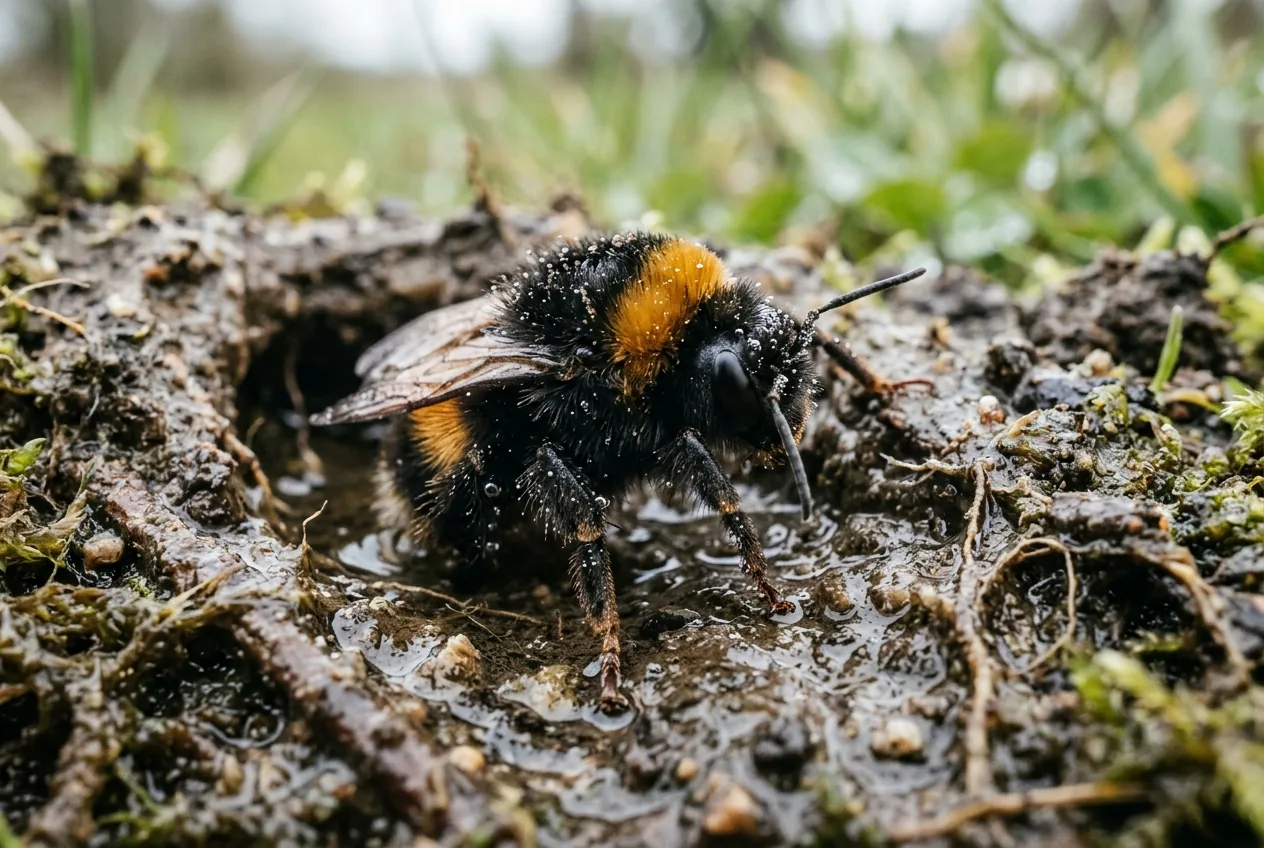
It began as a routine lab check. Researcher Sabrina Rondeau opened a shelf of soil-filled tubes, expecting the usual handful of dead or sluggish insects after a winter diapause experiment. Instead she found several queen bumblebees completely submerged in condensation and, to her surprise, alive. That serendipitous moment has now grown into a paper in Proceedings of the Royal Society B that documents how diapausing queen bumblebees can remain physiologically active while underwater for days—an example scientists describe as resilience environmental extremes in the queen bumblebee.
The detail matters. These queens were placed in cold, dark conditions that mimic winter diapause, then intentionally flooded in controlled chambers. Across exposures that ranged from a few hours up to eight days, the insects continued to generate carbon dioxide at low but measurable rates and accumulated lactate—evidence of a mixed aerobic/anaerobic metabolism that let them survive submerged conditions. For a species where the queen is the only stage that overwinters and founds the spring colony, this is not trivia: a drowned queen is an entire colony lost next season.
Resilience environmental extremes: queen physiology underwater
The study’s physiological takeaways are compact and surprising. Submerged queens did not simply drop into metabolic blackout; they produced carbon dioxide continuously at a reduced rate while in water, indicating ongoing gas exchange. Simultaneously, the insects used anaerobic pathways and accumulated lactate, which then required a multi-day metabolic recovery once they were removed from the water. The measured post-submergence spike in metabolic rate—lasting two to three days—looks like a cleanup bill the queen must pay for surviving the flood.
Those data point to two linked capacities: the ability to sustain minimal aerobic respiration while submerged and a tolerance of anaerobic metabolism during prolonged low-oxygen periods. The exact anatomical or physical mechanism that permits underwater gas exchange was not spelled out definitively in the paper. The authors emphasize the physiological evidence (CO2 output and lactate levels) rather than claiming they have observed a particular respiratory trick; whether queens use micro air films, altered spiracle control, or some cutaneous gas diffusion remains unresolved and a clear next step for researchers.
A lab accident that became a field-relevant experiment
Serendipity is an honest pathway to discovery in ecology. The work reported here grew from a chance observation in an experiment on pesticides, when condensation-filled tubes left several queens underwater. The team followed up with deliberate, controlled submergence in the laboratory and careful metabolic measurements. That design gave them two advantages: repeatable conditions and the ability to record physiological markers over time, including carbon dioxide production and lactate accumulation.
Because the queens were induced into diapause in cold, dark chambers, the conditions approximate what queens face in shallow winter burrows: low temperature, low metabolism and, at times, sudden immersion as snow melts or heavy rains flood soil. The experiments therefore bridge a lab observation and a plausible field scenario rather than presenting an exotic laboratory artifact divorced from the bumblebee’s ecology.
Resilience environmental extremes: ecological and conservation stakes
The ecological punchline is straightforward: queen survival over winter is the linchpin of future colony presence and local pollination services. Many bumblebee species overwinter only as queens, often in shallow soil scrapes or vegetated litter that are vulnerable to winter rain-on-snow events and spring thaws. If queens routinely drown when burrows flood, local populations could drop abruptly; if they can endure submergence for days, that provides a buffer against increasingly erratic precipitation patterns linked to climate change.
How the queen’s role shapes risk
Understanding this trait matters because the queen carries an outsized ecological responsibility. A single queen that survives to spring can re-establish a colony that provides weeks of pollination in agricultural and wild plant communities. Conversely, a landscape-level failure of overwintering queens translates into fewer colonies, poorer pollination services and potential crop losses. The physiological resilience to short-term flooding reduces one vulnerability, but it does not remove the management and policy problems that determine whether queens have access to good overwintering habitats at all.
Field-level consequences are therefore not simply biological questions but land-use and policy issues. Where do queens choose to dig? Are traditional overwintering microhabitats being paved, tilled, or compacted? Are pesticide regimes reducing fat accumulation before diapause and thereby lowering the odds a queen can survive a submerged spell? These are the kinds of cross-scale questions that turn a lab paper into a practical conservation agenda.
Limits and open questions scientists want answered
Good science is the polite admission of what remains unknown. The lab study measured metabolism and lactate but did not fully map the anatomical pathway of underwater gas exchange, nor did it test a wide range of bumblebee species. Species differences matter: the experiment used queens of certain bumblebee taxa, and it would be premature to generalize to every Bombus species across continents and climates. Likewise, lab-controlled submergence and field flood dynamics are not identical—oxygen levels, temperature, soil chemistry and microbial communities vary in ways that could change survival outcomes.
Practical implications for monitoring, beekeeping and policy
For beekeepers, land managers and conservationists the message is nuanced. This finding does not mean queens are invincible to flood risk; it means they have a physiological safety margin that can buy time. Conservation actions that preserve or create dry overwintering refuges—undisturbed grass tussocks, hedgerow bases, and coarse litter layers—remain worthwhile. At the same time, monitoring programs that track overwintering mortality and spring colony founding would help convert this laboratory result into an actionable indicator for managers.
Policy levers also matter. Agricultural practices that improve floral abundance into autumn (boosting queen fat reserves), restrictions on pesticides that impair overwintering condition, and landscape measures that reduce rapid runoff and erosion could all alter how often queens encounter life-or-death submergence events. In short, the physiology buys time; management choices determine whether that time will be enough.
The queen survives in the waterlogged burrow; whether the landscapes we shape let her survive the next season is another question entirely.




Comments
No comments yet. Be the first!