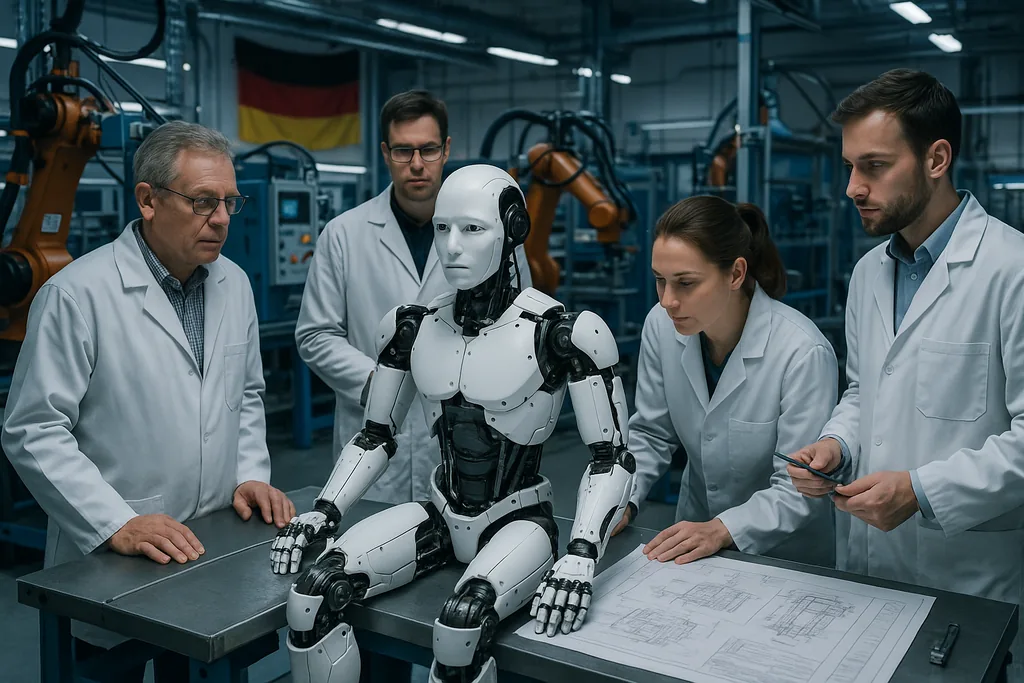
Germany’s Neura Robotics raise lands at the centre of a high‑stakes tech push
germany’s neura robotics raise: deal terms, valuation and context
The reported round, described in contemporaneous coverage, would make Neura one of Europe’s best‑funded humanoid efforts. People familiar with the matter told news outlets that the investment would be backed by Tether Holdings SA. Neura itself has previously disclosed strong commercial interest—CEO David Reger said the company had nearly $1 billion in purchase orders from industrial customers—and it raised €120 million in early 2025 from a syndicate led by Lingotto Investment Management, the investment arm of Exor. A fresh €1 billion check is being framed inside the company’s stated ambition to scale manufacturing and to develop a software and services platform the firm calls Neuraverse.
Although coverage lists headline numbers and a possible €4 billion valuation, the fine print of private rounds often changes before close: allocation between primary growth capital and secondary liquidity, investor protections, and any staged tranche structure will matter for control, governance and follow‑on financing. For Neura that matters because turning humanoid prototypes into reliable, safe production units requires capital for factories, supply chains, safety certification and staff—areas where a large strategic backer can accelerate timelines but also influence corporate strategy.
germany’s neura robotics raise: what Neura builds and how it sells it
Neura Robotics was founded in 2019 with the aim of developing what it calls cognitive robots: machines that combine cameras and sensors, real‑time control, and machine learning so they can perceive, reason and act in human environments. The company’s stated approach puts hardware and software in a single product stack—sometimes described internally and in investor materials as a “smartphone with arms and legs.” That stack includes robot bodies, actuators, perception systems and Neuraverse, the cloud and edge platform for deploying and updating robot behaviour.
On the commercial side Neura has targeted both industrial customers and later‑stage commercial markets. The company says it already has purchase commitments from major automation vendors, and news reports have named Kawasaki Heavy Industries and Omron among early customers or partners. That order pipeline—if genuine and firm—would likely focus initial deployments on logistics, assembly and inspection tasks where humanoid form factors can be used in environments designed for humans, avoiding expensive retooling of existing facilities.
Tether’s involvement and how the investment is likely to work
Coverage identifies Tether—the company behind the USDT stablecoin—as a backer in the round, but public reporting so far describes the connection as backing rather than full‑disclosure of legal terms. In prior transactions where corporate treasuries or crypto‑era firms invest in startups, commitments can take forms such as direct equity, convertible instruments or participation via affiliated investment vehicles. The reports do not publish a definitive mechanics sheet for this deal, and private financing often uses multiple vehicles to accommodate regulatory, tax and balance‑sheet considerations.
Tether’s name draws attention because it is a major player in the crypto ecosystem and because critics frequently press for greater transparency around large corporate treasuries. From Neura’s perspective, a deep pocketed investor that is prepared to fund manufacturing scale‑up is attractive; from public policy and governance perspectives, the provenance and conditions of the capital are important to understand when a technology has potential dual‑use consequences.
Commercial rollout, timelines, and the question of deployment
When might Neura’s humanoids appear in real, paying operations? The short answer is: in stages. Robots designed for logistics and light manufacturing typically face fewer regulatory and safety hurdles than robots intended for consumer interaction or defence applications. Given the company’s claimed order book with industrial partners, the earliest deployments are likely to be in controlled manufacturing lines and warehouses, where integrators such as Kawasaki and Omron can add Neura units to existing automation suites.
Scaling to hundreds or thousands of units requires building production capacity, supply‑chain resilience for actuators and sensors, and operational tooling for software updates and remote monitoring. Investors who write large growth checks usually expect a multi‑year ramp: prototypes and pilot fleets in months to a couple of years, and broader commercial availability on a three‑to‑five‑year horizon—conditional on successful qualification and a stable parts supply.
Safety, ethics and the idea of an "AI humanoid army"
Headlines that phrase the project as building an “AI humanoid army” capture public anxieties but risk conflating distinct issues. Neura’s product roadmap, as described in company statements and reporting, centres on industrial and service use cases. However, the same physical capabilities that make humanoids useful—mobility in human spaces, dexterous manipulation and perception—are potentially dual‑use. That raises ethical and policy questions about weaponisation, autonomous decision‑making, accountability and export controls.
Scholars and civil society groups emphasise three overlapping concerns. First, safety engineering and verification: robots operating around people must demonstrate robust fail‑safe behaviour and explainable control logic. Second, labour and economic impact: replacing human tasks at scale changes workforce dynamics and requires planning for reskilling and social policy. Third, governance of dual use and defence applications: states and companies must negotiate export restrictions, procurement rules and norms to prevent misuse. Public debate will be critical as humanoid platforms become more capable and more widely deployed.
Why Tether might fund robotics and what it signals
Why would a firm associated with stablecoins back robotics? For corporate treasuries with large liquid holdings, diversifying into private technology investments is a strategic choice: equity in high‑growth hardware firms can offer long‑term upside and strategic exposure to industrial innovation. For Neura, a backer with large resources can underwrite factory builds and early production losses—an attractive proposition for a capital‑intensive hardware company.
The optics of a crypto‑era investor in advanced robotics also matters. It draws scrutiny from regulators, customers and other investors who may question governance, sanctions compliance, and transparency around fund sources. For an industrial robotics company selling into regulated sectors, investor provenance can affect customer decisions and public acceptance—another reason the details of any deal will be watched closely.
Practical uses, timelines for deployment and policy implications
Practical use cases for humanoid robots are already visible: repetitive or ergonomically risky tasks in logistics and assembly, inspection in constrained spaces, and task support in healthcare settings such as lifting assistance or supply movement. Defence uses are technically feasible but institutionally sensitive; military adoption typically requires bespoke specifications, long procurement cycles and legal frameworks for autonomy—factors that push defence deployments later than industrial ones.
In sum, germany’s neura robotics raise, as reported this week, would be a major step toward industrialising humanoid robotics in Europe. The move highlights the tension between large, rapid private financing and the deliberate public conversation needed to govern a technology that could reshape work, industry and national security.
Sources
- Neura Robotics (company statements and commercial disclosures)
- Tether Holdings SA (corporate filings and investor materials)
- Kawasaki Heavy Industries and Omron (customer and partnership announcements)
- Lingotto Investment Management / Exor (investment records for Neura's January 2025 financing)




Comments
No comments yet. Be the first!