Four people in a small capsule and a number that matters
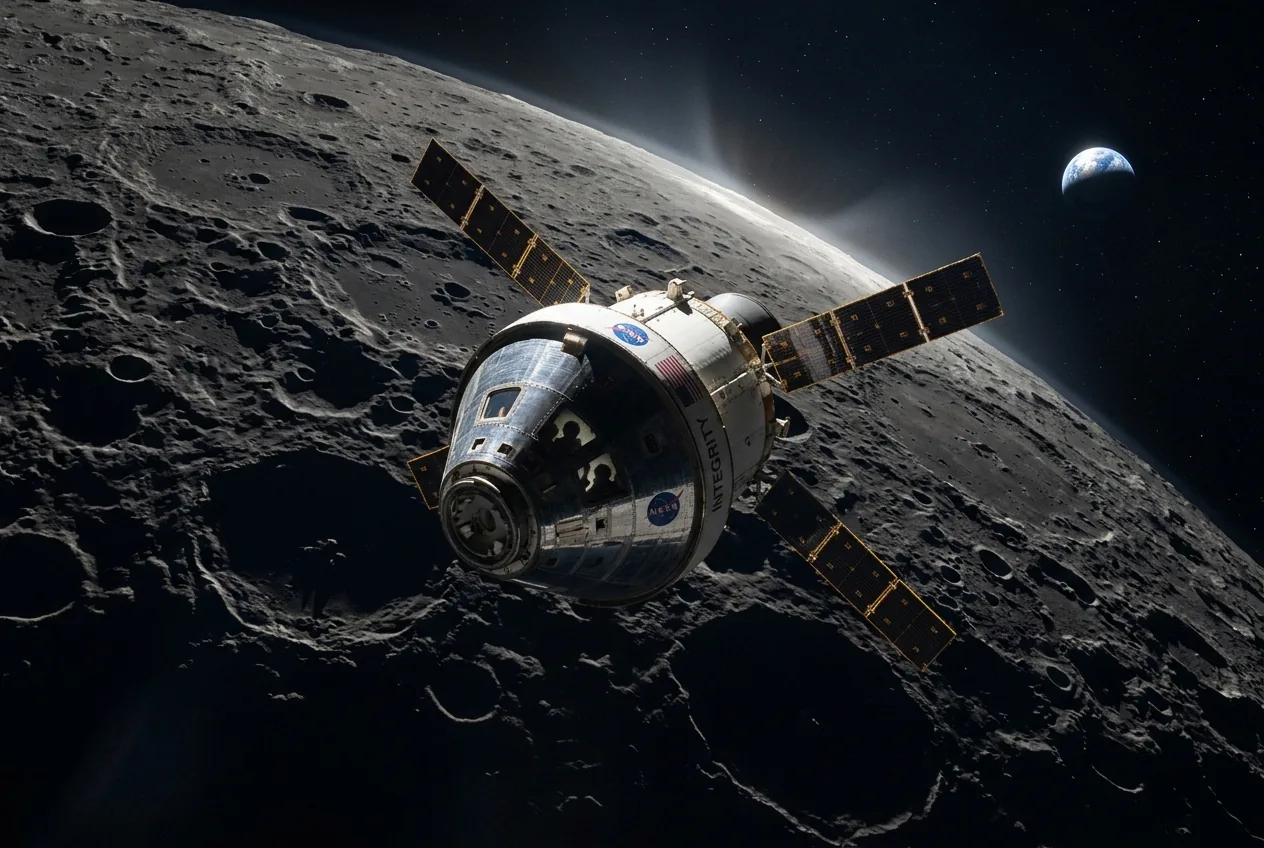
On April 6, 2026, NASA's Artemis II crew — Reid Wiseman, Victor Glover, Christina Koch and Canadian Jeremy Hansen — passed a quiet, technical milestone: they became the humans who have gone farthest from Earth. During their free‑return lunar flyby the Orion capsule reached roughly 252,756 miles (about 406,773 km) from home, eclipsing the Apollo 13 mark of 248,655 miles set in April 1970. The distance record is the kind of headline that sounds like nostalgia; the real interest is in the why and how: artemis astronauts travel farther because of a specific trajectory and a calendar that favoured physics over brute force.
Why the record matters now — more than a trivia point
This isn't simply a stunt. Artemis II was a systems dress rehearsal: a crewed check of Orion, mission operations, communications handoffs and observation procedures that will have to work for Artemis III and beyond. The mission put humans back beyond low‑Earth orbit for the first time since 1972, proved operational procedures during a planned 40‑minute loss of signal behind the Moon, and returned photographs and live observations of lunar regions rarely — or never — seen with human eyes. For policy and industry the milestone matters because it signals progress: NASA is testing hardware and crews on trajectories that will be used to return people to the lunar surface and, in time, to build a sustainable lunar architecture. It also means a new generation of students and engineers can point to a current mission rather than a museum photograph when they pick a career, which is exactly what university outreach teams were saying this week.
How artemis astronauts travel farther: timing, trajectory and gravity
There are three simple, non‑romantic reasons Artemis II beat the Apollo distance record, and none of them are "more powerful rocket" in the naïve sense. First, trajectory: Artemis II followed a free‑return profile — the same trick Apollo 13 used — which routes the spacecraft out past the far side and then lets lunar gravity bend the path back to Earth without requiring a big insertion burn. Second, timing: the mission's lunar encounter happened when the Moon was near apogee, the furthest point in its elliptical orbit, so the spacecraft's farthest point from Earth sat on top of an already larger Earth‑Moon separation. Third, orbital mechanics and the carefully timed trans‑lunar injection: engineers fired Orion's propulsion at the optimal moment in the spacecraft's Earth‑bound arc, getting the largest change in the spacecraft's orbit for the smallest fuel cost. Put together, those three factors let Newton do the heavy lifting.
Trajectory choices vs. raw rocket power: a practical comparison
It's tempting to compare modern rockets to the Saturn V in headlines, but that comparison misses the operational point. Thrust and total fuel load matter for lifting mass into space, but they do not by themselves determine how far a crewed capsule will be from Earth at a particular moment. Artemis II launched on a modern Space Launch System stack and Orion, supported by the European Service Module, used a planned boost and then an efficient mid‑course burn timed relative to Earth's gravity well. By choosing a free‑return flyby rather than insertion into lunar orbit, mission designers accepted a mission profile that intentionally places the capsule farther from the Moon's near side — and therefore, at the far side of that geometry, a little farther from Earth than many Apollo missions did. In short: smart timing and trajectory choices beat brute thrust for this particular record.
What the crew actually did and saw during the record swing
The milestone occurred during a six‑plus hour observational window as Orion arced behind the Moon. The capsule's closest approach to the lunar surface was roughly 4,067 miles (≈6,547 km) — a long way above the terrain, but close enough for the crew to peer at the far side with handheld cameras and to spot transient phenomena. During the planned blackout the spacecraft reached its maximum distance from Earth and later re‑established contact, reporting dramatic views: an hour‑long solar eclipse visible only to the crew, Earthrise from the far side, and multiple impact flashes on the lunar surface. These human observations — described in real time to Mission Control — are part of the mission's scientific and outreach value, and they show why mission timing and crew procedures are as important as propulsion calculations.
Supply chains, Europe's stake and a German‑flavoured industrial angle
How far will Artemis II travel, when did it launch, and what's next?
The capsule's maximum distance from Earth on April 6 peaked at approximately 252,756 miles (≈406,773 km), about 4,100 miles beyond the Apollo 13 high‑water mark. Artemis II launched on April 1, 2026, and is scheduled to splash down back on Earth around April 10, completing roughly a ten‑day mission. Its stated objectives were pragmatic: validate Orion's life‑support and communications with crew aboard, exercise mission control procedures during the loss‑of‑signal behind the Moon, and collect human‑observed imagery and science data during the flyby. The mission is a stepping stone: Artemis III is aimed at testing rendezvous with a commercial lunar lander and — if schedules hold — Artemis IV is the next planned lunar landing window in the second half of the decade.
What the record does — and doesn't — imply for future human exploration
Breaking a distance record is a neat historical footnote, but it should not be mistaken for a capability ceiling. The Artemis II profile maximised distance because that matched the mission requirements: safe test of systems, low fuel usage, predictable return. Sending humans farther (for example to lunar L2 or on longer cislunar missions) is entirely feasible, but it trades off mission duration, radiation exposure, life‑support logistics and political appetite. For Europe and Germany the tactical task is obvious: keep building reliable modules and avionics, but also push for clearer, long‑term funding commitments so industry can scale without stopping and starting. The Moon will keep its calendar; politics and industrial strategy must learn to keep up.
Small human moment to finish: the astronauts radioed home that the sight of Earthrise and the eclipse felt like a reset button on perspective. Records get headlines; perspective changes careers.
And if you want the slightly wry industrial one‑liner — Germany has the machinery, Brussels has the paperwork, and Newton still decides when you get the best headline.
Sources
- NASA (Artemis II mission updates and mission status)
- European Space Agency (Orion European Service Module contribution)
- Iowa State University (Inside Iowa State coverage of Artemis II outreach and education)



Comments
No comments yet. Be the first!