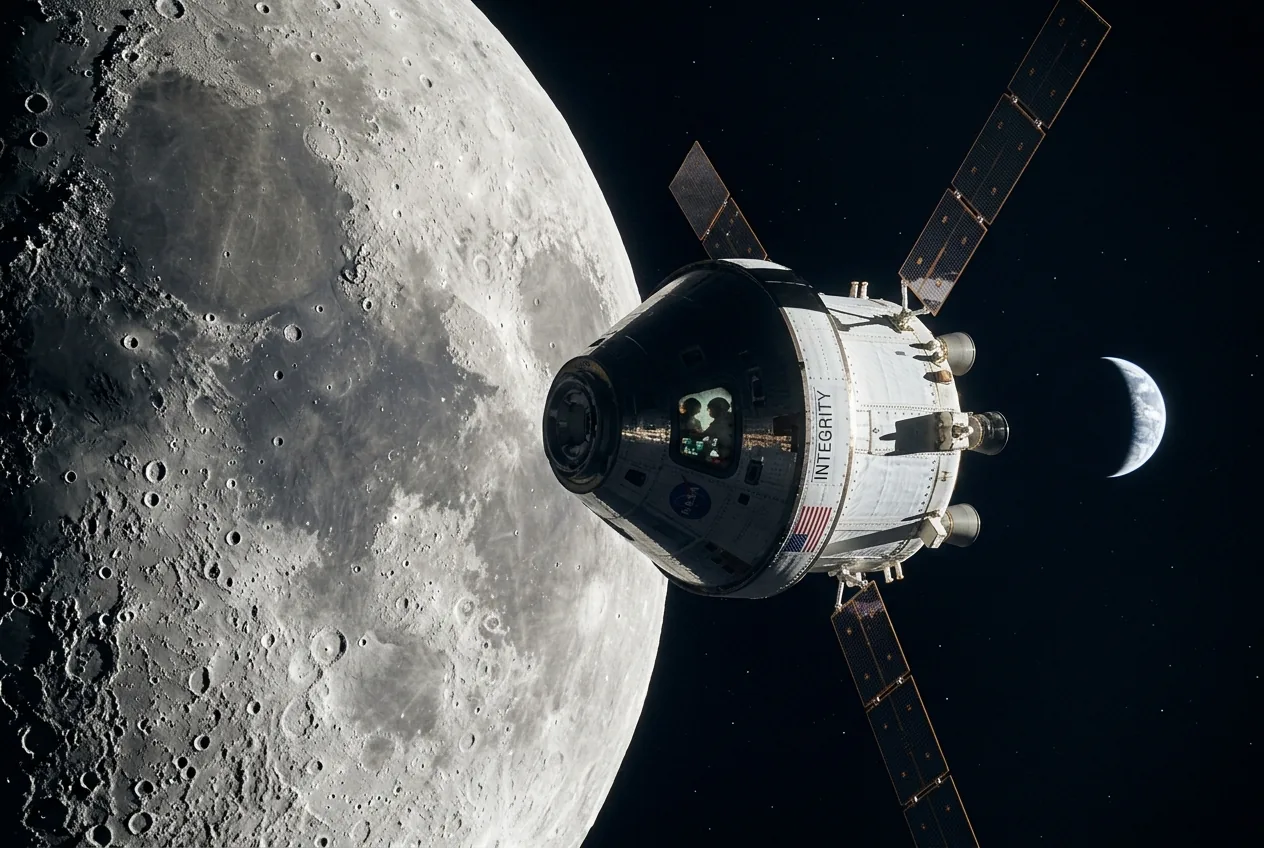
Artemis astronauts head home after a record-setting lunar flyby
The Orion capsule Integrity has turned its nose toward Earth and begun the four-day trip home, carrying Commander Reid Wiseman, Pilot Victor Glover, Mission Specialist Christina Koch and Canadian Space Agency astronaut Jeremy Hansen. The phrase "artemis astronauts head home" flashed across mission feeds on Tuesday as the crew left the Moon's gravitational neighbourhood after a flyby that set a new distance record — about 252,756 miles from Earth, roughly 4,100 miles beyond the Apollo 13 mark from 1970. Launched on 1 April, the 10-day test flight is scheduled to end with a Pacific splashdown near San Diego on Friday evening.
For a few breathless hours the four were the only humans with an unmediated view of large tracts of the Moon's far side. They also finished the flight's primary business: testing Orion's systems with a live crew on board — manual piloting, life support, navigation and the new deep-space toilet all saw in-flight checks. Mission controllers in Houston called back and forth with the crew through tight windows of contact; there was, as planned, a roughly 40-minute blackout while Orion slid behind the Moon.
How artemis astronauts head home shapes the roadmap to a lunar landing
The importance of this return leg is practical, not ceremonial. Artemis II is explicitly a rehearsal: it does not attempt a landing but validates the procedures, hardware and human factors that will have to work flawlessly when crews finally descend to the lunar surface in the latter half of the decade. During the mission the astronauts practised manual control of Orion, tested life-support routines and performed return-trajectory burns on a free-return path — the same gravitational figure-eight manoeuvre that served Apollo 13 in an emergency and that Artemis II used deliberately to minimise propellant risk.
What the crew did on the far side: cameras, colour notes and an eclipse
During the multi-hour observation window the four astronauts split into pairs and worked through an annotated target list of about 35 geological sites. Their human eyes and handheld cameras recorded colour contrasts and textures that spacecraft cameras and orbital sensors can miss. NASA scientists emphasised that human perception remains valuable for picking out nuances in illumination and subtle albedo differences, which can hint at mineralogy and surface age in ways that automated imaging sometimes obscures.
Highlights from the flyby were concrete: the crew photographed the Orientale Basin in full for the first time as humans, watched an hour-long total solar eclipse from a vantage point unreachable on Earth, and reported several impact flashes — short-lived bursts of light from small meteoroids striking the lunar surface. Those flashes, heard about in Mission Control and later confirmed by the science team, matter because they provide direct, time-stamped examples of the Moon’s ongoing bombardment and help calibrate impact-rate models used to date surface features.
On the operations side the astronauts practised donning suits mid-flight and ran through emergency procedures while testing Orion’s manual piloting during trajectory correction burns. NASA also trotted out one of the odder test items: the Universal Waste Management System, the mission’s deep-space lavatory, which had a few hiccups earlier in the flight but was declared nominal for the return. None of the headlines about glamour hide that much of the mission’s value will be judged on mundane systems that have to work every time.
A far-side view that matters to scientists — Orientale, impacts and new colour notes
The crew’s descriptions of "shades of browns and blues" and the identification of very fresh, bright micro-craters will feed laboratory spectroscopy and orbital datasets. That human–machine duet — astronauts calling what they see, scientists on the ground queuing camera settings and annotation — is one of Artemis II’s designed experiments. The data will influence landing-site prioritisation when planners pick zones near the lunar south pole for Artemis III and future missions. In short: those little colour notes could eventually change where boots touch down.
European stakes: industry, data and the politics of being seconded to the Moon
For Europe the mission is both an opportunity and a bureaucratic headache. ESA and individual European contractors supply components and subsystems to Artemis and to associated lunar lander work; the political promise is that European astronauts will fly on later Artemis missions. But industrial-policy reality remains a tangle. Germany has manufacturing capability and a deep supply chain in avionics and propulsion test hardware, while Brussels supplies funding frameworks and diplomatic heft. Neither alone is enough.
From a security and trade perspective the Artemis cadence also bumps against export-control regimes and procurement rules. European firms hoping to win work on future landers or on lunar infrastructure need clear, long-term contracts; yet the U.S. approach mixes commercial awards with NASA-directed procurement, creating timing and compliance headaches for firms outside the United States. The European role will therefore depend on whether ESA negotiators can turn goodwill and expertise into binding industrial work packages without losing domestic political capital in member states.
Uncertainties, trade-offs and the quiet things engineers worry about
Engineers quietly note the mission's trade-offs. A free-return trajectory buys safety at the cost of time on target near the Moon; photographic windows are short and highly dependent on illumination geometry. Human observers add judgment and serendipity but cannot replace continuous, high-cadence orbital instruments. There are also scheduling risks: Artemis III, the first landing attempt in the current sequence, still depends on delivery of new landers and suits whose schedules are tight. NASA’s decision to pause Gateway development complicates orbital servicing architecture and may shift more pressure onto ground-up commercial landers.
Then there is politics. Timetables are optimistic and budgets are finite. Europe’s involvement, which is politically desirable for both sides, will hinge on who pays for what, who builds which components, and how export controls are navigated. The Artemis II return will give engineers more empirical data to reduce technical uncertainty, but it cannot change calendars on a ministerial clock.
Homecoming and what comes next
When the capsule splashes down later this week, that will answer some simple public questions: yes, Artemis II flew around the Moon and returned to Earth; the mission lasted ten days and will be judged a success if Orion, its crew and the data come back in good order. The crew performed the tasks NASA set for them: they tested Orion with humans aboard, executed observations the agency wanted, practised manual piloting and returned with photos and notes that scientists will pore over for months.
Beyond the immediate returns, Artemis II’s true value is in reducing unknowns. It hands engineers a shorter list of "what ifs" for Artemis III and later landings. It also hands policy teams a new reality: there is political appetite for lunar activity, but turning that appetite into sustainable European industrial participation will require more than optimism. As one European space official dryly noted in the run-up to the mission, "Europe has the machinery; Brussels has the paperwork; someone still needs to cart the helium for the test rigs."
Expect the next few weeks to be busy: science teams will catalogue imagery and voice transcripts, flight ops will unpack procedural learnings, and procurement officials in Europe will re-run spreadsheets. The headline images and the eclipse footage will be the public memory; the small, technical fixes will be the actual currency for the programme's future.
For now, the Orion crew is on its way home with thousands of pictures, a few human impressions that already sound like poetry, and the concrete hardware test results engineers need. Whether that will be enough to keep Artemis on its fastest possible timetable depends on politics and contracts as much as it does on engineering. But for one quiet technical community in Houston and several noisy control rooms in Europe, the important sentence for the record is simple: the artemis astronauts head home with their ship intact and a long to-do list that finally looks tractable.
They brought Earth back with them in a tiny window — and that image, more than any speech, is likely to shape the next decade of lunar policy and industry.
Sources
- NASA (Artemis mission pages and Johnson Space Center mission operations)
- Canadian Space Agency (crew information and mission statements)
- European Space Agency (industrial and partnership briefings)




Comments
No comments yet. Be the first!