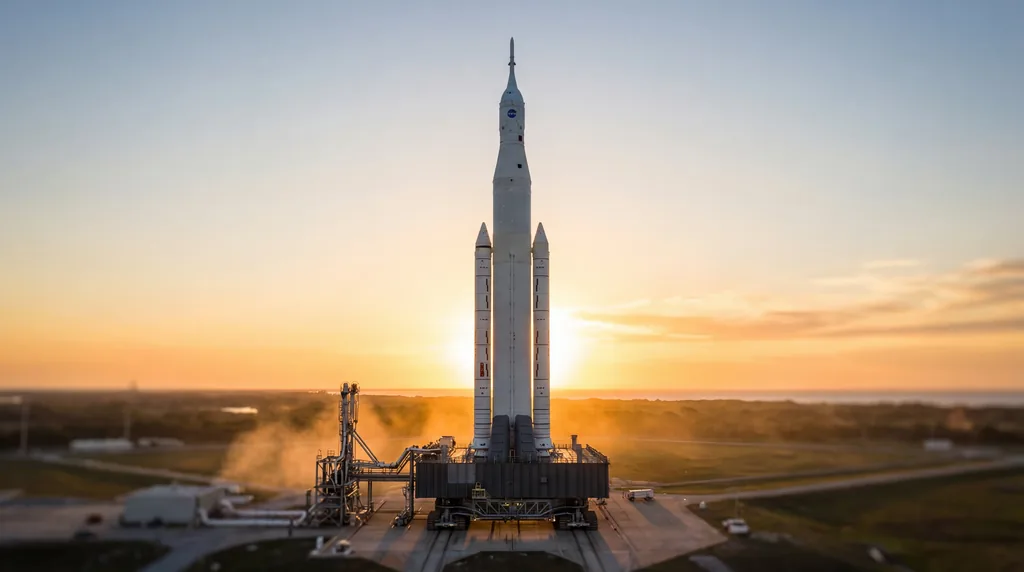

Artemis 2 Returns to Launch Pad as NASA Sets Sights on April Crewed Mission
NASA has successfully returned the Artemis 2 Space Launch System (SLS) rocket and Orion spacecraft to Launch Complex 39B at the Kennedy Space Center, signaling the final phase of preparations for the first crewed mission of the Artemis program. The mobile launch platform emerged from the Vehicle Assembly Building (VAB) at 12:20 a.m. Eastern on March 20, 2026, completing the four-mile journey to the pad 11 hours later. This critical move positions the agency for a highly anticipated launch attempt as early as April 1, following a series of technical delays and hardware rectifications.
Why was the Artemis 2 rocket rolled back to the Vehicle Assembly Building?
NASA technicians rolled the Artemis 2 rocket back to the VAB to resolve a critical helium flow blockage detected within the vehicle's upper stage. Engineers identified that a dislodged seal in a quick-disconnect line was obstructing the flow of helium into the Interim Cryogenic Propulsion Stage (ICPS). This maneuver allowed teams to access internal components and replace the faulty seals, ensuring the propulsion system functions safely for the upcoming crewed flight.
The decision to return the 322-foot-tall vehicle to the VAB was made on February 21, just one day after NASA had initially targeted a March launch date. The helium blockage was viewed as a "showstopper" for flight safety, as helium is essential for pressurizing propellant tanks and operating valves during the mission's ascent. During the month-long stay in the VAB, engineers not only replaced the dislodged seal but also conducted a comprehensive Flight Readiness Review on March 12, ultimately clearing the vehicle for its return to the pad.
What issues delayed Artemis 2 from February to April?
The primary issues that delayed Artemis 2 were a combination of helium hardware failures and liquid hydrogen leaks identified during "wet dress rehearsal" fueling tests. While the helium blockage necessitated a rollback, NASA also contended with persistent hydrogen leaks at the pad in early February. These technical hurdles required a shift in the launch schedule from the original March 6 window to the current April 1 opening to ensure all life-support and propulsion systems were fully validated.
Lori Glaze, NASA’s acting associate administrator for exploration systems development, emphasized that the agency is prioritizing a "clean" countdown for the next phase. NASA officials confirmed they do not intend to perform another fueling test before the actual launch day. "From my perspective, when we tank the vehicle the very next time, I would like it to be on a day we could actually launch," Glaze stated during a March 12 briefing. The agency is confident that the seal modifications and hardware adjustments performed in the VAB have mitigated the leak risks that plagued earlier attempts.
How does Artemis 2 differ from Apollo missions?
Artemis 2 differs from the Apollo missions by utilizing the Space Launch System (SLS), the world’s most powerful rocket, and carrying a diverse, four-person international crew. While Apollo focused on short-duration lunar landings with three-person crews, Artemis 2 serves as a high-altitude crewed flyby intended to test deep-space life support. It features NASA astronauts Reid Wiseman, Victor Glover, and Christina Koch, alongside Jeremy Hansen from the Canadian Space Agency, marking a new era of international lunar cooperation.
Technologically, the Orion spacecraft represents a massive leap forward from the Apollo Command Modules. Orion is equipped with advanced radiation shielding, autonomous flight software, and a European-built Service Module that provides power and propulsion. Furthermore, the Artemis program aims for a sustained lunar presence rather than the "flags and footprints" approach of the 1960s. This mission will validate the communication and navigation systems required for Artemis 3, which is slated to land the first woman and first person of color on the lunar surface.
Integrated Systems Testing and Mission Goals
The upcoming 10-day mission will see the Artemis 2 crew travel approximately 6,400 miles beyond the far side of the Moon. This trajectory, known as a hybrid free-return trajectory, uses the Moon's gravity to pull the spacecraft back toward Earth without a massive engine burn. The primary scientific goal is to verify that Orion’s Environmental Control and Life Support System (ECLSS) can maintain a safe atmosphere for astronauts during a trans-lunar journey, a feat not attempted by humans since Apollo 17 in 1972.
Operational testing will also focus on the spacecraft’s manual handling capabilities. Once in orbit, the crew will perform a proximity operations demonstration, using the ICPS as a target to test Orion's handling and sensors. These maneuvers are vital for future missions that will require Orion to dock with the Lunar Gateway or human landing systems in lunar orbit.
Future Directions and Programmatic Shifts
As the countdown for Artemis 2 begins, NASA is already restructuring the broader lunar roadmap. The agency recently announced it would no longer develop the Exploration Upper Stage (EUS) for immediate use, opting instead to procure modified Centaur upper stages from United Launch Alliance (ULA) for the Artemis 4 and 5 missions. This shift aims to accelerate the timeline for lunar landings, which are now targeted for early 2028.
International interest in these updates remains high. Josef Aschbacher, Director General of the European Space Agency (ESA), noted that NASA has invited international partners to Washington for a briefing on these strategic changes. This collaboration is mirrored in the domestic sector, as the Artemis Suppliers Conference is scheduled for late March to coordinate the efforts of the thousands of private companies contributing to the SLS and Orion supply chains.
The Final Countdown: Launch Windows
NASA has identified daily two-hour launch windows between April 1 and April 6, 2026. The first window is set to open at 6:24 p.m. Eastern on April 1. Due to the complexities of cryogenic fueling and crew ingress, the agency will be limited to four total launch attempts during this six-day period. If the vehicle is unable to fly by April 6, the next available opportunity will not occur until April 30, contingent on planetary alignment and thermal constraints for the Orion spacecraft.
- Primary Launch Target: April 1, 2026, at 6:24 p.m. ET.
- Crew Members: Reid Wiseman, Victor Glover, Christina Koch, Jeremy Hansen.
- Vehicle: SLS Block 1 with Orion Spacecraft.
- Mission Duration: Approximately 10 days.
The successful rollout to Launch Complex 39B brings humanity one step closer to leaving low Earth orbit for the first time in over half a century. With the technical hurdles of the helium system seemingly resolved, the focus now shifts to the Flight Readiness Review and the final countdown sequence that will determine when the next generation of explorers begins their journey toward the Moon.





Comments
No comments yet. Be the first!