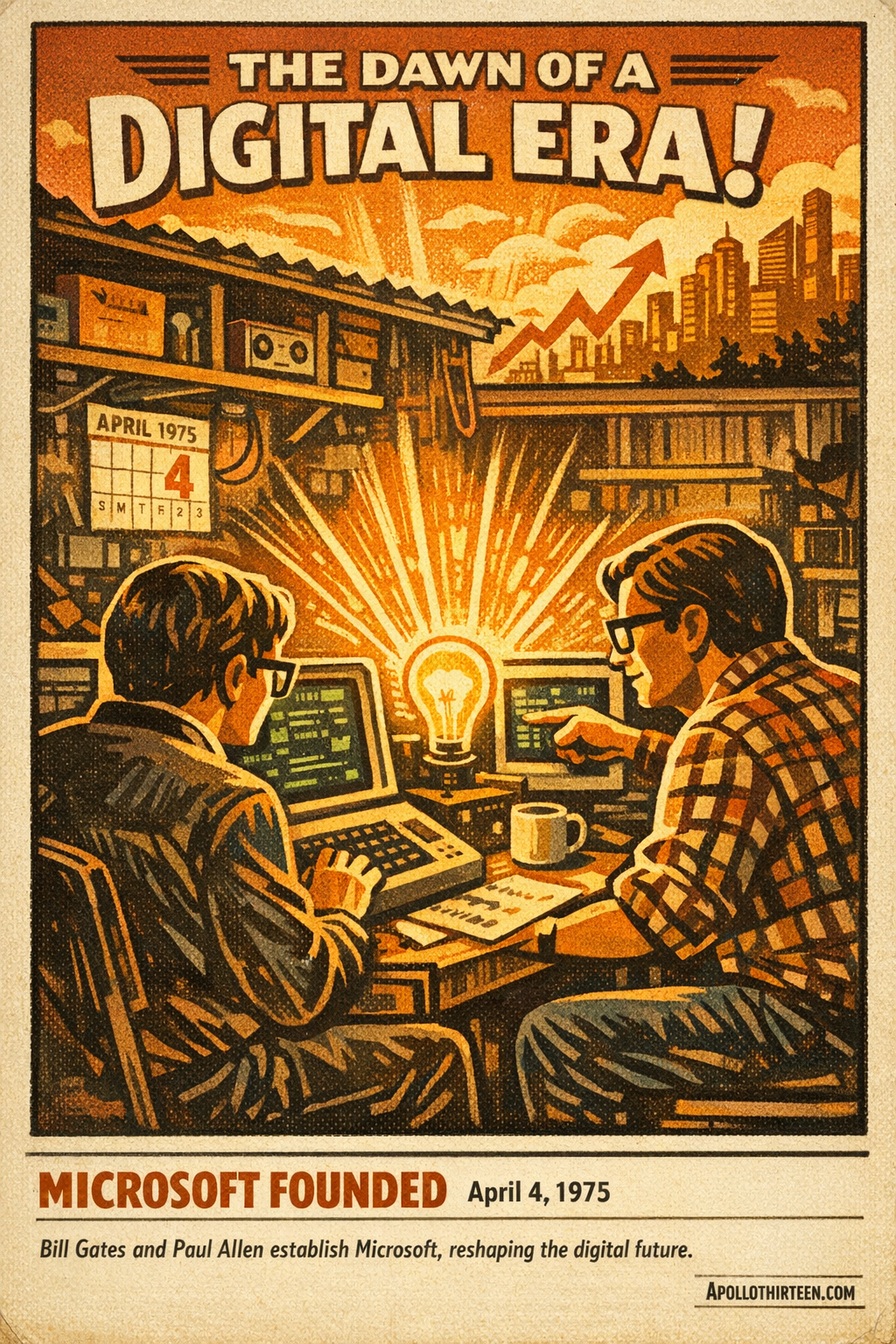
The Day That Changed Everything
Fifty-one years ago today, in the dusty light of an Albuquerque spring, two young men sealed a quiet bargain that would rewrite how the world thinks, works and plays. It was not a ribbon-cutting or a ribboned hall—no brass plaque, no ticker-tape parade. There was, instead, a partnership agreement signed in a small office and a long night's work that had begun months earlier: the birth of Microsoft.
The date—April 4, 1975—reads modestly on a calendar. But on that day a decisive pivot occurred in the culture of technology. Until then, computing had been a cathedral of mainframes and minicomputers: powerful, expensive, and confined to corporations, universities and government labs. The arrival of microprocessors and kits like the Altair 8800 had cracked that cathedral’s doors, inviting hobbyists, students and dreamers to build machines in their garages. What Bill Gates and Paul Allen brought to the table was different: they made the unseen engine that runs a computer—its software—into a product in its own right. They were betting that code, not iron, would drive the next revolution.
That wager began as a practical response to a small, startling opportunity. When Popular Electronics put the Altair on its cover in January 1975, the world of computing felt a seismic jolt. Here was a tiny box you could afford to own. Gates and Allen, two friends who had grown up tinkering with software and machines, saw not just a gadget but a market—people who would need languages and tools to make these devices useful. Thirty-one years later, the world would know their names as synonymous with personal computing. On that spring morning in Albuquerque, it was still a risky, scrappy start-up with $16,000 of revenue and the audacity to believe software could be the product, the platform and the future.
What Actually Happened
The founding of Microsoft was the kind of event historians like because it looks straightforward on paper and messy up close. On April 4, 1975, Bill Gates, then 19 and a Harvard student, and Paul Allen, 22, formally declared a partnership in Albuquerque, New Mexico. But the partnership was the endpoint of a flurry of activity that had begun months earlier.
In January 1975, the Altair 8800—a kit computer built around the Intel 8080 microprocessor—appeared on the cover of Popular Electronics, captivating hobbyists. Gates and Allen recognized a need: the Altair, like other microcomputers, was only truly useful if people could tell it what to do. BASIC, a programming language designed to be accessible to beginners, was ideal. The two set out to create an implementation of BASIC for the Altair, and by February they had a working product—Altair BASIC—which they sold to Micro Instrumentation and Telemetry Systems (MITS), the Albuquerque company behind the Altair.
There were practical complications. Gates was at Harvard and Allen was in Boston; neither owned an Altair to test their software. Paul Allen solved the problem with elegant engineering: he wrote an emulator that ran on a DEC PDP-10 minicomputer, allowing them to develop and test the interpreter remotely. In early April, the business arrangement was formalized: within days of the partnership declaration, Gates and Allen would sign a licensing agreement with MITS that permitted the Altair BASIC to be distributed with the Altair machines.
The company's name was not yet set in stone on April 4. Bill Gates used the hyphenated form "Micro-soft" in a letter to Allen on July 29, 1975—the earliest known written reference to the name—and the hyphen would eventually be dropped. Microsoft was not incorporated immediately; the company was registered as "Microsoft" with the Secretary of State of New Mexico on November 26, 1976. In its first year of operation, the fledgling business took in a modest $16,000—hardly the kind of revenue that presages a global empire. Yet the product was right: versions of BASIC for a range of microcomputers quickly made Microsoft a roommate in the fledgling personal-computer revolution.
Over the next half-decade Microsoft turned its small, specialized product into a de facto standard for many hobbyist and early consumer machines. Contracts followed: Applesoft BASIC for the Apple II, Commodore BASIC for the Commodore 64, and later MS-DOS as the foundation for IBM’s personal computer. The latter arrangement in 1980 and 1981—when IBM approached Microsoft for an operating system for its forthcoming personal computer—was the moment the world began to notice. The rest, as the aphorism goes, is history.
The People Behind It
At the center of this origin story are two young engineers and their shared, almost familial, determination. Bill Gates and Paul Allen were not archetypal businessmen. They were lifelong tinkerers who had bonded over punch cards, BASIC programs and a love of solving puzzles.
Bill Gates, the younger of the two, was a Harvard undergraduate prone to single-minded focus. He had the mathematical curiosity of an engineer and, perhaps more importantly, the ruthless discipline of someone who believed software could be designed, packaged and sold. Paul Allen was the older and the practical technician, with the knack for making projects run despite limited resources—like building an emulator on a remote minicomputer so their software could live before the hardware did.
They were joined early on by Ric Weiland, a high-school friend, who worked as their first employee and helped keep the codebases and contracts moving. Another key figure—less often mentioned but vitally important in the origin story—was Ed Roberts, founder of MITS, the small New Mexico firm whose Altair kit had fired the opening round in the personal-computer revolution. Without Roberts’ machine there would have been little commercial demand for the software Gates and Allen were writing.
The motivations were human and familiar. Gates was preparing for a life that could have been academic; Allen was exploring a career as a programmer. Both chose to gamble on a small idea in a moment when the cost of failure was high and the upside, though unpredictable, was enormous. They moved to Albuquerque to be near MITS not because of a carefully drawn business plan, but because proximity mattered: hardware-makers were concentrated, and relationships came from being physically present. The move speaks to a bygone era—before the internet tied distant collaborators together, being in the same city as a customer could decide survival.
The team that grew around them in those early years attracted a blend of hobbyists, engineers and ambitious managers. Steve Ballmer joined in 1980 and would later take over as CEO. Employees who joined in the 1970s and 1980s would go on to shape Microsoft's culture: rigorous, competitive, and focused on winning platform battles. That culture, for better and for worse, has been as central to Microsoft’s history as the technology it created.
Why the World Reacted the Way It Did
When Microsoft was founded, the public barely registered it. The mid-1970s computing community was small, formed of hobbyist clubs, company newsletters and a scattering of enthusiasts staring at esoteric magazine articles. The Altair’s appearance on a magazine cover was a headline to that crowd; the idea of a "software company" selling interpreters and operating systems had not yet captured the popular imagination. For many, a computer was a machine; software was the obscure stuff that made the machine hum, handled principally by specialists in insulated rooms.
Why did the world eventually react with astonishment, adoration and unease? Because Gates and Allen had hit on an idea that multiplied value quietly and relentlessly: software can be copied, adapted and licensed at near-zero marginal cost; when it becomes the core of a computer’s utility, it accrues disproportionate power. By writing and licensing BASIC across many platforms, Microsoft created a network of compatibility that made their software a standard. Standards breed lock-in: once millions of users and thousands of programmers build around a language and its quirks, the world tilts toward the standard-holder.
The tipping point came not with a single product but with a relationship: IBM. When IBM decided to enter the personal-computer market in 1980, it had credibility and distribution on a scale no startup could match. Microsoft supplied the operating system—MS-DOS—and in doing so transformed both itself and the market. Suddenly software licensing agreements translated into streams of revenue and leverage. Microsoft went from hobbyist vendor to cornerstone of the PC industry.
The public reaction was not immediate awe but a slow dawning. Consumers loved the hardware that came into stores, but the platform structures that software companies built influenced business, government and culture. That influence provoked public and political scrutiny: when a company becomes the gatekeeper to a vast ecosystem—what products will run, how they interoperate, who controls distribution—regulators begin to ask questions. The company’s later decades would be marked by high-profile disputes over browsers, bundling and competition. Those battles are part of a longer story about how societies mediate concentrated technological power.
What We Know Now
Half a century on, the technical and economic logic that underlay Microsoft’s rise is clear. Computers did not become more useful because their silicon got denser alone. They became useful because software organized hardware into predictable, reusable tasks. Software is not mere instruction to a machine; it is a model of functionality, user experience and business logic—all portable across devices and networks.
At its simplest, BASIC did two things: it provided a readable syntax for controlling machines, and it lowered the cognitive barrier to programming. Early hobbyists could type commands, play with loops and conditional logic, and see immediate results. That accessibility seeded a generation of developers and tinkerers. Later, operating systems like MS-DOS and Windows standardized how applications interacted with hardware—abstracting away machine-level quirks and providing a consistent environment for developers. These abstractions are the core idea that persists in modern software engineering: layers of software build safety, portability and scale.
We also understand now the systemic consequences of that approach. A single standard, once widely adopted, creates network effects: the more users and developers it attracts, the more value it accrues, making it harder for alternatives to displace it. Those same network effects can stifle competition and concentrate economic power, which is why platform companies are subject to scrutiny and sometimes legal action. Microsoft’s antitrust battle in the late 1990s is a clear example of society wrestling with the governance of digital platforms.
Technically, the field moved from tightly coupled hardware-software pairs to layered, distributed systems. The emergent architecture of cloud computing, mobile ecosystems and web-based services still owes its lineage to Microsoft’s model: software as the product, sold, licensed and updated independently of the device. But we’ve also learned to value openness. The open-source movement—sometimes cast as a counterweight to proprietary strategies—has reshaped expectations about transparency, collaboration and reuse. Today’s major software ecosystems mix proprietary platforms, open standards and interoperable services in ways that would have been hard to imagine in 1975.
Finally, the scale of computation and the kinds of questions we ask have evolved. The earliest BASIC programs were playful and immediate: graphics doodles, simple calculations, games. Now software drives genomic sequencing, climate modeling and large-scale artificial intelligence. That jump in ambition—moving from making simple machines useful to enabling scientific discovery—is part of a continuum that started in those first years of personal computing.
Legacy — How It Shaped Science Today
Microsoft’s founding changed more than consumer habits; it changed how science gets done. The most visible effect is the democratization of computation. Laboratories that once counted on a mainframe’s limited batch cycles now harness desktops, clusters and cloud services. Scientists write, run and share code in the same lingua franca that commercial software provides—languages, libraries and development environments shaped by decades of engineering practices that Microsoft helped mainstream.
Software standards and tools—integrated development environments, version control, libraries—make modern scientific work reproducible and sharable. The explosion of computational biology, climate science, data-driven social science and digital humanities rests on an infrastructure that treats code as the research instrument. Microsoft’s insistence on common runtimes and application compatibility made it easier for tools to be transferred from industry labs to academic ones and back again.
The company also had an indirect but powerful impact on education. BASIC’s accessibility encouraged schools to teach programming earlier, fostering a generation comfortable with logic and algorithmic thinking. That shift is not trivial: programming is a set of cognitive tools that enable new modes of inquiry in fields as diverse as economics, engineering and the arts.
Beyond tooling and pedagogy, Microsoft’s trajectory illuminated the politics of technology. The debates surrounding platform dominance, interoperability and antitrust in the 1990s and 2000s forced governments and institutions to confront how digital infrastructure ought to be governed. Those conversations shape science funding and research priorities today. When a public laboratory relies on a proprietary stack, the costs, access and reproducibility issues become policy questions as much as technical ones.
Microsoft’s philanthropic turn—Bill Gates’s transition from software mogul to global public-health and education philanthropist—also left a trace on scientific practice. The Gates Foundation’s large-scale investments in vaccine development, global health infrastructure and education have funded applied research that interacts with the computational ecosystem Microsoft helped create. In this way, the personal decisions of the company’s founders influenced where scientific money flowed and how problems were framed.
Finally, the culture of engineering that grew out of Microsoft’s early years—aggressive product cycles, focus on user experience, the importance of backward compatibility—shaped expectations across the tech industry. That culture produced software that, for better or worse, accelerated the pace at which science can iterate, test and deploy. In an era where software updates can change experimental pipelines overnight, the influence of that early ethos is still palpable.
Fast Facts
- Date of founding: April 4, 1975 (partnership declared in Albuquerque, New Mexico)
- Founders: Bill Gates (age 19) and Paul Allen (age 22)
- First product: Altair BASIC, sold to MITS in early 1975
- Earliest use of the company name: "Micro-soft" appeared in a letter from Bill Gates to Paul Allen on July 29, 1975
- Official registration as "Microsoft": November 26, 1976
- First-year revenue: Approximately $16,000
- First employee: Ric Weiland (early collaborator and coder)
- Notable early hire: Steve Ballmer (joined June 11, 1980; later CEO)
- Pivotal partnership: Licensing MS-DOS to IBM for the IBM PC (1980–1981), which amplified Microsoft’s reach
- Legacy effects: Standardization of BASIC and later operating systems; software-first model for personal computing; influence on education, research tooling and public policy
Fifty-one years after a modest agreement signed in a spare office in Albuquerque, the world shaped by that partnership is unmistakable. The machines we carry are only as powerful as the code that gives them purpose, and the markets, laws and cultures that govern those machines were formed in the years after two young men decided to make software the product. Microsoft’s birth was not merely the start of a company; it was the opening move in a century-long reweaving of how people compute, create and collaborate. The story of those first months is a reminder that revolutions sometimes begin with small, practical acts: shipping a program, signing a license, moving city to be near a customer. Those pragmatic choices spawned an industry—and with it, a new language for thought, work and discovery. Fifty-one years on, the legacy is not a single device or program but an entire ecosystem that continues to shape what science can ask and how it can answer.



Comments
No comments yet. Be the first!