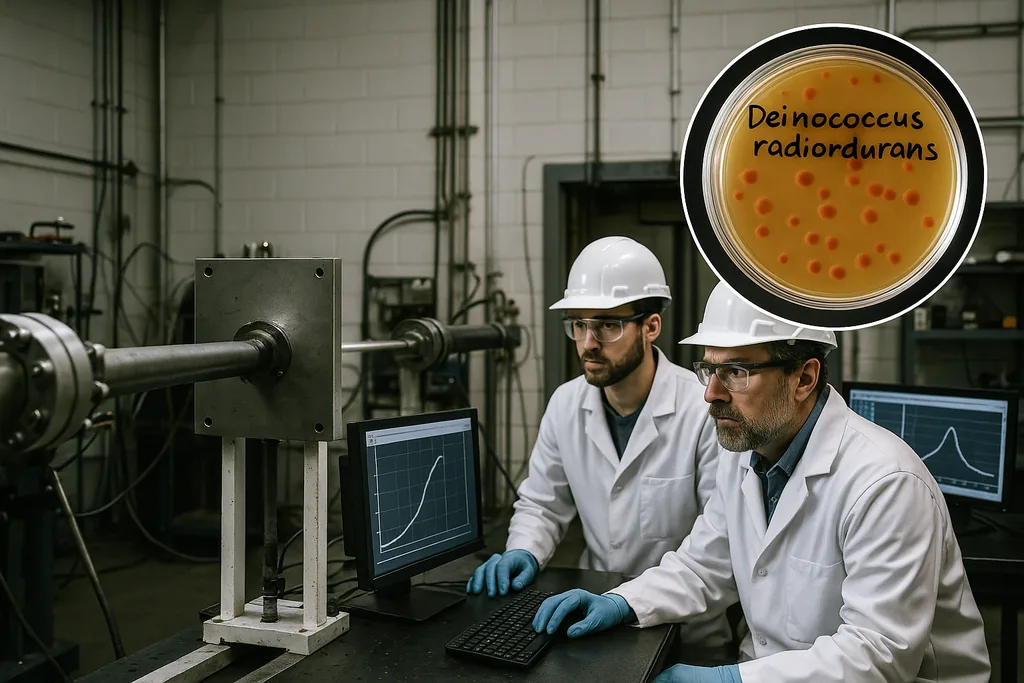
A set of shock‑wave experiments published this week suggests that lifeforms can planet-hop asteroids and survive the violent launch that would fling rock from Mars (or other worlds) into space. Researchers at Johns Hopkins University fired projectiles at metal plates sandwiching a radiation‑tolerant bacterium and found surprisingly large fractions of cells remained viable after gigapascal‑scale pressures comparable to impact ejection. The result changes the arithmetic on an old question: if microbes hide inside blasted‑off grit and rock, could they travel between planets and still be alive when they arrive?
lifeforms can planet-hop asteroids: experimental shock tests
The shock levels achieved in the tests ranged from about 1.4 to 2.4 gigapascals (GPa). For context, the static pressure at the bottom of the deepest ocean trench is an order of magnitude lower. At the lower end of the shock spectrum, nearly all cells survived with no obvious membrane damage; at higher pressures about 60% of the population remained viable, and some cells did show ruptured membranes and internal injury. Importantly, the configuration of the steel plates and the experimental setup failed mechanically before the microbes did in some runs—an unusual but telling demonstration of microbial toughness under transient shock.
Laboratory shock tests cannot reproduce every detail of a real impact: ejection from a planetary surface involves complex spallation, heating, and a range of pressures across fragments. Still, the experiments push the lower bound of survivability upward. Previous assumptions that even the brief, violent pressures of ejection would sterilize rock fragments are now harder to sustain; a non‑negligible fraction of life may survive a single ejection event if it is sheltered in rock fragments of the right size and stress history.
lifeforms can planet-hop asteroids: pathways and protection in space
The laboratory data matter because they fit into a larger, decades‑long picture of interplanetary material exchange. Martian meteorites on Earth show that rocks can be launched from Mars, cross space, and slam into our planet intact. That empirical fact underpins the lithopanspermia hypothesis: life can hitch a ride inside debris and move between worlds. What the new work adds is a realistic, organism‑level demonstration that shock alone is not an insurmountable barrier.
Transit through space presents other hazards: vacuum, extreme cold and heating during atmospheric entry, and ionizing radiation over possibly thousands or millions of years. Microbes survive these stresses in several ways. Desiccation‑tolerant cells enter a dormant state that reduces metabolic damage; D. radiodurans and similar extremophiles possess efficient DNA‑repair systems that can reassemble shattered genomes; and the interior of a rock fragment provides substantial shielding from ultraviolet and cosmic radiation. Size matters: millimetre‑to‑metre‑scale fragments can attenuate harmful radiation and thermal pulses, and spallation models show that some fragments are ejected with modest heating and velocities that allow relatively rapid transfer to nearby bodies.
Have any lifeforms been found on asteroids or meteorites? Not in the sense of living organisms. There are no confirmed reports of active microbes on returned asteroid samples. However, primitive organic molecules and prebiotic chemistry have been detected in meteorites and on sample return missions, demonstrating that the raw ingredients for life—amino acids, organic carbon—can survive space transport. The new shock‑survival results do not prove that life has actually moved from Mars to Earth, but they make the scenario physically plausible and deserve incorporation into models of planetary exchange and origin‑of‑life hypotheses.
Planetary protection, sample‑return and mission policy
The experiments have immediate policy implications for planetary protection. Current protocols were developed to reduce the risk of forward contamination (Earth organisms contaminating another world) and back contamination (returning extraterrestrial life to Earth). Those rules already make sample returns from Mars among the most tightly controlled operations in space exploration. The Johns Hopkins results imply that natural transfer of material — for instance, Martian ejecta landing on proximal targets such as Phobos or Deimos — could carry viable microbes without human assistance. That raises the stakes for missions to moons or small bodies orbiting potentially habitable worlds.
Phobos in particular orbits so close to Mars that many ejection scenarios deposit material there with lower peak pressures and shorter transfer times than material headed to Earth. The Johns Hopkins authors argue that policy planners should re‑examine whether currently less restricted targets might need stricter handling. For mission designers, the takeaway is twofold: first, maintain and update sterilization and containment standards for landers and returned samples; second, plan experiments that can directly test viability in simulated multi‑stage transfer scenarios (shock + vacuum + radiation + re‑entry heating).
What the results mean for panspermia and origins of life
If microbes (or their spores) can survive ejection, transit and deposition, then the possibility that life on Earth and Mars shares a common ancestor becomes more plausible. Lithopanspermia does not tell us whether life began here or there, but it widens the set of credible origin stories: either life arose independently in multiple places, or it originated once and spread. The new data shift the prior distribution in favour of transfer playing a role in the inner solar system.
That said, key gaps remain. Long‑term survival in interplanetary space under continuous cosmic‑ray bombardment, the effects of repeated shock cycles from multiple impacts, and the survivability of non‑bacterial life (fungi, multicellular spores) are open questions. The Johns Hopkins team plans to test repeat impacts and other organisms; independent work will need to examine the combined effect of shock followed by months to years of vacuum and radiation. Until sample returns deliver biological assays from Mars or its moons, the hypothesis remains an informed and strengthened possibility rather than a settled fact.
Practically, the study reframes our approach to astrobiology: design laboratories and missions that reflect the resilience demonstrated in realistic physical tests, and bring planetary‑protection policy into closer dialogue with experimental impact science. If lifeforms can planet‑hop asteroids, the solar system is more connected biologically than many models have assumed—and that both complicates the search for a unique origin and amplifies the ethical duty to avoid contaminating alien biospheres.
Sources
- PNAS Nexus (research paper on impact‑induced ejection survival)
- Johns Hopkins University (laboratory study and press materials)




Comments
No comments yet. Be the first!