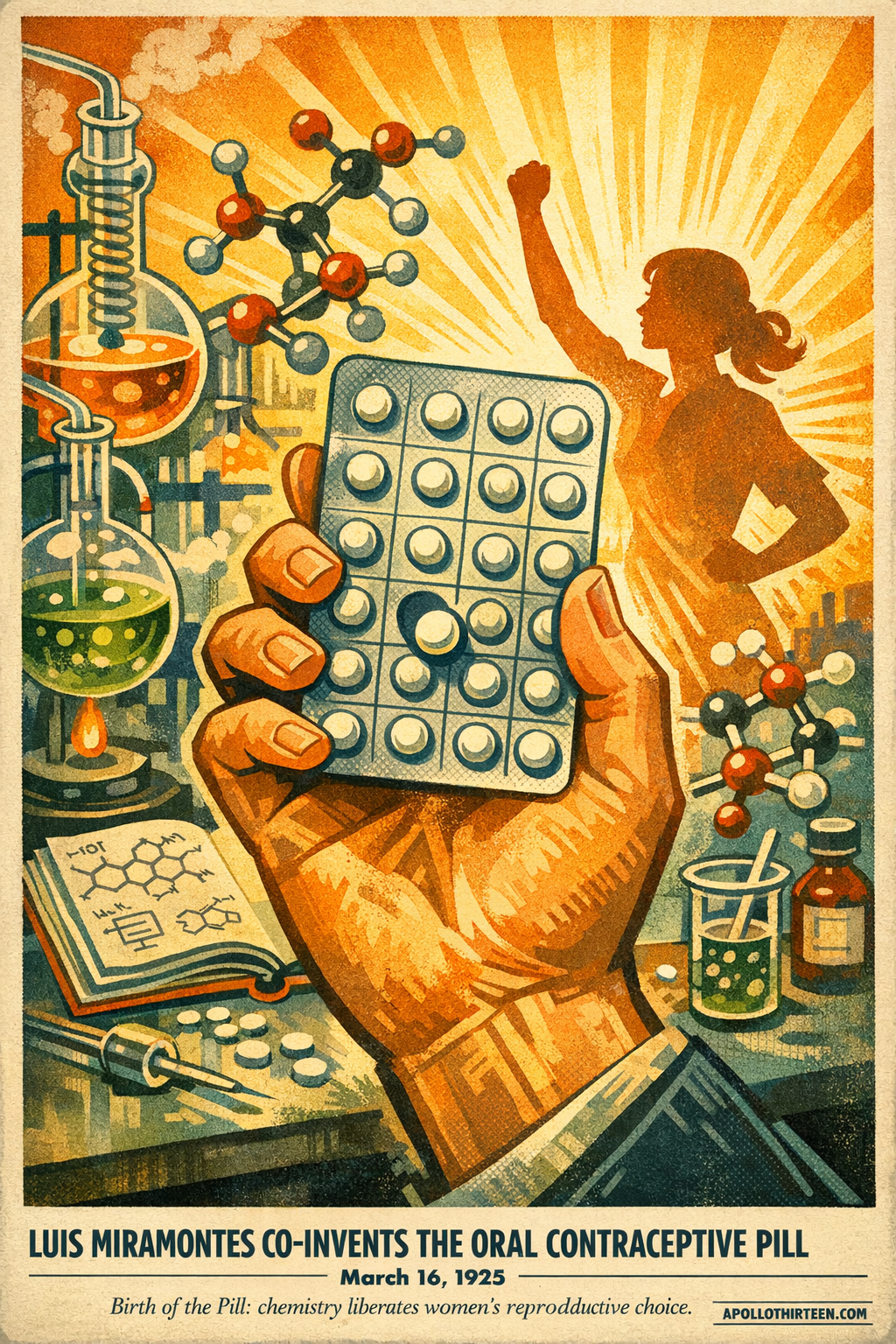
The Day That Changed Everything
101 years ago today, a boy was born in Tepic, Nayarit, who would one day help hand the world a new kind of power: the power to decide. Luis Ernesto Miramontes Cárdenas arrived on March 16, 1925, into a Mexico and a globe where reproductive fate was largely preordained by poverty, tradition, and biology. A generation later, in a cluttered laboratory in Mexico City, he threaded together a few strands of chemistry that would loosen that fate for millions of women.
The moment that matters was not his birth but a single entry in a laboratory notebook on October 15, 1951. On that day, a 26-year-old undergraduate in chemical engineering ran a sequence of reactions that finished with a compound called norethindrone — the first progestin potent enough and sturdy enough to survive the stomach and be taken as a pill. It was a chemical small in scale but tectonic in consequence. The Pill did not fall fully formed on that day, but the single molecule Miramontes helped produce became the keystone of a revolution in reproductive freedom, social life and medical practice that rolled across the late 20th century.
To stand inside that lab is to see a contrasting picture: the bustle of Syntex S.A., a company of immigrants and exiles harnessing Mexico’s wild yams into modern steroid chemistry; a young engineer bent over glassware and notebooks; the tired and skeptical eyes of a team that did not yet know it had made history. The story of the Pill is half chemical trick and half social ignition. The anniversary of Miramontes’ birth is a convenient hinge on which to hang both.
What Actually Happened
October 15, 1951, is the day the experiment in the Syntex laboratories achieved what earlier chemists only dreamed of: the synthesis of an orally active progestin. The compound, known as norethindrone or norethisterone, is a steroid engineered to mimic the activity of progesterone — the natural hormone that prepares a woman’s body for pregnancy and helps suppress ovulation. The problem was that progesterone itself cannot be taken as a pill; the digestive system degrades it too quickly. What Miramontes did, under the direction of Carl Djerassi and George Rosenkranz at Syntex, was execute a chemical change that made a progesterone-like molecule resistant to digestion and potent enough to block ovulation when taken by mouth.
The chemistry was clever if not flashy: start with diosgenin, a plant steroid extracted from Mexican wild yams, and through a series of transformations shape it into a molecule with an ethinyl group at a specific position. That small structural tweak — a minuscule appendage on the steroid skeleton — changed everything. It made the hormone survive stomach acid and liver enzymes and interact with the body’s hormone receptors in a way that mimicked pregnancy and thus prevented ovulation.
Miramontes, a student at the National Autonomous University of Mexico (UNAM), had been recruited to Syntex by Rosenkranz and worked under Djerassi’s direction. What he produced that October evening was recorded in the lab notebook and later patented in a filing that named Miramontes alongside Djerassi and Rosenkranz. The molecule did not turn overnight into a contraceptive pill; it first had to be purified, scaled up, tested for safety and efficacy in clinical trials — and then manufactured in quantities large enough to matter. But the breakthrough was unmistakable: oral progestins were chemically feasible.
In the years that followed, the compound was tested in clinical settings. Trials in Puerto Rico in the mid-1950s and elsewhere confirmed that these synthetic progestins could reliably prevent ovulation when taken daily. By 1960, pharmaceutical companies in the United States began marketing oral contraceptives — first for menstrual disorders, then for birth control — and public uptake exploded through the 1960s and 1970s.
The People Behind It
This is a story of collaboration, opportunism and exile. Syntex itself was a product of circumstance: founded in Mexico City in 1944 by a handful of chemists and entrepreneurs, it prospered by turning a local resource — the wild yam species that yielded diosgenin — into the raw material of modern steroid chemistry. The team in which Miramontes worked included two older, more prominent figures whose names often appear in headline accounts: Carl Djerassi and George Rosenkranz.
Carl Djerassi, Viennese by birth, had fled Europe in the turmoil before World War II and became Syntex’s vice president of research. He was a visionary in synthetic organic chemistry, a driven researcher who later embraced public life as a writer and polemicist. George Rosenkranz, likewise an immigrant, ran the steroid program and built Syntex into a hub for steroid hormone synthesis. Both men supervised the work that led to norethindrone and both signed the patent with Miramontes.
Luis Miramontes himself was young and relatively unknown when he stepped into that lab. He was a talented student, curious and meticulous, and he executed the critical step that produced the compound. He did so as part of his undergraduate thesis work; he was not a wealthy industrial magnate nor the architect of a marketing campaign. The patent that resulted from the work listed Miramontes as a co-inventor, but the downstream rewards and celebrity flowed in multiple directions — from scientists like Djerassi to the corporations that later profited.
Beyond the triumvirate in the patent are figures whose names populate the social story of the Pill: Gregory Pincus and John Rock, American researchers who ran pivotal clinical trials; doctors and public health officials in Puerto Rico and elsewhere who implemented trials; the pharmaceutical companies that manufactured and marketed oral contraceptives; and millions of women — ordinary people whose uptake, activism and everyday choices created the Pill’s cultural force. There were also strangers at the margins who shaped the context: Russell Marker, the American chemist who pioneered the use of diosgenin in the 1940s; the boatloads of yams harvested in the Mexican countryside; and the laborers in Syntex’s factories who scaled the chemistry into pills.
The human texture of the story matters. Miramontes later became a respected chemist in his own right, accruing patents, teaching and receiving honors long after that single October day. Djerassi would be remembered as both an artisan of molecules and a public intellectual. Rosenkranz, likewise, would remain central to steroid chemistry. But for the women who took the first pills, the names on lab notebooks mattered less than what those pills allowed them to imagine and do.
Why the World Reacted the Way It Did
The arrival of a safe, reliable oral contraceptive did not drop into a vacuum. The 1950s and 1960s were decades of demographic anxiety, medical optimism and social ferment. Governments fretted about population growth, scientists touted the promise of hormone therapy, and young people began to challenge the social rules governing sex and family.
When oral contraceptives reached the market, reactions polarized along cultural, religious and political lines. For women and feminist advocates, the Pill was liberation in pill form. It separated sex from reproduction in a practical way for the first time at mass scale. It allowed women to plan careers and education, to space births, to avoid the health risks of repeated pregnancies. The Pill is often credited with helping to fuel the second-wave feminist movement by expanding women’s freedom to chart life courses independent of continuous childbearing.
Religions, particularly the Roman Catholic Church, reacted with suspicion and sometimes hostility. The Church condemned artificial contraception as morally problematic, and when Pope Paul VI released Humanae Vitae in 1968 reaffirming that condemnation, it initiated a prolonged debate and resistance within Catholic communities. In many countries, moral and legal strictures limited access for years; in others, access spread rapidly.
Politically, the Pill became entangled with questions of governance and power. In the United States, legal battles culminated with Griswold v. Connecticut in 1965, when the Supreme Court invalidated state laws banning contraception for married couples, and later Eisenstadt v. Baird (1972) extended privacy rights to unmarried individuals. These rulings reflected a profound social shift: contraception was not just a private medical matter but a constitutional one.
There were darker threads, too. Some early trials and family-planning programs operated under questionable ethics. The large-scale trials in Puerto Rico, in which thousands of women participated in the mid-1950s, were driven partly by U.S. interests in population control and came with insufficient informed consent and limited options for participants. That episode is a reminder that science can be done without full regard for human dignity, especially when marginalized communities are treated as convenient test populations.
Medical reaction was pragmatic and mixed. The Pill’s benefits were apparent: reliable contraception, reduction in maternal mortality from unwanted pregnancies, decreased ovarian and endometrial cancer risks. But by the late 1960s and 1970s side effects — notably an elevated risk of blood clots and stroke with some formulations — emerged and triggered safety investigations. Science responded by reducing hormone doses, refining formulations, and creating progestin-only options. The net result was a product that remained powerful and widely used, but also more carefully prescribed.
What We Know Now
The chemistry that Miramontes helped create is now an old friend of medicine, familiar and often unremarked. Yet beneath that familiarity are precise understandings of how these molecules act and why they mattered.
Norethindrone belongs to a class called progestins — synthetic molecules designed to mimic the hormone progesterone. Progesterone performs several reproductive functions: it prepares the uterus for implantation, supports early pregnancy, thickens cervical mucus and, crucially for contraception, inhibits the hormonal surges that trigger ovulation. When a synthetic progestin is present at sufficient levels, the brain’s signaling networks sense the “pregnancy-like” hormonal state and suppress the release of follicle-stimulating and luteinizing hormones. Without the mid-cycle LH surge, eggs are not released. Additional mechanisms — thicker cervical mucus and a thinner uterine lining — create further barriers to fertilization and implantation.
What Miramontes and colleagues found was a way to keep a progesterone-like signal present through a simple daily pill. The modification that made norethindrone orally active is a small structural change, but the result was profound: a hormone that can be swallowed, absorbed, survive first-pass metabolism in the liver, and still tug at the body’s reproductive signals.
Today, oral contraceptives have diversified. There are combined pills containing both an estrogen (often ethinylestradiol) and a progestin like norethindrone; there are progestin-only pills; long-acting injectables; implants; intrauterine devices that release progestins locally; and non-hormonal options. Physicians match methods to patients’ needs, balancing efficacy, side-effect profiles and personal preferences.
We have also learned a great deal about safety. Early high-dose pills carried a measurable risk of thrombosis — dangerous blood clots — particularly for smokers and older women. Modern formulations use much lower hormone doses and different progestins with better risk profiles. Nonetheless, hormonal contraception is not without side effects: mood changes, weight fluctuations, and rare but serious cardiovascular risks for certain users. Those risks are weighed against the protective effects — including a reduced risk of ovarian and endometrial cancers — and the social benefits of family planning.
Outside medicine, the Pill reshaped demographics. In many societies, access to reliable contraception led to a drop in fertility rates, contributing to economic changes, shifts in family structures and a reconfiguration of gender roles in the workplace and education. The Pill did not create these changes single-handedly, but it was often the enabling technology that made new possibilities believable and achievable.
Legacy — How It Shaped Science Today
The invention of an orally active progestin was not just a medical milestone; it altered the trajectory of science, industry and society. On the scientific front, it demonstrated how subtle molecular edits could produce large pharmacological changes — a lesson that now undergirds modern drug design. The techniques and industrial processes Syntex developed for steroid manipulation helped build a worldwide pharmaceutical industry in Mexico and beyond, proving that high-value chemical innovation need not be confined to Europe and the United States.
For women, the Pill became an instrument of autonomy. It shifted bargaining positions inside households, farms and corporations. Women took jobs and deferred childbirth; universities saw a rise in women students who could plan around their reproductive lives. Economists and sociologists argue that this expansion of choice contributed to decades of growth in female labor-force participation, higher educational attainment and shifts in fertility patterns.
The Pill also shaped how medicine thinks about prevention versus treatment. Contraception turned family planning into a routine preventive care service, comparable to vaccination or prenatal vitamins. It normalized ongoing user-controlled interventions, leading to a medical culture that accepts long-term hormonal management for reasons of public health and individual preference.
At the same time, the Pill raised enduring ethical debates that continue today. Questions about access, informed consent, the role of governments and corporations in reproductive health, and the socioeconomic disparities in who benefits from new medical technologies remain urgent. The early trials of contraceptives revealed the dangers of testing new technologies on vulnerable populations without adequate protections — a lesson applied in subsequent decades to research ethics.
Luis Miramontes himself lived a life that mirrored this ambivalence of fame and obscurity. He went on to a long and productive career in chemistry, holding dozens of patents beyond the Pill, teaching and receiving honors, including induction into the U.S. National Inventors Hall of Fame in 2000. He did not, by most accounts, personally reap the fortunes associated with the global contraceptive industry. The pill that his chemistry made possible became part of an industrial complex of licensing, marketing and corporate consolidation. Syntex would eventually be acquired by Roche; the market for hormonal contraception grew into a multibillion-dollar sector.
Yet if Miramontes did not get rich, his legacy is harder to measure in money than in lives. The ability to plan pregnancies has ripple effects across decades. It affects education, health outcomes, economic stability, and the very shape of families. That the key step toward oral contraception happened in a modest lab in Mexico City — with a young student’s hand writing the final outcome in a lab book — is a humbling reminder that world-altering science often happens away from gilded halls.
Fast Facts
- March 16, 1925: Luis Ernesto Miramontes Cárdenas is born in Tepic, Nayarit, Mexico.
- October 15, 1951: Miramontes synthesizes norethindrone, the first orally active progestin, in Mexico City as part of work at Syntex.
- 1950s: Clinical trials, including major studies in Puerto Rico, show contraceptive efficacy of oral progestins.
- 1960: The U.S. Food and Drug Administration approves the first oral contraceptive (initially for menstrual disorders).
- 1961: Oral contraceptives begin to be marketed more widely for birth control.
- 1965: Griswold v. Connecticut legalizes contraception for married couples in the U.S.; later rulings expand access further.
- 2000: Miramontes inducted into the U.S. National Inventors Hall of Fame.
- Legacy: Norethindrone and related progestins remain core drugs in many contraceptive formulations, used by tens of millions globally.
Why does this matter now, 101 years after Miramontes’ birth? Because the Pill is still a prism through which we view modernity. It is not only a pill but a compact symbol of a larger bargain: technology offers new choices, but those choices land in existing political, religious and economic structures that shape who benefits. The chemistry on a lab bench is only the beginning. How society distributes the benefits, manages the risks and remembers the ethical costs is the rest of the story.
A century after his birth, Miramontes’ small laboratory accomplishment sits at the junction of science and social change. That single carbon tweak in a steroid skeleton allowed millions of women to plan if and when they would bear children. It reshaped households and economies. It stirred churches, courtrooms and kitchens. It revealed the possibilities of chemistry and the responsibilities of the societies that wield it.
On the anniversary of Miramontes’ birth, we can look back not merely to honor a scientific milestone but to reckon with the living legacy it produced: the enduring question of how we steward technologies that change intimate human lives. The Pill remains both a triumph of chemistry and an ongoing civic challenge — to ensure that the choices it enables are available, safe and informed for all who might want them.



Comments
No comments yet. Be the first!