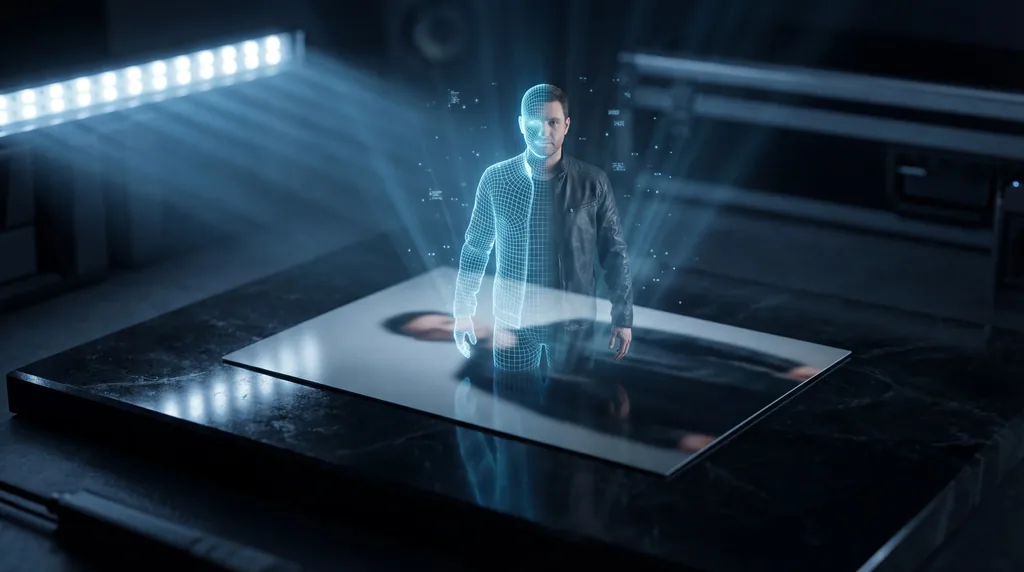

HumanOrbit represents a significant departure from traditional 3D reconstruction by utilizing a fusion of video diffusion techniques to synthesize continuous 360-degree views from a single image. While conventional methods rely on static multi-view synthesis that often results in anatomical distortions, HumanOrbit leverages temporal coherence to ensure that the subject’s identity, clothing textures, and physical proportions remain stable across all angles. Developed by researchers Lei Wang, Peng Liu, and Bang Du, this framework effectively bridges the gap between 2D generative AI and high-fidelity 3D modeling.
How does HumanOrbit differ from other 3D human reconstruction methods?
HumanOrbit differs from existing 3D human reconstruction methods by shifting the focus from individual image generation to continuous video-based orbit generation. Traditional frameworks often encounter "identity drift," where a person's features change as the camera moves. By using a video diffusion model, HumanOrbit ensures that every frame in a 360-degree rotation is physically and geometrically consistent with the original input photo.
The primary challenge in 3D human reconstruction has long been the "hallucination" of features. When an AI attempts to predict what the back of a person looks like based only on a front-facing photo, it frequently generates inconsistent geometry or blurred textures. Current state-of-the-art models typically adapt image-based diffusion for multi-view synthesis, but these often lack the structural rigor required for professional-grade digital twins. The fusion of temporal data within HumanOrbit allows the system to treat the camera's path as a logical progression, preventing the jarring transitions commonly seen in frame-by-frame synthesis.
The technical foundation of HumanOrbit rests on its ability to maintain geometric consistency. By simulating a camera orbiting the subject, the model preserves the spatial relationship between different body parts. This prevents common errors such as limbs changing shape or clothing patterns shifting unnaturally during rotation. The result is a seamless transition between views that serves as a reliable blueprint for creating a three-dimensional asset.
What are the advantages of using video diffusion models for multi-view synthesis?
The primary advantage of using video diffusion models for multi-view synthesis is the inherent temporal coherence that stabilizes visual features across different perspectives. Unlike static models, video diffusion maintains a "memory" of previous frames, ensuring that fine details like fabric folds and facial features remain identical. This approach results in high-fidelity 3D models with superior completeness compared to image-based baselines.
In the realm of Computer Vision, video diffusion models have demonstrated a unique capacity for generating photorealistic results that align strictly with a given prompt or reference image. HumanOrbit capitalizes on this by treating the 360-degree orbit as a cinematic sequence. This method allows for a more natural fusion of perspectives, where the AI understands the 3D volume of the human body rather than just predicting a series of flat images. The advantages include:
- Temporal Stability: Eliminates flickering and warping between different viewing angles.
- Identity Preservation: Ensures the "digital twin" remains recognizable as the specific individual in the source photo.
- High Resolution: Supports the generation of intricate textures and clothing details that are often lost in lower-dimensional modeling.
- Automated Workflow: Reduces the need for manual cleanup by producing geometrically sound initial frames.
Can HumanOrbit be used for virtual try-on or fashion applications?
HumanOrbit is exceptionally well-suited for virtual try-on and fashion applications due to its ability to generate high-resolution textured meshes from a single photograph. By producing a consistent 360-degree view, the model allows retailers to create digital twins of customers or garments. This enables users to visualize how clothing drapes and fits from every possible angle in a Virtual Reality environment.
The researchers, including Lei Wang and colleagues, highlight that the generated multi-view frames are fed into a specialized reconstruction pipeline. This pipeline converts the video data into a textured mesh, which is the standard format for 3D assets in e-commerce and gaming. In a retail context, this means a shopper could upload one photo and instantly see a 3D avatar of themselves wearing a new collection, complete with accurate representations of fabric texture and fit.
Beyond fashion, the implications for Generative AI in entertainment are substantial. Character creators for video games and cinematic visual effects often require hours of manual labor to turn a concept sketch into a 3D model. HumanOrbit streamlines this by providing a high-fidelity starting point that preserves the original artistic intent. This fusion of speed and precision represents a major step forward for the automated creation of 3D content.
The Future of High-Fidelity 3D Reconstruction
Looking ahead, the research team aims to refine the HumanOrbit framework to handle even more complex poses and diverse lighting conditions. While the current model excels at standing subjects, future iterations may incorporate dynamic movements, allowing for the reconstruction of humans in motion. As Computer Vision continues to evolve, tools like HumanOrbit will likely become foundational in the development of the metaverse and advanced telepresence technologies.
The experimental results of the study validate that HumanOrbit outperforms current state-of-the-art baselines in both visual quality and structural accuracy. By prioritizing the fusion of video coherence with 3D geometry, Lei Wang, Peng Liu, and Bang Du have provided a robust solution to one of the most persistent problems in AI-driven content creation: making the transition from a flat image to a living, breathing digital double.




Comments
No comments yet. Be the first!