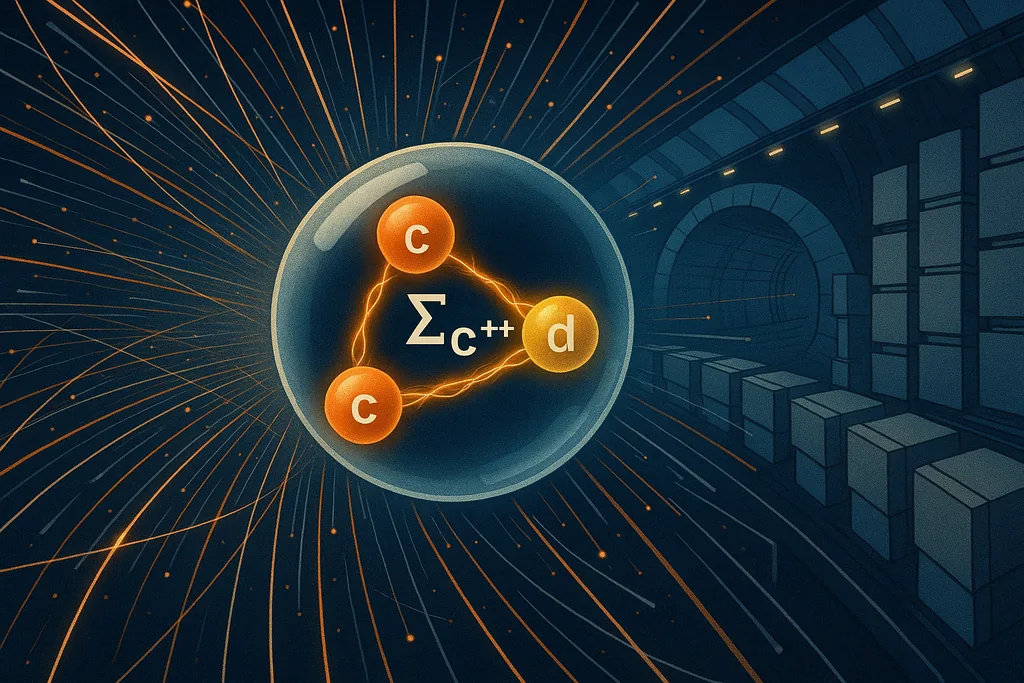
On 17 March 2026 scientists discover heavier version of the proton at CERN
On 17 March 2026 scientists discover heavier version of the proton when the LHCb experiment at CERN announced the clear observation of a new baryon, Xi-cc-plus. The particle is not a stable proton but a close relative: it contains two charm quarks and a down quark instead of the proton's two up quarks and one down quark, giving it a mass about four times that of a normal proton. The signal — a sharp peak in reconstructed decay products recorded during Run 3 of the Large Hadron Collider — reached a statistical significance above the conventional 5-sigma discovery threshold and was presented at the Moriond electroweak conference.
Scientists discover heavier version: what Xi-cc-plus is
Xi-cc-plus (written Xi_cc^+) is a baryon: a three‑quark hadron similar in structure to the proton but with a very different internal composition. Where a proton contains two up quarks and one down quark, Xi-cc-plus replaces both up quarks with heavier charm quarks. That substitution explains why the particle's measured mass sits at roughly 3,620 MeV/c^2 — roughly four times the proton's mass of about 938 MeV/c^2 — and why the state is short‑lived.
The LHCb analysis reconstructed the Xi-cc-plus from its decay products; the collaboration reported seeing on the order of a thousand candidate events clustered at the same mass and quoting a 7‑sigma significance for the peak. The particle survives for a vanishingly small time — fractions of a trillionth of a second — before decaying into lighter hadrons and leptons. That fleeting lifetime makes the finding experimentally challenging and explains why improvements in detector precision were crucial to the result.
Scientists discover heavier version and the role of the upgraded LHCb detector
The discovery was the first new hadron identified after the LHCb detector upgrade finished installation and commissioning in recent years. The upgraded detector includes a redesigned silicon‑pixel vertex detector and tracking systems with improved spatial resolution, faster readout electronics and the ability to operate at higher collision rates. Those hardware and firmware improvements allowed LHCb to record cleaner decay chains and to separate very short decay vertices from the dense spray of particles produced in each proton–proton collision.
Teams from a large international collaboration, with important contributions from groups such as the University of Manchester, built and commissioned the new silicon modules that act like a high‑speed, ultra‑fine camera for particle tracks. LHCb collaborators point out that the signal appeared in a single year of Run 3 data where the previous detector, during a decade of running, could not isolate the same feature. In short, the upgrade increased the detector’s discovery potential by combining higher statistics with finer imaging of decay topologies.
How the result fits into quantum chromodynamics and the Standard Model
Xi-cc-plus is not a surprise that overturns the Standard Model; rather, it is a predicted member of the baryon family whose properties test detailed predictions of quantum chromodynamics (QCD), the theory of the strong interaction. QCD governs how quarks bind together via gluons and it is notoriously hard to compute at low energies because the force becomes strongly coupled. Heavy‑quark baryons like Xi-cc-plus provide clean laboratories: the presence of two charm quarks changes the dynamics and lets theorists check lattice‑QCD and other models that attempt to calculate masses, lifetimes and decay patterns from first principles.
Because the charm quarks are much heavier than up or down quarks, they influence binding energies, spin couplings and the ways decays proceed. Comparing the measured mass and the unexpectedly short lifetime of Xi-cc-plus to theoretical expectations helps reveal how the strong force distributes energy inside baryons and how much of a hadron’s mass arises from quark masses versus binding energy. So the discovery sharpens our understanding of where mass comes from in composite particles without contradicting the Standard Model framework.
Experimental details and what was measured
The observation follows a pattern: LHC experiments have now increased the roster of discovered hadrons substantially, and the latest result marks only the second time a baryon containing two heavy charm quarks has been observed. The earlier doubly charmed baryon discovered by LHCb had an up rather than a down quark; the new Xi-cc-plus replaces that up quark with a down quark, changing quantum numbers and decay behaviour in ways theorists can compute and compare to the data.
Why this matters beyond particle bookkeeping
Discovering a heavier proton-like particle has value beyond adding another name to the particle list. Each new baryon provides constraints on non‑perturbative QCD calculations and on models of hadronic structure — constraints that cascade into other areas, from interpreting heavy‑ion collision data to refining inputs used in searches for new physics. In practice, this helps reduce theoretical uncertainties in processes where hadronic effects otherwise dominate.
There are also practical, institutional consequences. The discovery underlines the scientific return on investment in detector upgrades and accelerator performance. It also has become part of a live policy debate: researchers have used the result to argue that continued funding for LHCb upgrade phases and for high‑luminosity running is essential if the community wants to extract the most physics from the LHC complex.
What questions remain and where the field goes next
Xi-cc-plus raises immediate follow‑ups: improved measurements of its lifetime, spin and parity, searches for other decay modes, and refined mass determinations. LHCb and other LHC experiments will collect more data in Run 3 and beyond, while theorists will feed the new numbers into lattice‑QCD calculations and effective models to test whether computed masses and widths match reality. Any persistent discrepancy could hint at missing ingredients in our treatment of strong‑interaction dynamics, though no such shock currently appears in the published numbers.
Beyond characterization, the discovery motivates searches for related states — other combinations of heavy and light quarks, and exotic multiquark configurations — that could expose new patterns of binding. It also strengthens the case for further detector upgrades that boost sensitivity to very short‑lived states and rare decay channels.
Sources
- CERN (LHCb Collaboration announcement and presentation at Moriond 2026)
- University of Manchester (LHCb upgrade contributions and detector technical work)
- Rencontres de Moriond (2026 Electroweak conference presentation)




Comments
No comments yet. Be the first!