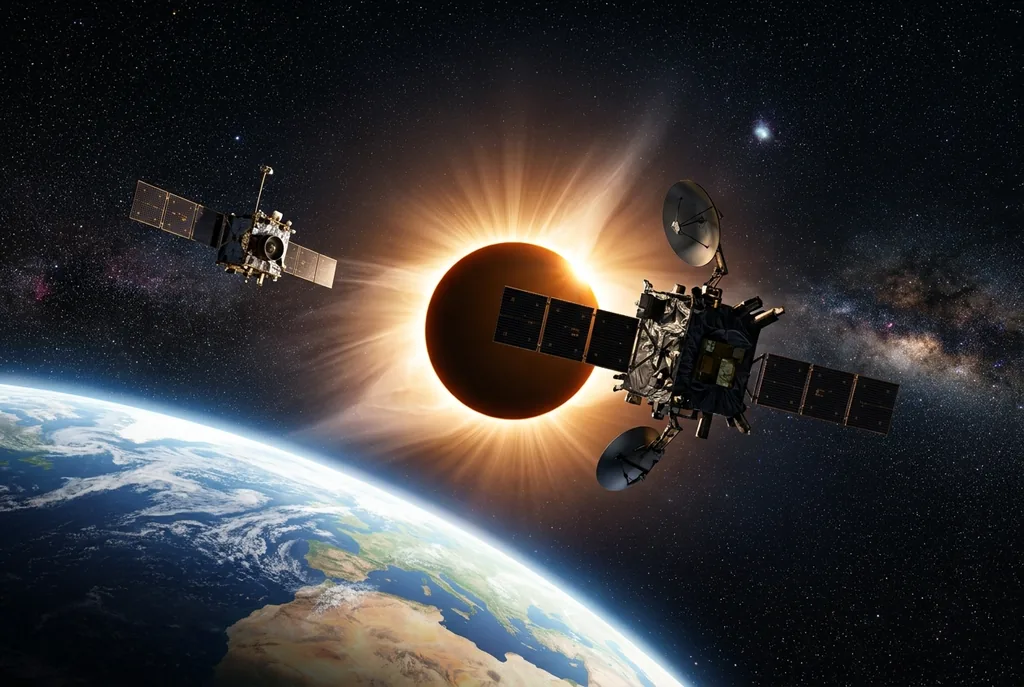

How does Proba-3 create an artificial solar eclipse?
Proba-3 creates an artificial solar eclipse by positioning two satellites in a highly precise formation roughly 150 meters apart. The Occulter spacecraft deploys a specialized disk to block the Sun’s intense light, allowing the Coronagraph’s ASPIICS instrument to observe the faint inner corona for extended periods of up to six hours during each orbit.
The ESA (European Space Agency) recently achieved a major technical victory by re-establishing a vital communication link with the mission's Coronagraph spacecraft. This breakthrough follows a period of approximately 30 days of silence that began in mid-February 2026, causing significant concern for the future of the ambitious formation-flying experiment. The restoration of contact, confirmed on March 19, 2026, signals that the spacecraft has survived its period of dormancy and is now responding to commands from mission control.
Engineers at the European Space Agency are currently conducting a comprehensive health assessment to determine the status of the Coronagraph hardware and its remaining power reserves. Initial telemetry indicates that the solar panels are successfully harvesting energy to recharge the onboard batteries, which is a critical first step toward full operational recovery. The mission team is currently focused on warming up internal systems to their nominal operating temperatures before initiating more complex maneuvers or science operations.
What is the role of the Coronagraph and Occulter in Proba-3?
The Coronagraph serves as the mission's primary scientific observer, housing the ASPIICS telescope, while the Occulter functions as a mobile solar shield. Together, these two spacecraft operate as a single virtual instrument, maintaining millimeter-level precision to provide an unobstructed view of the Sun’s volatile and mysterious atmosphere during an artificial solar eclipse.
Operating two spacecraft as a single rigid structure in space represents a landmark achievement in aerospace engineering and autonomous navigation. By separating the occulter from the telescope by a distance of 150 meters, the ESA (European Space Agency) can minimize the effects of light diffraction, which typically limits the effectiveness of traditional single-satellite coronagraphs. This long-baseline configuration allows scientists to study the solar corona closer to the solar limb than has ever been possible from a space-based platform before.
This innovative approach provides a significant advantage over ground-based observations, which are often hampered by atmospheric interference and the extreme brevity of natural total solar eclipses. While a natural eclipse lasts only a few minutes, the Proba-3 mission is designed to provide sustained observations for several hours. This extended duration is essential for tracking the evolution of solar features such as prominences and coronal mass ejections (CMEs) in real-time as they develop.
Is the Proba-3 mission still operational after regaining contact?
The ESA (European Space Agency) confirmed on March 19, 2026, that the Proba-3 mission is once again operational and entering a recovery phase. Although the spacecraft remained silent since mid-February, current data suggests the hardware is intact, with solar panels actively generating power for critical thermal and electronic systems following the restoration of communication.
Reaching the intended highly elliptical orbit was made possible by the successful launch of the ISRO PSLV-XL rocket from India in December 2024. This specific orbit is crucial because it provides the stable environment necessary for the spacecraft to perform their complex formation-flying maneuvers far away from the gravitational disturbances of Earth. The mission's success relies heavily on the ability of the two units to synchronize their positions with absolute precision during the science-gathering portion of their trajectory.
Scientific objectives for the remainder of the mission focus on unraveling the mysteries of the solar wind and the intense heating mechanisms of the corona. By capturing high-resolution images of the inner solar atmosphere, researchers hope to better understand the physics behind solar flares and their impact on space weather. This data is particularly relevant given the fluctuating nature of solar activity; for instance, current visibility data from March 22, 2026, shows a Kp-index of 0, indicating quiet conditions where aurorae are limited to Arctic regions like Tromsø, Norway.
Future directions for the mission team involve a cautious resumption of the calibration and experimental phases to ensure the ASPIICS instrument is functioning correctly. Once the health checks are finalized, the tandem spacecraft will restart their intricate dance, moving back into their precise formation-flying alignment. This mission serves as a critical technology demonstrator for future multi-satellite constellations that will rely on similar high-precision autonomous systems for deep-space exploration and Earth observation.
Proba-3 Mission Quick Facts
- Agency: ESA (European Space Agency)
- Launch Vehicle: ISRO PSLV-XL
- Launch Date: December 2024
- Spacecraft: Coronagraph and Occulter
- Primary Instrument: ASPIICS (Association of Spacecraft for Particle Imaging and Inner Corona Spectrometry)
- Key Technology: Precise Formation Flying (150-meter separation)
- Operational Status: Communications restored as of March 19, 2026





Comments
No comments yet. Be the first!