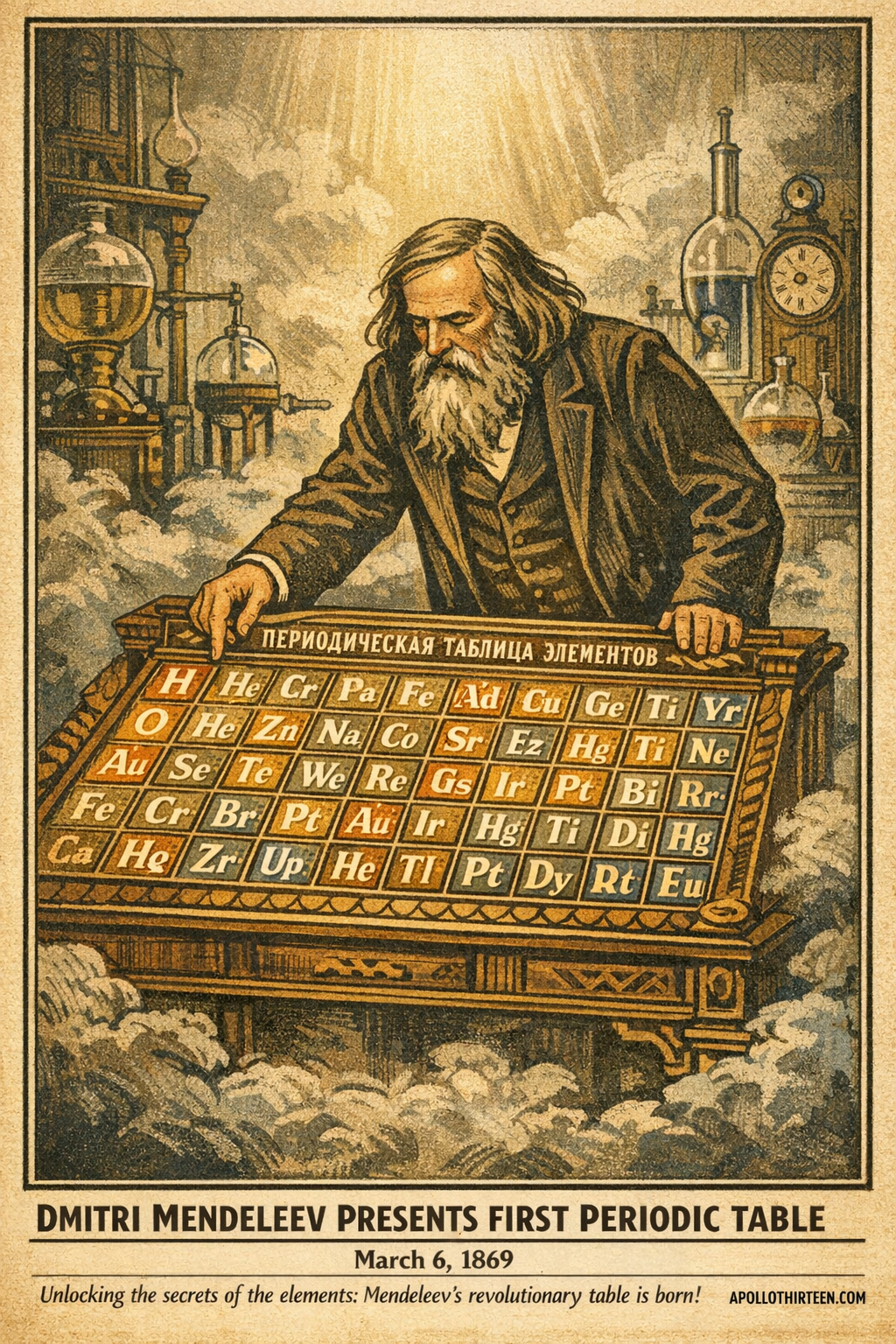
The Day That Changed Everything
One hundred and fifty-seven years ago today, a quiet room in St. Petersburg held a scene that would ripple through every laboratory and classroom on Earth. It was not a thunderclap of discovery; there were no loud fanfares, no triumphant proclamations. A professor stood before colleagues in the newly formed Russian Chemical Society and laid out, in a rough sketch and an urgent voice, a radical idea: the bewildering list of chemical elements that scientists had been cataloguing for a century might, after all, obey a simple and beautiful rule.
Dmitri Ivanovich Mendeleev had spent months cutting up cards, writing element names and their properties on little pieces of paper, and placing them under lamps and on tabletops until the pattern revealed itself. On March 6, 1869, he presented the result—a proto-periodic table arranging 63 known elements so that similar chemical characters recurred in a predictable pattern. He even left blank spaces—question marks—where the data suggested elements must exist but had not yet been found. It was, at once, a map and a prophecy.
What happened that day did not announce itself with fanfare. But it seeded a way of thinking so profound that, within a few decades, Mendeleev’s table would become as indispensable to chemistry as a clock is to timekeeping. The rest of the world would take its time catching up. The seeds sown in that St. Petersburg meeting matured into a framework that transformed an unruly catalogue of elements into an ordered tapestry that could predict the behavior of matter itself.
What Actually Happened
On a cold early March evening in 1869, Dmitri Mendeleev addressed a meeting of the Russian Chemical Society in St. Petersburg. He had been a central force in founding that society just months earlier; now he used it as his platform. The version he presented that night was not the sleek chart shown in classrooms today. The elements were listed vertically in columns primarily by increasing atomic weight, and the familiar horizontal periods had not yet crystallized into the modern format. What mattered was the core insight: when you order the elements by weight, their chemical properties recur at regular intervals.
Mendeleev built the table the old-fashioned way—by hand. He wrote each element’s name, atomic weight, and salient chemical properties on cards and shuffled them on a table until an order suggested itself. He later said the arrangement came to him almost like a vision—an oft-repeated anecdote has him waking from a dream to confirm the pattern—but the work that led to that insight was painstakingly empirical.
The sketch he showed the Society grouped elements with like properties and, crucially, left deliberate gaps. Where some elements did not yet fit or where the pattern demanded a missing member, he placed question marks and even predicted their properties: weight, oxide formulas, valency, and chemical behavior. He coined provisional names—“eka-aluminum” for an element beneath aluminum, for example—and offered specific expectations for their densities and chemical affinities.
That first presentation was followed later in 1869 by a short paper in the Russian Chemical Society’s journal and a briefer abstract in a German periodical. Outside Russia, hardly anyone noticed. Within the Russian chemical community, however, it began a debate. Some colleagues were intrigued. Others were skeptical: atomic weights were still measured with error, and the idea of leaving blank spaces for undiscovered elements struck many as audacious, even presumptuous.
Mendeleev did not wait for colleagues to come around. He continued to refine the table, publishing an expanded version in the second edition of his textbook on inorganic chemistry in 1871. He worked to reconcile anomalies—most famously the position of iodine and tellurium, which had atomic weights that suggested one order but chemical properties that argued for another. In such conflicts he trusted chemistry over arithmetic, rearranging elements to preserve chemical families even if that meant departing from strict weight order. Those choices, initially controversial, would later be vindicated by deeper insights into atomic structure.
The proof, ultimately, came not from argument but from discovery. When gallium was isolated in 1875, it fit the predictions Mendeleev had made for “eka-aluminum.” Scandium followed in 1879, and germanium in 1886—each matching his forecasts for density, oxide composition, and chemical behavior with uncanny accuracy. What had been a bold organizational scheme had become a predictive apparatus.
The People Behind It
At the center of this story is Dmitri Mendeleev: teacher, experimenter, and relentless synthesizer. Born in Tobolsk in Siberia in 1834, he rose from a family that had faced hardship and loss to become a professor at the University of St. Petersburg. Mendeleev was a man of many orders—he wrote prize-winning textbooks, argued forcefully for standardized weights and measures in Russia, and cared deeply about education. He was also prone to dramatic outbursts and obstinate defense of his ideas. His life contained a streak of the theatrical: the dream anecdote, the obstinacy in the face of criticism, the penchant for daring predictions.
Lothar Meyer, the German chemist, arrives in the narrative as a quiet foil. Meyer had independently plotted relationships between atomic weight and properties—most notably atomic volume—and produced a table showing periodicity. His work, published around the same time, emphasized the physical recurrence of properties. He did not, however, leave gaps and predict the properties of undiscovered elements the way Mendeleev did. Both men were eventually honored for their contributions—the Royal Society’s Davy Medal went to them in 1882—but history places Mendeleev in the starring role because of the table’s prescriptive power.
Before either man, John Newlands had proposed an “octave” law in 1866: he noticed that when elements were ordered by weight, every eighth element had similar properties—much like musical notes repeating every eighth tone. His idea was ridiculed by some peers and dismissed as simplistic; critics mocked the idea by suggesting elements be organized alphabetically. Newlands’s music analogy was ahead of its time and would be recognized later for its prescience, but in 1866 the scientific establishment was not ready.
Around Mendeleev was a rising Russian chemical community that had just formalized itself in the Society where he presented the table. That institutional scaffolding mattered: without a forum, the sketch might simply have remained a private musing. The Russian Chemical Society gave the work a voice and at least a stage—however small at first—to be examined, criticized, and ultimately refined.
Mendeleev’s personal life provided both pressure and paradox. He labored on the table during a period of personal turmoil—his first wife was ill—and he was a man who courted controversy in more arenas than chemistry. Anecdotes from his life touch on affairs, a missed duel, and a restless energy that pushed him to tackle social reforms and standardization projects alongside his scientific work. These human details remind us that the periodic table was not conjured in a vacuum but emerged from the messiness of a life lived on many fronts.
Why the World Reacted the Way It Did
The initial reaction to Mendeleev’s table was muted and, at times, skeptical. That should surprise no one. Science proceeds slowly, and an audacious reordering of the known elements—especially one that told chemists to expect things that did not yet exist—was bound to unsettle a community accustomed to cataloging and measuring. Atomic weights themselves were not exact; experimental errors could be significant. To some, Mendeleev’s decision to override weight data where it conflicted with chemical character looked like intellectual opportunism rather than insight.
There were also national and linguistic barriers. Much of Mendeleev’s earliest writing was in Russian; the German abstract drew little attention. Scientific networks in Europe were not as connected as they are now, and an innovation in St. Petersburg could be slow to reach Paris or London in a way that compelled immediate acceptance.
Publicly, there was no political controversy in the sense of government intervention or censorship. But the story is also a human and cultural one: the scientific community has its hierarchies, its tastes, and its fashions. John Newlands’s earlier attempt was mocked because it sounded too quaintly musical; Lothar Meyer’s careful physical plots were respected but lacked predictive daring. Mendeleev’s boldness—to predict undiscovered elements and to insist that the periodic law reflected a universal order—was a gamble that required evidence beyond elegant arrangement.
That evidence came with time. When Ga, Sc, and Ge filled the gaps Mendeleev had left and matched his forecasts, the broader chemical community could no longer treat the table as mere parlor trick. Vindication was slow but decisive. By the 1880s, the periodic law had moved from curiosity to cornerstone. The award of the Davy Medal to Mendeleev and Meyer in 1882 was institutional recognition that the idea had crossed the threshold into accepted science.
The public at large, removed from the technical debates about atomic weights and valency, responded with admiration once the table began to prove itself. Mendeleev’s status rose; he became a symbol of scientific imagination tempered by rigor. Later generations would turn the periodic table into an icon of science—a neat, colorful grid that promised order amid nature’s complexity.
What We Know Now
We now read the periodic table differently than Mendeleev could have. He organized elements by atomic weight because that was the best-available numeric measure correlated with elemental behavior. But the deeper driver of periodicity is not mass; it is charge—the number of protons in an atom’s nucleus. That insight came after Mendeleev, notably from Henry Moseley’s work in 1913, which used X-ray spectroscopy to show that atomic number, not weight, is the proper ordering principle. Once atomic number was understood as the organizing variable, several anomalies in Mendeleev’s original ordering—cases where heavier atoms seemed to come before lighter ones—fell into place.
The twentieth century added even more depth. Quantum mechanics explained why elements in the same column behave similarly: electrons occupy shells and subshells around the nucleus, and elements in a group share the same outer electron configurations. Trends in reactivity, ionization energy, atomic radius, and electronegativity—all those observed periodicities—trace back to how electrons fill orbitals. Isotopes and nuclear structure clarified why atomic masses can be messy: elements can exist in different atomic mass variants, but their proton counts remain definitive.
The table has also grown. Mendeleev began with some 63 elements; today we count 118 recognized elements, with the heaviest synthesized in particle accelerators and confirmed through nuclear decay chains and spectroscopy. New element names, placements of the lanthanide and actinide series, and the addition of noble gases all represent refinements that Mendeleev could not have anticipated but that rest squarely on the logic he first articulated: that periodicity is a natural order, not a human convenience.
Modern chemistry also understands the limits of the table. For superheavy elements, relativistic effects on electrons change predicted behaviors, making chemistry of the heaviest elements an active area of research. The periodic table remains a living document, updated as science proceeds. Element 101, mendelevium, was named in his honor in 1955—an elegant recognition that the man whose table foretold elements deserved to have his own name added to the list he once sketched.
Legacy — How It Shaped Science Today
The periodic table is more than a pedagogical convenience; it is a mode of thought. Mendeleev’s act was to insist that chemical facts were not merely a list but a structure—an ordered system with gaps that could be filled by experiment. That shift in perspective is what made prediction possible. He turned chemistry from inventory into theory, and that theory guided discovery.
Practical consequences are everywhere. The table guides how chemists synthesize materials, how pharmaceutical researchers think about molecular interactions, and how engineers select elements for alloys, semiconductors, and catalysts. In every laboratory, the periodic table is an active tool: it helps you anticipate how an element will bond, how it will conduct heat, how it will oxidize, or what kind of ionic charge it will prefer.
The periodic table also bridged disciplines. It became a template for organizing other complex systems—ideas borrowed outside chemistry to inspire ordering principles in physics, materials science, and even biology. The notion that complexity can be ordered into a periodic framework seeded a cultural appetite for finding deep patterns amid messy data.
There is a human legacy, too. Mendeleev’s willingness to predict the unknown—placing empty slots in his table and confidently claiming what might fill them—embodies a kind of scientific audacity. It’s a posture scientists still admire: to make clear, falsifiable predictions and then place them in the hands of experiment. His life story—his doggedness, his public battles, his teaching and institutional efforts—reminds us that science advances not only by clever insight but by stubborn commitment and institutional nurturing.
The periodic table has become an emblem of scientific literacy. In classrooms, it is often presented as a map of chemistry—colorful, approachable, and seemingly self-evident. Yet its origins were messy, contested, and human. Remembering that story matters. It shows how scientific revolutions can emerge from patient work at a kitchen-table scale—cutting cards, jotting numbers, and testing until a pattern becomes undeniable.
And the table still matters because it continues to be useful. The materials that underpin modern electronics, energy technologies, and medicines are understood through the lens of periodic trends. Quantum chemistry, the design of new alloys, and nanotechnology all lean on the regularities Mendeleev made visible. Even in the era of big data and computational discovery, a simple chart on a wall remains a lodestar: the periodic table organizes expectations and channels curiosity.
Fast Facts
- Date of first presentation: March 6, 1869—Mendeleev presented his initial sketch to the Russian Chemical Society in St. Petersburg.
- Number of elements known at the time: about 63.
- Key innovations: grouping elements by repeating properties and ordering them by atomic weight; leaving gaps for predicted elements.
- Famous predictions: “Eka-aluminum” (gallium), “eka-boron” (scandium), “eka-silicon” (germanium), each discovered and fitting Mendeleev’s forecasts.
- Early skeptics: John Newlands (Law of Octaves) and Lothar Meyer (independently produced similar tables); Mendeleev’s bold predictions set his work apart.
- Formal recognition: Mendeleev and Lothar Meyer shared the Royal Society’s Davy Medal in 1882.
- Modern reordering principle: atomic number (proton count), recognized after Henry Moseley’s X-ray studies in 1913.
- Element named in his honor: mendelevium (element 101), synthesized in 1955.
One hundred and fifty-seven years on, the periodic table remains an object of wonder—simple to look at, deep in implication. Mendeleev’s sketch was not merely taxonomy; it was a wager that nature hides patterns we can find, articulate, and test. He placed question marks where ignorance lived and wrote down numbers that dared experimenters to look for what might fill them. Time and experiment answered his dare.
Today the chart hangs in classrooms and laboratories as both tool and talisman. It still teaches patience: that discovery often grows from quiet work, stubborn debate, and a willingness to trust patterns over the fixed comfort of the known. It still teaches courage: to predict, publicly and precisely, what others cannot yet see.
The periodic table began in a small meeting room in St. Petersburg, with a man who shuffled index cards until a pattern emerged. It has become a global scaffold of knowledge. That arc—from card table to cornerstone—reminds us of what science does best: turning the unruly into the intelligible, and in doing so, opening doors to worlds we have not yet imagined.



Comments
No comments yet. Be the first!