State media announced a production breakthrough on 25 January 2026 that promises to change how lithium is squeezed from high‑altitude salt lakes.
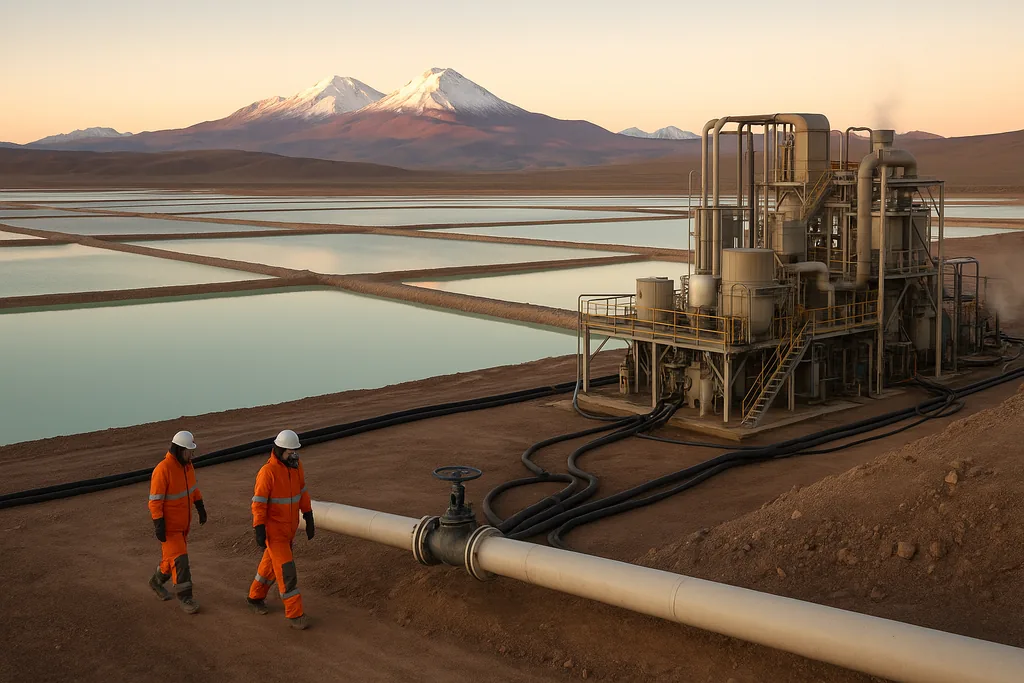
China’s state press reported this week that Qinghai CITIC Guoan Technology Development Co. has put a 20,000‑tonne production line into operation that uses a new, multi‑patent process to extract lithium from salt‑lake brine. According to the company and domestic media accounts, the method raises recovery from the critical salt‑pan stage from industry averages below 50% to more than 78%, and lifts overall plant recovery from roughly 75.4% to 90.4%.
Technical leap within familiar chemistry
Lithium from salt lakes is a chemical game rather than a hard‑rock excavation: operators concentrate brine, remove interfering ions (notably magnesium), then precipitate or chemically convert lithium into carbonate or hydroxide. Recovery rates in the evaporation and intermediate processing steps determine how much of the metal in a brine ends up as sellable product — and how much ends up lost to ponds, wastes or unrecoverable streams.
Why the numbers matter for Tibet and the plateau
- Higher recovery multiplies the value of each tonne of brine: a jump from ~75% to ~90% overall means a much larger share of in‑place lithium becomes saleable metal, improving project economics even after capital costs.
- Tibet and adjacent Qinghai host many of China’s salt‑lake brine deposits. Some—like Zabuye and parts of the Qaidam Basin—have favourable magnesium‑to‑lithium ratios and have been attractive targets for development. Technology that reduces losses in the salt‑pan stage unlocks more output from those same brines.
- Firms report the new line preserves the ability to recover co‑products such as potassium and boron, which helps overall plant revenue and reduces pressure to prioritise lithium over other resources embedded in brines.
What likely changed, and what remains opaque
The industry is littered with incremental improvements: better adsorbents, improved membrane materials, optimized multi‑stage electrodialysis and tighter integration between potash and lithium circuits. The claim of multiple patents points to a packaged process rather than a single magic step. But two caveats matter:
- Published recovery gains are company figures and, as with many industrial rollouts, require independent verification and operational run‑time to confirm they hold at scale across different brine chemistries.
- Higher recovery often comes with higher upfront capital and operating costs (membrane replacement, chemical reagents, energy for pumps or thermal steps). The net economic gain depends on the balance between yield improvements and these additional costs.
Economic and market implications
If the technology reliably produces battery‑grade lithium at the claimed yields and cost points, it could hasten new capacity coming online from Qinghai and Tibet. That would increase near‑term supply of a metal central to electric vehicles, grid storage and consumer electronics — and put downward pressure on global lithium prices over time.
For China, more profitable plateau extraction strengthens a strategic supply base: it lowers per‑unit costs for domestically produced battery feedstocks and reduces reliance on imported hard‑rock concentrates or South American brine output. The timing matters because automakers and battery makers are sensitive to raw‑material cost swings and to long‑term supply visibility when making investments.
Environmental and social trade‑offs on the plateau
Higher recovery does not eliminate environmental costs. Salt‑lake extraction is water‑intensive and transforms landscapes: solar ponds alter evaporation patterns, and some chemical routes generate waste streams requiring treatment. Tibet’s high‑altitude ecosystems are especially sensitive—permafrost, glacier melt and downstream river systems that supply billions are all at risk if industrial activity is poorly managed.
Practical constraints still limit rapid expansion in many Tibetan sites: extreme altitude drives up construction and labour costs, terrain can restrict the area available for salt fields, and logistics add to capital intensity. Those real‑world limits mean higher recovery improves profitability but does not automatically remove environmental or operational hurdles.
Geopolitics and supply‑chain resilience
Any credible improvement in China’s low‑cost, high‑volume production strengthens its global leverage over battery‑grade lithium supply. That sits alongside broader strategic concentrations — such as China’s share of battery manufacturing and refining capacity — and will factor into how policymakers in consuming countries think about diversification and strategic stockpiles.
At the same time, more economic output from domestic plateau brines could ease some global scarcity pressures that in past cycles pushed prices to extremes. For manufacturers and investors the key questions will be speed of rollout, cost trajectory, and whether new capacity is concentrated or broadly dispersed across multiple operators and basins.
Short‑term watchers and longer‑term tests
Expect three near‑term developments to judge how consequential this announcement is:
- Independent confirmation of production statistics and product quality from the new Qinghai line over several months of steady operation.
- Market response: announcements of follow‑up lines, investment plans in other plateau projects, and any immediate effect on spot lithium pricing or offtake negotiations.
- Regulatory and environmental scrutiny: provincial and central authorities in China will be under pressure to demonstrate oversight of water use, waste disposal and community impacts as production scales.
The technology claim is plausibly important: boosting salt‑pan and overall recovery can tilt many marginal operations into profitability and change the economics of where future capacity is built. But the gains are not automatic—environmental constraints, logistics, and the cost of deploying and operating the new processes will determine whether this breakthrough reshapes global lithium supply or simply accelerates capacity in a handful of favourable basins.
Sources
- Qinghai CITIC Guoan Technology Development Co. (company press materials and Chinese domestic reporting)
- Salt Lake Research Institute, Chinese Academy of Sciences (technical background on brine chemistry and processing routes)
- Shanghai Metals Market (SMM) industry reports on salt‑lake extraction technologies and cost curves




Comments
No comments yet. Be the first!