A Cambridge startup joins the global sprint
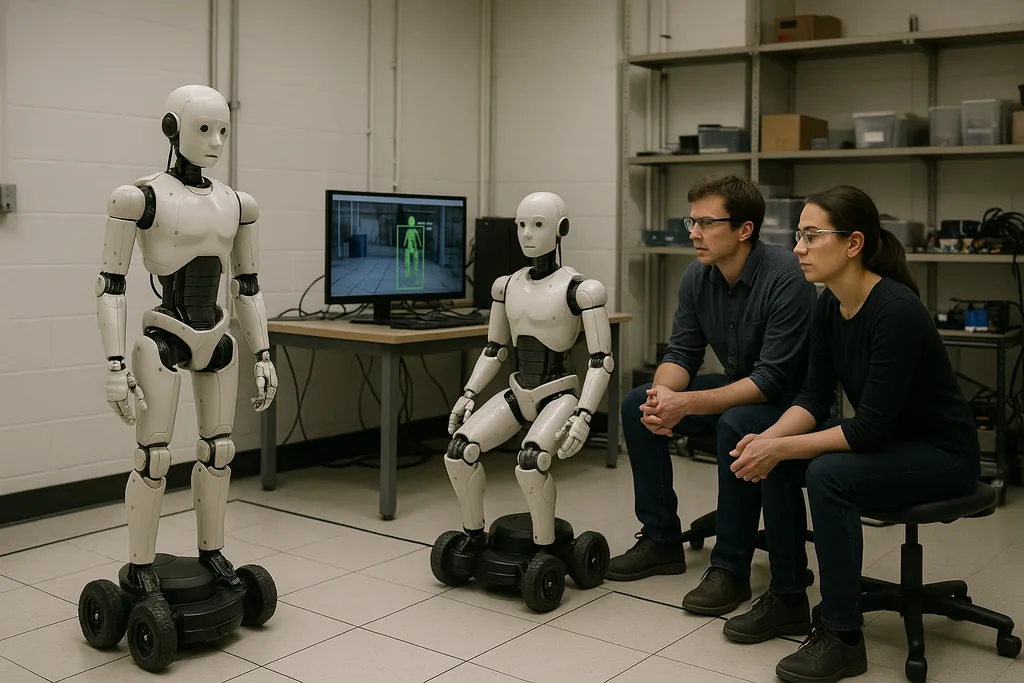
Meet canadian team racing to build the next generation of AI-powered workers: this week a Cambridge, Ontario startup called Mirsee Robotics showed off its MH3 prototype as it prepares to move from lab builds to higher-volume manufacturing. The company’s CEO, Tarek Rahim, told reporters the third-generation MH3 has a Canadian-made vision stack, on-board AI for basic tasking and a deliberate design choice that sets it apart from much of the viral humanoid footage coming out of China: the MH3 moves on wheels, not two legs. That choice is about uptime, stability and battery life—practical trade-offs for machines intended to work on factory floors and in warehouses rather than on stage.
The Mirsee demonstration—locating a water bottle with machine vision, grasping it and carrying it—looks modest beside viral kung-fu routines, but Rahim argues those modest tasks are the hard ones when you want a robot to reliably replace a human on a repetitive shift. Mirsee says it has two of the latest robots and expects to build six more this year, and plans a mass-production model next year. The timeline, and the language of mass production, helps explain why venture money, supply-chain bottlenecks and government policy are suddenly centre stage in conversations that were academic just a few years ago.
Meet canadian team racing: industrial design choices and timelines
Mirsee’s approach illustrates the central engineering and business questions for groups trying to field AI-powered workers. One immediate question is whether a future workforce of robots should mimic human locomotion or borrow simpler mechanical solutions. Mirsee’s wheels trade mobility for endurance. That reduces the need for fast balance control and complex actuation, which in turn lowers energy draw and improves uptime—key metrics for factory managers comparing capital costs with labour costs. Other companies in Canada and abroad are choosing different trade-offs: Sanctuary AI and Agility Robotics pursue anthropomorphic motion because it unlocks more human-centric environments, while companies like Unitree and many Chinese firms have shown rapid mechanical progress that emphasises dynamic motion and cost performance.
Sensors, software and the supply chain
At the technology level, the next generation of AI-powered workers is a stack of several interdependent components: perception, manipulation, planning and power. Perception uses camera-based vision systems, lidar in some cases, and task-specific sensors. Mirsee emphasises its Canadian-built vision stack; Forcen, a Toronto company, recently closed funding to scale force-sensing prototypes that let robotic hands detect contact and adjust grip. Those tactile and force sensors are essential for handling irregular items—a carton versus a fragile bottle—without human oversight.
On the software side, companies are integrating large language models, transformer-based perception networks, reinforcement-learning controllers and deterministic motion planners. The LLM layer is increasingly used for higher-level task sequencing—mapping an instruction like “pack these five items” to a sequence of perception and manipulation subroutines—while lower-level controllers run on edge hardware for latency and safety. That split between cloud and edge is a critical design decision: it affects real-time safety, data bandwidth, and whether a fleet can operate during network outages.
Finally, everything depends on semiconductors, power and manufacturing supply chains. The broader AI demand for GPUs and custom accelerators has created a scramble for compute that affects robot makers too. Market analysts have been clear that AI’s hardware needs drive chip and power investments; a shortage in either can delay production or make robots economically unviable for some customers.
Policy, jobs and Canada’s competitive posture
Canada’s strengths—research clusters, startups and established industrial firms—are clear, but policy and talent gaps could slow adoption. A Deloitte Canada report cited low preparedness across many workplaces: organisations are interested in AI but lack the staff and training to deploy it safely. Mirsee’s CEO publicly urged more federal support for robotics; at the same time the federal Strategic Innovation Fund has invested tens of millions in semiconductor packaging and quantum partnerships with firms such as IBM in Bromont, Quebec, signalling a government awareness that advanced hardware ecosystems matter if Canada wants a role in manufacturing AI systems domestically.
The employment effects are complicated. The immediate gains are on productivity—robots can reduce turnover in dull, repetitive roles and lower production cost—but displacement is real. Historical automation waves created new roles in maintenance, programming and supervision, and many researchers expect similar rebalancing with robotics: demand for robotics technicians, site integrators and AI safety engineers will grow. The timing and scale of that transition will determine whether communities face disruption or faster economic growth.
What technologies define the next-generation AI worker?
The menu of enabling technologies is long. Visual perception and depth sensing, high-bandwidth edge compute (NVIDIA-style GPUs or custom accelerators), force and tactile sensing, modular grippers, and robust battery systems are the obvious hardware pieces. On the software side, companies use a mix of classical motion planning, reinforcement learning trained in simulation, and foundation models adapted for task planning. Safety layers—both software watchdogs that constrain motions and physical fail-safes—are mandatory in industrial settings.
New entrants such as AutoAlign have spun out solutions intended to secure LLMs and reduce hallucinations or unsafe actions, recognising that an agentic AI in a moving body needs stricter controls. At the same time, the industry is learning from other areas of AI: the child-safety measures big firms agreed to for generative systems illustrate how governance frameworks can be developed collaboratively. Robotics will require the same level of multi-stakeholder coordination: manufacturers, operators, unions, regulators and researchers will need common standards for certification and auditing.
Benefits, risks and how Canada can position itself
The benefits are tangible: improved workplace safety, lower unit costs for repetitive tasks, and the ability to automate roles where labour is scarce. Canada’s industrial base—automotive, food processing and logistics—could see productivity gains if the technology is affordable and reliable. But risks include job displacement, concentration of manufacturing and cloud infrastructure in a few global hubs, and the social effects of rapid change.
To capitalise, Canada needs a three-part strategy: targeted public funding for hardware and packaging facilities, investment in workforce retraining and mid-career robotics education, and incentives that encourage local assembly and software development. Existing moves—like Strategic Innovation Fund support for IBM’s Bromont facility and grants for sensor companies—help, but Deloitte’s talent warnings show more work is required to keep domestic capability from evaporating into larger markets abroad.
For Canadians wondering what the project looks like on the factory floor: expect wheeled, purpose-built machines to appear in distribution centres within a few years, with humanoid or more general-purpose platforms appearing more slowly as safety, cost and regulatory regimes mature. The technology stack—vision, force sensing, LLM planners, edge compute—already exists; the challenge is integrating it into systems that run economically and safely for years on end.
Sources used for this reporting include company briefings and industry research from Canadian institutions and government programmes.
Sources
- Deloitte Canada (Future of Canada Centre)
- Government of Canada Strategic Innovation Fund documentation
- Thorn (child-safety organisation)




Comments
No comments yet. Be the first!