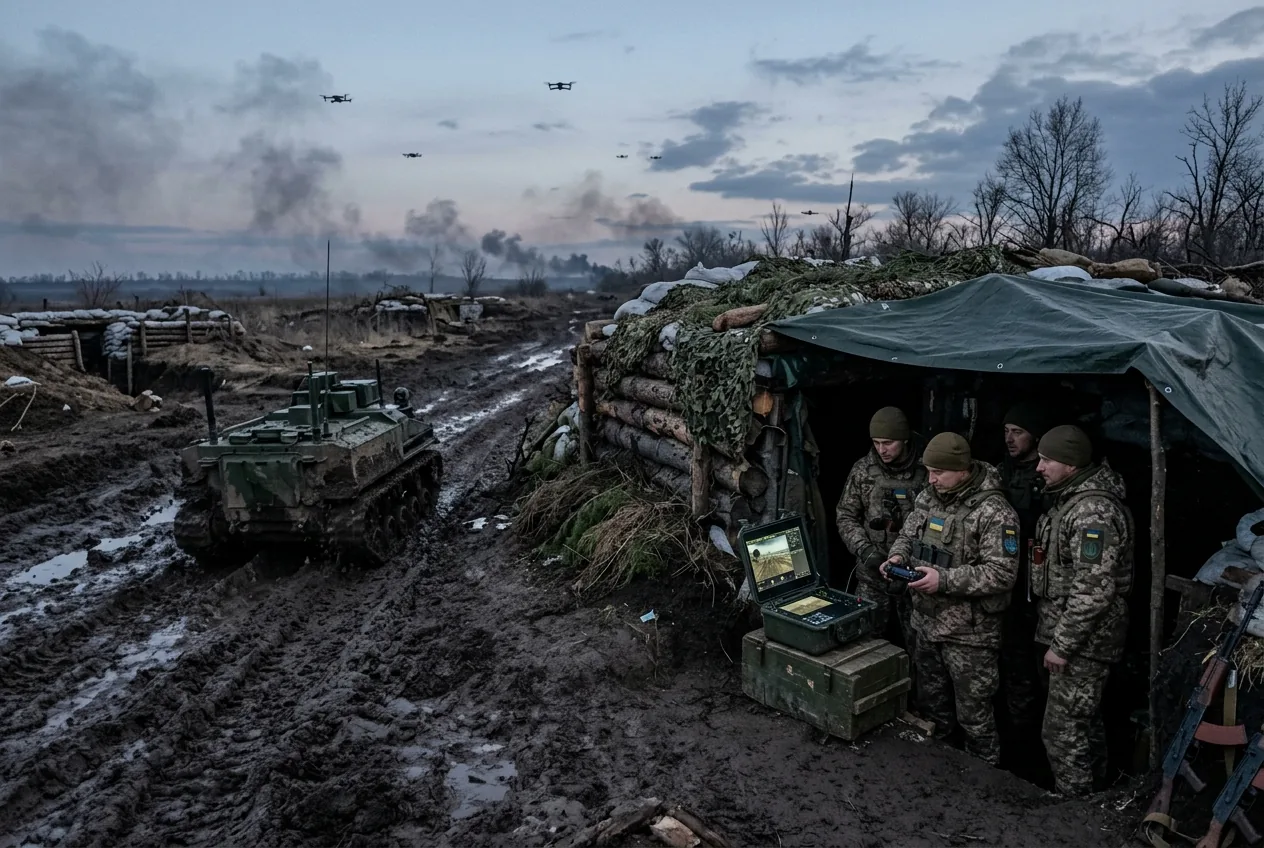
A tracked land robot rolled up to a dugout outside Pokrovsk, lowered its ramp and spooled out a crate of ammunition while Russian artillery smoke still hung in the trees. The soldier watching a small screen did not sprint across open ground; he breathed, pushed a joystick and waited for a teleoperated arm to bring the supplies into the shelter. Nearby, a UGV clanked away towards the next position — mundane, noisy and built to be expendable, not cinematic. A young operator laughed dryly as it rolled into the night: "It doesn't complain when you hit it with shrapnel. It also doesn't get tired."
That scene has become a recurring image of Ukraine’s evolving tactics. Unmanned systems—from backyard-built tracked cargo carriers to the Brave1 programme’s fielded kit, full-size remote gun trucks and coordinated aerial swarms—have shifted from experiments to core assets for resupply, scouting and attack. The immediate payoff is tangible: fewer exposed patrols, faster logistics and new strike options. But those battlefield wins expose a different struggle far from the dirt and shelling: who supplies the sensors, chips and spare parts when attrition is treated as a feature, not a bug?
Variety on the ground, and the attrition that follows
On the eastern front the catalogue of UGVs is broad: cargo carriers that deliver ammo, tug-like platforms for casualty evacuation, small assault robots armed with remotely operated machine guns, and mine‑laying rigs. Ukrainian units report thousands of ground‑robot missions per month; one unit said it ran more than 7,000 UGV sorties in January alone, a scale that changes how commanders plan movement and supply. Yet attrition is severe where air control and electronic warfare are contested — front-line officers describe losing multiple robots per day to jamming and loitering munitions — and those losses are consciously budgeted as a trade-off to keep infantry safer.
Human control now, pressure toward autonomy later
Most systems in use retain a human in the loop for lethal decisions, and manufacturers advertise human approval as a design constraint. Still, demonstrations on the battlefield show increasing autonomy: aerial swarms that coordinate flight paths, drones that confirm strikes, and pathfinding algorithms that let ground robots keep moving when signal links are degraded. In contested electronic environments the calculus changes — if communications are jammed, preprogrammed autonomy becomes an operational necessity rather than a theoretical risk — and that movement from supervised tools to capable autonomy is where legal and ethical red lines are being stress‑tested under fire.
Logistics and tactics: robots change how wars are supplied
Robots reconfigure tactical problems in predictable but consequential ways. Logistics becomes stealthier and distributed: small, frequent deliveries replace large convoys; reconnaissance shifts from episodic sorties to continuous sensing; and attrition warfare prizes producers of cheap, repairable platforms much like shell factories mattered in past wars. That means the battle is no longer confined to maps and trenches — it migrates to workshops, semiconductor lines and shipping routes where components and replacements are sourced.
The industrial bottleneck Europe cannot ignore
The industrial dimension is the quiet strategic story. Ukraine’s innovation ecosystem mixes improvised local tinkering with Western-supplied modules and venture-backed startups, producing prototypes in days and fielding iterations quickly. But scaling to thousands of attritable units requires resilient supply chains for computing, power electronics and sensors — areas where Europe has mechanical and machine‑tool strengths but not a single dependable, end‑to‑end supplier network. Germany has the machine tools; Brussels holds funds and regulatory levers. What neither currently has is coordinated, patient procurement that guarantees production continuity through attrition cycles.
Autonomy, norms and the international patchwork
Diplomats have described the shift to weaponised autonomy as an "Oppenheimer moment" for the current generation—a shorthand for the ethical alarm bells now ringing in Vienna and other capitals. NGOs and some states press for binding limits on systems that remove predictable human control from lethal decisions, while major militaries simultaneously invest in swarms and attritable autonomous tools to blunt peer threats. The practical consequence is a fragmented regime: rapid operational adoption on the ground with slow, uneven regulation above. The more degraded the battlefield’s communications, the stronger the incentive to accept autonomy as a robustness strategy, lowering the threshold for fully removing human sign‑off.
Brussels, Berlin and the arithmetic of sovereignty
For European industrial‑policy audiences Ukraine is both a live testbed and an uncomfortable mirror. Field trials accelerate iteration, but EU procurement, export controls and certification still lag the battlefield reality they are supposed to regulate. If Europe intends to supply coalition partners and secure its own forces, it needs shared standards for electromagnetic resilience, clear export licensing for dual‑use modules and financing that sustains production through wear and tear — not just innovation grants. Otherwise the bodies of European robots will be built locally while the critical ‘‘brains’’ — cameras, chips and specialised power electronics — come from overseas, turning a tactical advantage into a strategic dependency.
There are also thorny legal and technical governance questions. Who is accountable when a semi‑autonomous system errs under electronic attack? How are target‑recognition models audited and logged after a strike? Those issues have engineering solutions — tamper‑resistant logs, explainable classifiers and audit trails — but they require regulatory teeth and cross‑border cooperation to be credible in practice.
On the ground the calculus remains starkly pragmatic: the machines save lives and simplify certain tasks, even as they create new vulnerabilities in chips, networks and factories. For policymakers, Ukraine’s robotisation is a hurry‑up call: treat autonomous systems as an industrial, procurement and regulatory programme of the same scale as tanks once were, or accept that someone else will make the cheap cameras and the compute. Europe can build the frames; someone else will sell the brains — unless Berlin, Brussels and industry decide to stop treating this as an abstract ethics debate and start treating it as a supply‑chain, standards and financing problem.
Outside a roadside village at dusk, a young operator watched his UGV fade into the trees and shrugged. "It doesn't complain when you hit it with shrapnel," he said again. "It also doesn't get tired." It is a practical line, and for now it explains why Ukraine’s robots offer hope: hope that is costly, fragile and fiercely political.
Sources
- International Institute for Strategic Studies (IISS)
- Future of Life Institute (autonomous weapons conference materials)
- Ukrainian Ministry of Digital Transformation / Brave1 programme
- U.S. Defense Innovation Unit (DIU)




Comments
No comments yet. Be the first!