TransAstra's gambit lands in the open: an audacious, testable idea
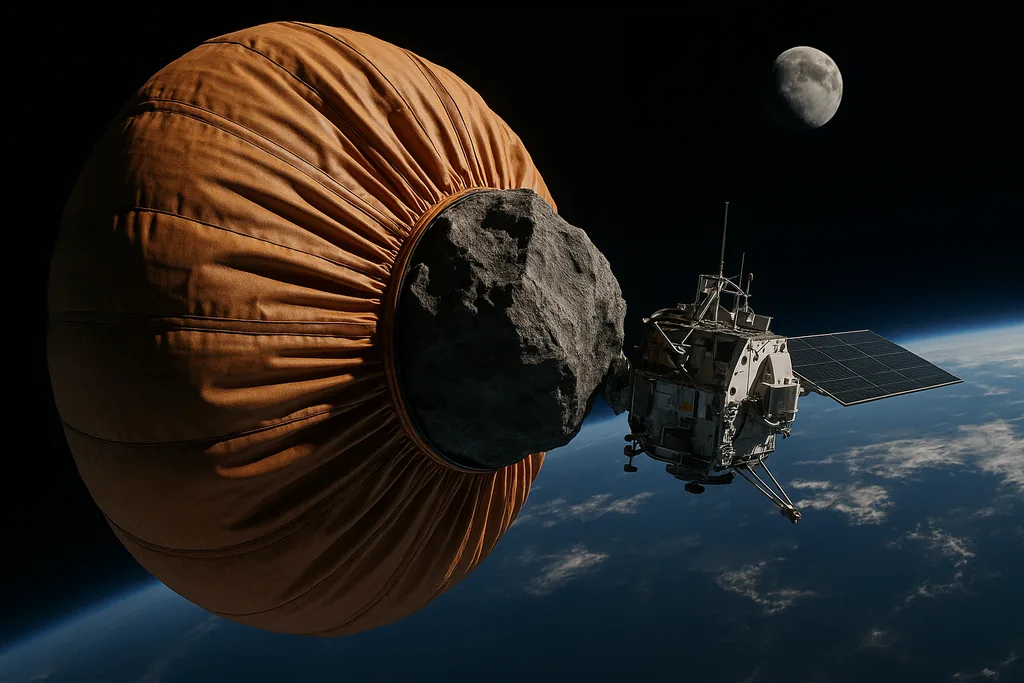
This week a Los Angeles startup gave the space industry a high‑concept jolt: the proposal to literally catch a house‑sized asteroid in a giant inflatable capture bag and tow the 100‑ton rock into a stable near‑Earth location for mining. The phrase inside audacious plan bag captures the project’s mix of big‑thinking and concrete engineering—the company calls the concept New Moon, and has run hardware into space, won a small NASA contract, and is completing a feasibility study funded by an unnamed customer. If the plan stays on schedule, TransAstra says a retrieval mission could fly as early as 2028.
Inside audacious plan bag: how the capture bag works
The core trick is disarmingly simple: instead of clamping onto a tumbling rock with rigid grapples, a service spacecraft would envelop a small asteroid in a flexible, laminated bag, cinch it closed and use its own propulsion to escort the mass to a benign orbit. TransAstra has built prototype bags from space‑qualified laminates such as Kapton and tested a one‑metre demonstrator on the International Space Station’s Bishop airlock. That experiment, conducted in October 2025, demonstrated inflation and repeated deployment in vacuum—an essential de‑risking milestone.
Scaling that hardware is nontrivial. The operational bag the company plans is roughly 10 metres across to swallow a ~20‑metre or smaller object weighing on the order of 100 metric tonnes, and it must cope with irregular shapes, loose regolith that can shift, and residual rotation. The bag concept avoids brittle mechanical contact and provides some flexibility with momentum damping, but it still requires precise navigation, soft‑capture algorithms and fail‑safe plans for partially captured or fragmenting targets.
In practical terms the capture stage combines proven elements—pressurised inflatables, robotic actuators, and autonomous rendezvous software—with novel operational choreography. The company has slated a full‑scale bag test at a Jet Propulsion Laboratory high bay to simulate the real dynamics, a necessary step before committing to flight hardware for an actual asteroid rendezvous.
Inside audacious plan bag: propulsion, tracking and rendezvous
Bagging an asteroid is only half the challenge—moving it is the other. TransAstra proposes using its Omnivore Solar Thermal Propulsion architecture to provide the long, gentle thrust needed to change the rock’s orbit without massive chemical stages. Solar thermal or other electric propulsion approaches are attractive because they deliver high specific impulse, cutting the propellant mass required to tow tens to hundreds of tonnes across interplanetary space.
Accurate target selection and tracking are critical. The ideal candidates are small near‑Earth objects—C‑type bodies for water, M‑type for metals—no bigger than about 20 metres so they can be bagged and towed without prohibitive delta‑v. Finding those meter‑to‑tens‑of‑metre rocks has been difficult, but new survey assets such as the Vera C. Rubin Observatory and a distributed network of Sutter telescopes (deployed by TransAstra with Space Force funding) are rapidly populating the catalog of candidate objects.
The rendezvous phase requires autonomous station‑keeping, fine‑grain optical navigation and adaptive control to approach a spinning, lumpy body. That hardware and software exist in derivative form—sample return missions and rendezvous spacecraft have done the heavy lifting—but marrying them to the inflatable capture method and prolonged towing operations introduces new engineering regimes to prove in ground and orbital tests.
Economics and timelines for a toe‑in‑the‑water industry
Asteroid retrieval is often framed as either wildly speculative or inevitably revolutionary. The real answer sits between: high risk, high potential reward. TransAstra’s estimate for an initial New Moon mission is in the range of “a few hundred million” dollars—far below the billion‑plus price tag of an OSIRIS‑REx‑style science return but still heavy for a private demonstrator. The company has secured a modest NASA contract (about $2.5 million) and matching private funds to push the study and testing forward.
Why bother at all? In‑space resources change the fundamental economics of exploration: water harvested from a captured asteroid can be split into hydrogen and oxygen for propellant, dramatically lowering the cost to refill spacecraft in cislunar space. Metals and regolith can be used for radiation shielding, construction material or feedstock for additive manufacturing in microgravity. TransAstra’s long‑range vision is to capture dozens and eventually hundreds of rocks across the 2030s and scale toward millions of tons over decades—an industrial‑scale shift that would undercut the cost of lifting propellant from Earth.
That said, timelines from capture to profitable mining are measured in years. After a retrieval, operators would need to build and commission robotic processing hardware at the destination (Earth‑moon system or Earth‑Sun L2), which itself will be costly and time‑consuming. Early missions are likely to be technology demonstrations and service‑provisioning (water and shielding) rather than immediate, large‑scale metal exports to Earth’s markets.
Legal, safety and environmental challenges to a near‑Earth asteroid industry
Moving a mass into Earth‑near space raises policy and safety flags as quickly as it does engineering ones. International law is thin on resource extraction; the Outer Space Treaty bars national appropriation but leaves private exploitation in a grey area that national laws and licensing regimes are beginning to fill. Any company hauling material into the Earth‑moon system will need clear domestic authorization and international coordination to avoid diplomatic friction and ambiguity over resource rights.
Safety concerns are immediate and practical. A failed tow or a fragmented capture could produce orbital debris or send fragments on uncontrolled trajectories that endanger satellites or even risk reentry. Operators will have to demonstrate robust collision‑avoidance plans, secure long‑term orbital disposal strategies and comply with space traffic management rules. Planetary‑protection‑style constraints—designed to avoid biological contamination—are less applicable for inert asteroidal rock, but best practice will demand careful evaluation of any rendezvous that brings mass into cislunar resonant points.
There are also environmental and ethical questions: who decides which asteroids are fair game, and could a future market for space resources distort priorities away from recycling terrestrial materials? The U.S. mine‑waste literature shows large, recoverable stocks already on Earth; policymakers will have to weigh investment in off‑world mining against terrestrial recycling and efficient use of existing resources.
From capture to mining: operations, timescales and likely first products
Once in a stable parking spot—TransAstra suggests the Earth‑moon system or the Earth‑Sun L2 point—an asteroid can be turned into a robotic outpost for materials processing. The first operations will be conservative: characterise the rock remotely, stabilize any rotation, open a controlled access port and begin extracting volatile components such as water. Water is the low‑hanging fruit: its value as propellant and radiation shielding in space is immediate and easier to monetise than exporting bulk metals to Earth.
Establishing the processing chain—cracking rock in microgravity, separating minerals, storing cryogenic propellant—will take years and multiple missions. The earliest commercial payoffs are most plausible as in‑space services: selling propellant, supplying life‑support water, and providing bulk shielding or construction feedstock to other cislunar infrastructure projects. Exporting raw metals to Earth remains the most expensive and least likely near‑term outcome because launch and reentry logistics and Earth market dynamics make that pathway costly.
What stands between idea and reality
TransAstra’s bag‑and‑tow plan is technically ambitious but rooted in stepwise testing: prototype bags on the ISS, ground validation at JPL, and system integration with evolving survey assets. That pragmatic ladder—incremental flight tests, demonstrator missions and careful tracking—improves feasibility compared with a single grand step. Yet challenges remain: reliably finding suitable targets, ensuring safe rendezvous and tow, building durable orbital processing facilities, and securing the regulatory ecosystem to permit operations.
Economically, the venture is a bet on demand for in‑space resources. If cislunar infrastructure and human missions scale as planners hope, the value of local water and materials could collapse current assumptions about launch economics. If demand stalls, the sector could remain an expensive novelty. Either way, the New Moon concept has shifted the conversation from the purely speculative to a testable engineering roadmap—one that will be watched closely by agencies, investors and the growing community of space operators.
TransAstra’s idea may sound cinematic—an inflatable bag scooping a rock out of deep space—but the company has already turned prototypes into orbital tests and matched principal engineering choices (solar thermal towing, autonomous rendezvous, survey networks) with available infrastructure. Whether the industry blossoms or stalls will depend as much on policy, markets and safety rules as it does on whether the bag inflates and the tug has enough thrust to drag a house‑sized rock into a parkable orbit.
Sources
- TransAstra (company materials and New Moon proposal)
- NASA (ISS hardware tests, OSIRIS‑REx mission)
- Jet Propulsion Laboratory (spacecraft assembly and test facilities)
- University of Hawaii (near‑Earth object expertise)
- Vera C. Rubin Observatory (survey discovery capacity)
- U.S. Space Force (funding for tracking telescope deployments)




Comments
No comments yet. Be the first!