Smoke, feeds and split‑second choices
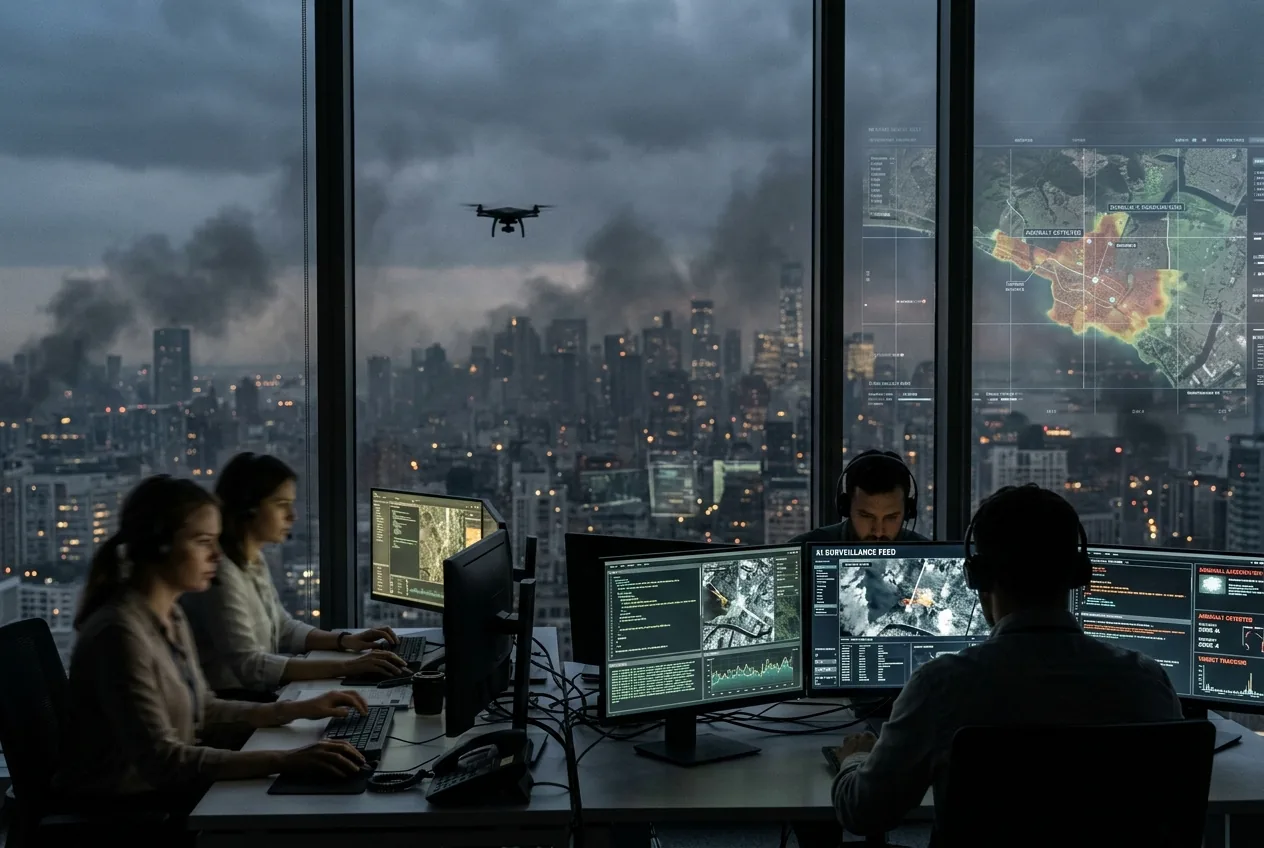
Smoke rose over Tehran after a night of strikes and within hours analysts on multiple continents were combing imagery, intercepts and social posts to build a picture of what had happened. Aerial footage, satellite captures and cellphone videos are stitched together by algorithms that can geolocate a blast, identify the model of an incoming drone and rate the credibility of a social post—all faster than any human team could. This tangle of surveillance, swarm tactics and digital persuasion is exactly how AI is being used iran war, reshaping both the tempo of conflict and the pathways by which civilians receive information.
Why the pace matters
That acceleration is not abstract. When raw sensor data becomes a near‑instant targeting recommendation, commanders face compressed timelines: verify, authorise, strike. The technical gains—computer vision that flags vehicles, pattern recognition that detects launch signatures, language models that summarize intercepted chatter—translate into operational speed and, crucially, into new risks. False positives, misattributed footage and algorithmic blind spots can turn a noisy data point into a strategic error. For European policymakers and defence planners, the question is no longer whether AI will change warfare; it is how to govern systems whose errors play out in real time on crowded urban battlefields.
Targeting and ISR being used iran war
On the ground and in the air, artificial intelligence is deployed chiefly as an augmentation to intelligence, surveillance and reconnaissance (ISR). Computer‑vision models sift imagery from drones and satellites to detect launchers, convoys or damaged infrastructure. In practice this means automated filters prioritise promising frames for human analysts, object‑tracking algorithms follow moving targets across camera feeds and geolocation tools match landmarks to open‑source maps. These tools shorten the cycle from detection to engagement, which is why militaries prize them.
Iran and its adversaries employ a mix of these capabilities. Iran has invested heavily in drones and loitering munitions that can be guided semi‑autonomously; image‑classification software helps operators discriminate between civilian and military infrastructure—at least in theory. Israel and the United States, with broader access to advanced chips, cloud infrastructure and commercial AI systems, tend to run larger, more integrated ISR stacks that combine multi‑spectral satellite data, signals intelligence and machine‑learning models trained on larger datasets. The difference is not only technical sophistication but also supply‑chain access: sanctions and export controls constrain how quickly Tehran can field the most advanced accelerators and cloud services.
Propaganda and influence being used iran war
Warfare now routinely has a parallel front: information. Social platforms, messaging apps and murky botnets are fertile ground for automated influence operations. Natural‑language models speed the generation of tailored narratives, translation tools amplify reach across languages and network‑analysis algorithms identify communities most susceptible to particular frames. In Syria we saw the playbook for social‑media warfare; in the current Iran confrontation, those tools are being reused and refined.
Autonomy, decision speed and legal grey zones
Experts split on the right remedy. Some advocates call for strict human‑in‑the‑loop rules: no weapon fires without a human explicitly authorising the action. Others argue that partial automation, where AI manages routine sensor fusion and humans handle exceptions, is more realistic on a fast battlefield. The policy tension matters to European capitals: impose too rigid a limit and allied forces may lose operational parity; impose too lax a standard and ethical commitments to civilian protection erode. This trade‑off underpins current debates in NATO and Brussels about export controls, procurement and ethics guidelines for dual‑use systems.
Cyber, signals and the hidden hand
AI is not only visible in cameras and bots; it also runs quietly inside cyber‑operations and signals intelligence. Pattern‑matching models can sift mountains of metadata to find anomalous command‑and‑control traffic, and automated intrusion tools can prioritise vulnerable targets for exploitation. In a layered conflict like the Iran theatre—where proxies, state assets and commercial infrastructure intermingle—these invisible uses of AI matter more than dramatic drone footage because they shape logistics, communications and the resilience of critical services.
What Iran can—and can't—do with AI
Analysts tend to characterise Iran as an asymmetric power in the AI domain. Tehran has demonstrated clever, cost‑effective applications—mass production of simple loitering munitions, resilient distributed command models inside allied militias, and effective use of social platforms for regime messaging. But it faces limits: sanctions and export controls constrain access to the latest AI accelerators, advanced node semiconductors and large cloud compute, which are material to training the highest‑performing models and running sustained ISR pipelines.
That gap matters strategically. It means Iran often compensates with tactics—scale, deception, and hybrid operations—rather than matching adversaries in raw computational horsepower. Meanwhile, Israel and the United States leverage superior sensors, richer training datasets and commercial AI partnerships to keep an edge. The result is a contested but unequal AI landscape, where ingenuity meets material constraints and where European policy choices about trade and technology transfers can tilt the balance.
Supply chains, sanctions and the European angle
European governments are watching this closely because their industrial policy choices have operational consequences. Chips, specialised sensors and cloud services are the soft infrastructure of modern militaries. Brussels can restrict exports for ethical reasons or loosen them to bolster partners, and Germany—home to advanced engineering firms—finds itself between industry demands and regulatory caution. The wider point is practical: Europe has manufacturing capability, engineering talent and research labs, but it also has rules, procurement inertia and a fragmented market that complicate rapid rearmament.
At the diplomatic level, the United Nations' recent Global Stage discussions underscored another divide: connectivity and access shape whose militaries can adopt AI at scale. The International Telecommunication Union has flagged that without secure networks and broader connectivity, many nations simply cannot leverage advanced AI responsibly. Europe’s response will matter not just for defence but for the ethics and governance regimes that shape how AI is exported, regulated and used in conflict zones.
A human problem in silicon clothing
Technology magnifies pre‑existing political choices. AI models delegate judgment, but they do so based on training data, cost pressures and procurement decisions—all human. The Iran conflict shows both sides using the same toolset—surveillance analytics, automated content amplification, autonomous weapons components—in different combinations determined by access and doctrine. That symmetry means policy levers still work: standards for human oversight, export rules for sensitive components, and greater transparency from private firms can change how the technology is applied.
Brussels has the paperwork; Tehran has the drones. That is progress, but not the sort investors put on a slide deck.
Sources
- United Nations (Global Stage session on AI and the workforce)
- International Telecommunication Union (ITU)
- U.S. Department of Defense (public statements and policy documents)
- Microsoft (contributions to Global Stage discussions on AI governance)




Comments
No comments yet. Be the first!