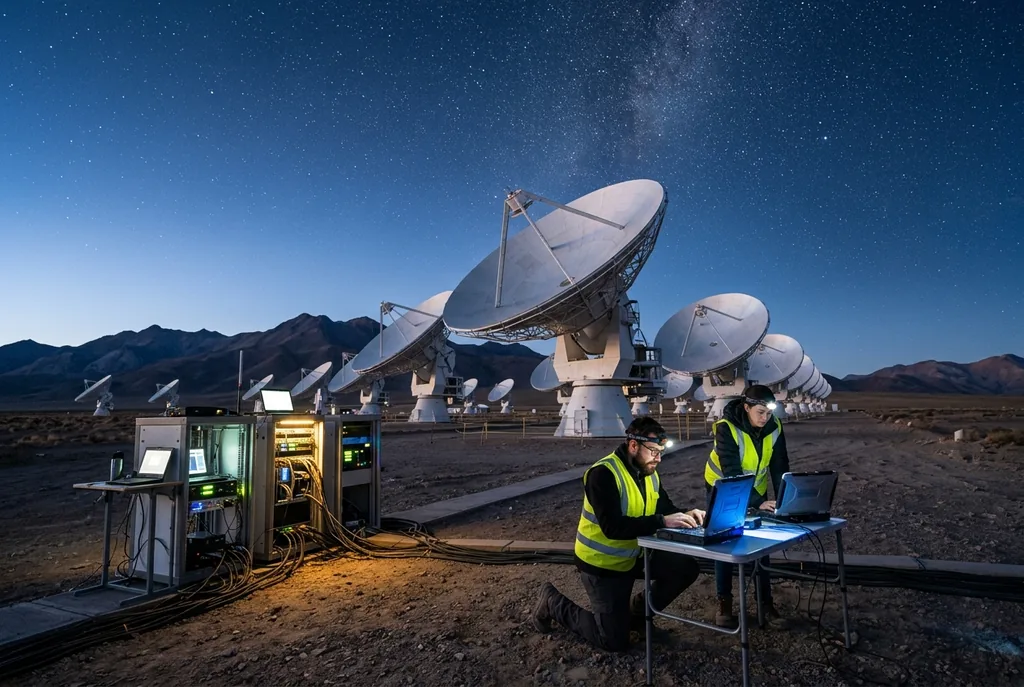
On a chilly February when headlines usually favor rocket launches and budget fights, radio astronomers announced something quieter and more unnerving: a mysterious radio signal from space that repeats on a precise 16.35‑day schedule. The pulses are not a steady beep but clusters of fast radio bursts — brief, intense flashes of radio energy — that show up roughly once an hour for about four days, then fall silent for the following 12 days, and return on schedule. The detections, accumulated by the Canadian Hydrogen Intensity Mapping Experiment/FRB Project between September 2018 and October 2019, trace the source to a galaxy roughly 500 million light‑years away.
The nut: why a 16‑day clock in the sky matters
A clock in the cosmos: mysterious radio signal space shows a 16.35‑day rhythm
The timeline of observations is straightforward and stubborn. Over a 13‑month window, the CHIME/FRB collaboration recorded repeated short bursts at the same sky location. Statistical analysis revealed a 16.35‑day periodicity: during each cycle the source is active for about four days, with detections averaging near one burst per hour in that active window, then staying quiet for roughly 12 days. The team reported the finding in a moderated, not fully peer‑reviewed preprint. Because CHIME surveys a large swath of northern sky every day, it was uniquely positioned to spot and measure this cadence.
How astronomers tracked and confirmed the 16‑day repeating space signal
It is worth stressing what this discovery does not mean. The dataset covers multiple cycles but is not infinite, and the preprint route means the community will continue to test robustness, potential selection effects, and whether subtle changes in rate or activity window occur. Still, the cadence is clean enough to be useful: telescopes now know when to point and when a non‑detection is truly a null result rather than bad timing.
Two leading interpretations: a binary companion or a precessing neutron star
The 16‑day clock immediately narrows the range of viable physical scenarios. One popular class of models places a highly magnetised neutron star — a magnetar — in a binary system. In such a picture, the emission might only be visible during a portion of the orbit because of geometry (an active cone that sweeps past Earth), changing absorption in a companion's wind, or because interaction with the companion triggers emission during parts of an eccentric orbit. A 16‑day orbital period is plausible for a wide, eccentric binary involving a massive companion.
The alternative is that the emitter itself precesses: imagine a wobbling spinning top whose beam gradually points toward and away from Earth, producing an activity window when the beam crosses our line of sight. Precession can be driven by internal stresses in a neutron star, tidal forces from a companion, or by the star's magnetic geometry. Both explanations map naturally onto observed features of repeating FRBs: short, bright pulses from a compact object with a powerful magnetic field, modulated on longer time scales by external or geometric factors.
Why the alien headline is still bad science
When mysterious, periodic signals arrive from deep space the popular imagination runs fast — and for good reason. But scientists are blunt: the energies involved in FRBs are enormous, and producing them repeatedly at extragalactic distances is not the sort of engineering any civilisation could carry out without leaving lighter clues. Researchers, including teams at institutions such as the Massachusetts Institute of Technology, stress that the simplest natural astrophysical explanations are much more probable than any techno‑signal hypothesis. In short, the periodic FRB is an exciting puzzle for high‑energy astrophysics, not a covert message board for interstellar civilisation planners.
What Europe can — and should — bring to the follow‑up
The discovery is a win for wide‑field radio monitoring, but turning a measured cadence into a detailed theory requires coordinated follow‑up across the spectrum. European facilities, from large single dishes to interferometric arrays and very long baseline networks, are well positioned to help: they offer complementary frequency coverage, higher spatial resolution, and the VLBI infrastructure needed to pin the source down inside its host galaxy and local environment. Germany’s radio astronomy community has experience in rapid follow‑up and instrument development, which could be decisive if teams want to watch the source through several scheduled active windows.
There is also a policy angle. European funding mechanisms have been explicit about building observational capacity for transient astronomy, but coordination — who gets time, which instrument is promised to which team, how data are shared — matters. The 16‑day clock gives schedulers predictability, which should make it easier to secure observing blocks during known active windows rather than scrambling for opportunistic ToO time. Still, the institutional dance between national observatories, European facilities and multi‑national collaborations will determine how quickly the source reveals its secrets.
What to watch for next
Expect a flurry of targeted observations during coming active windows. Astronomers will search for correlated emission at other wavelengths, subtle timing drifts that indicate orbital motion, and any changes in the burst properties across cycles. If a persistent radio source or an optical counterpart can be associated with the bursts, it will give direct clues about the local environment — whether the source lives in a dense star‑forming region, a supernova remnant, or a quieter galactic arm.
More broadly, the result forces theorists to make sharper predictions: if the signal is orbital, is the companion massive or compact? If precession, how stable is the wobble? And crucially for observers: the periodicity makes the source one of the rare transients you can schedule to watch deliberately instead of hoping to be lucky.
So yes, there is a mysterious radio signal from space that repeats every 16 days — and for once, the cosmos gave astronomers the luxury of a calendar. It will take coordinated observations, a few clever arguments and perhaps the sort of stubborn German engineering bureaucracy I grudgingly admire to turn this ticking radio source from riddle into mechanism. For now, the universe has set an alarm clock; the question is who will be awake to hear it ring.
Sources
- Canadian Hydrogen Intensity Mapping Experiment (CHIME) / CHIME/FRB collaboration (arXiv preprint reporting 16.35‑day periodicity)
- Massachusetts Institute of Technology (public statement on energetic scales and natural origins)




Comments
No comments yet. Be the first!