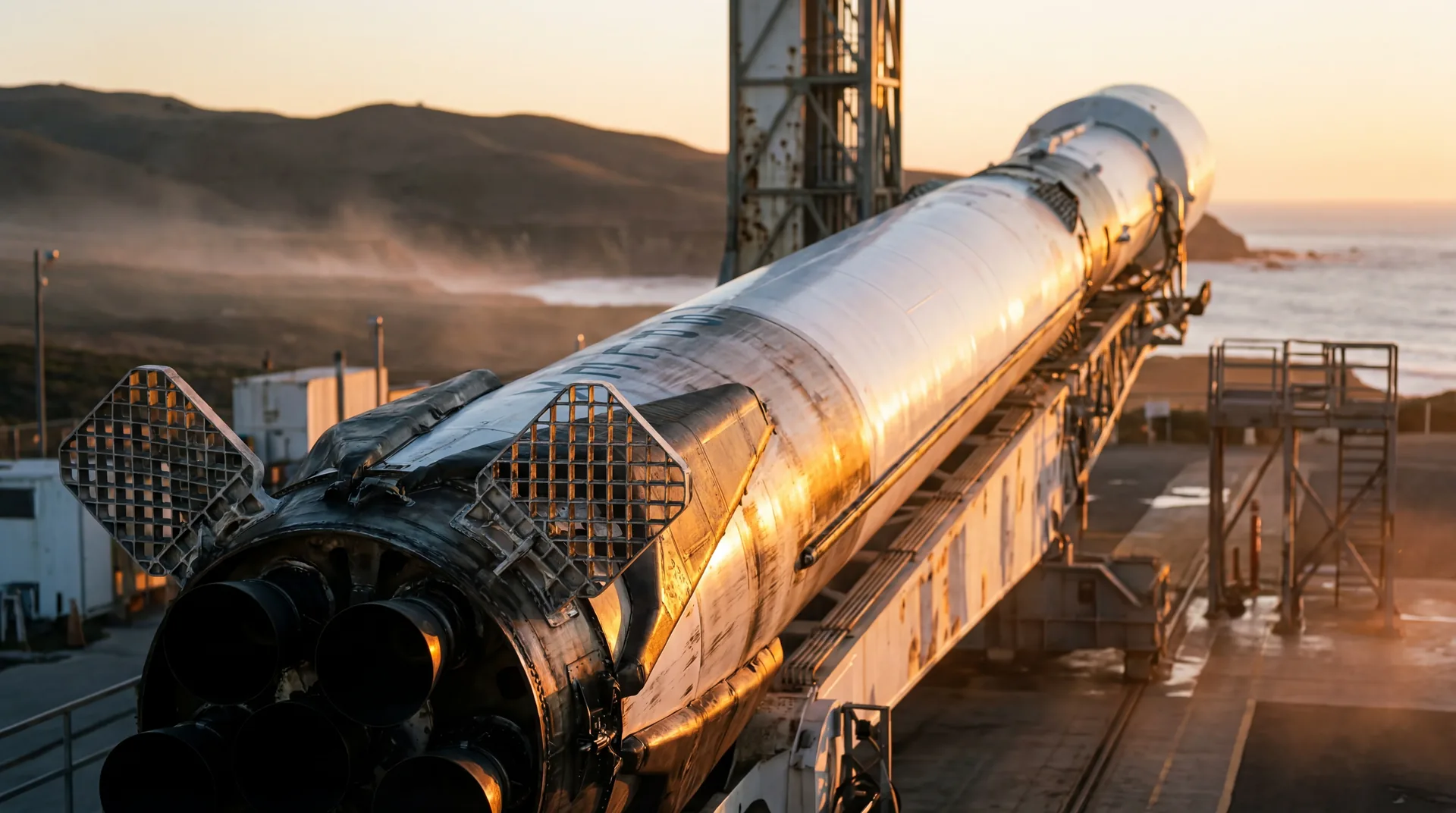

SpaceX’s Transporter-16 mission represents a critical milestone in the "New Space" economy by providing low-cost, scheduled access to orbit for 119 independent payloads. On March 30, 2026, the company successfully prepared its Falcon 9 rocket at Vandenberg Space Force Base for its 21st smallsat rideshare mission. By offering a standardized entry price of approximately $6,000 per kilogram, this program has fundamentally lowered the financial barriers that once prevented startups, universities, and smaller nations from participating in space exploration and commercialization.
How does SpaceX manage 119 independent payloads on one Falcon 9?
SpaceX manages 119 independent payloads on a single Falcon 9 by utilizing a modular rideshare architecture and standardized deployment adapters. This system allows multiple satellites, ranging from tiny CubeSats to larger microsatellites, to be stacked within the rocket's fairing. Each payload is released into a precise Sun-synchronous orbit using a carefully timed sequence to prevent collisions and ensure mission success for every customer.
The logistics of such a massive deployment rely heavily on third-party mission integrators who handle the manifesting and hardware interface for the satellites. For the Transporter-16 mission, Exolaunch managed 57 payloads, representing customers from 12 countries, while Seops Space oversaw 19 payloads, including a mix of 14 CubeSats and five PocketQubes. These integrators use specialized "deployers" that act as the mechanical interface between the SpaceX Falcon 9 and the individual satellites, ensuring that each craft is ejected at the correct velocity and orientation.
Technical precision is paramount when handling over 100 distinct orbital insertions. The Falcon 9’s second stage must execute multiple burns to reach the targeted altitude and inclination before beginning the deployment "bus" sequence. According to Will Robinson-Smith of Spaceflight Now, the first stage booster for this mission, B1093, is completing its 12th flight. This level of reusability is what makes the complex orbital dance of 119 satellites economically viable, as the core costs of the launch vehicle are distributed across dozens of paying customers.
Why is the Transporter program critical for the New Space economy?
The Transporter program is critical for the New Space economy because it provides predictable, high-frequency launch windows at a fraction of the cost of dedicated missions. By consolidating demand, SpaceX has captured more than 50% of the Western smallsat market, allowing companies to focus their capital on research and development rather than launch expenses. This democratization fuels innovation in Earth observation, telecommunications, and orbital manufacturing.
Startups are the primary beneficiaries of this shift in the aerospace landscape. Notable payloads on the Transporter-16 mission include Varda Space’s sixth reentry satellite bus, which is designed for pharmaceutical and material manufacturing in microgravity. Additionally, the Gravitas satellite from K2 Space serves as a high-power "cake topper" for this mission. According to Matt Cooper, Principal Mission Assurance Engineer at K2 Space, Gravitas features a massive 40-meter wingspan and is capable of producing 20 kW of electricity, a feat typically reserved for much larger, more expensive satellite classes.
The economic impact extends beyond individual companies to include sovereign governments and academic institutions. The Transporter-16 manifest includes payloads from 13 different countries, such as Nepal, Vietnam, and Malaysia. This global participation is made possible by the rideshare model, which transforms space from an exclusive domain of superpowers into a shared resource for global scientific advancement. Key benefits of this model include:
- Reduced Launch Costs: Prices are up to ten times lower than dedicated small-lift launchers.
- Reliable Scheduling: Regular "bus routes" to Sun-synchronous orbits allow for better project planning.
- Rapid Iteration: Companies can launch prototypes frequently to test hardware in a live environment.
Are smallsat rideshare missions becoming the industry standard?
Smallsat rideshare missions are rapidly becoming the industry standard as they offer the most efficient path to orbit for the burgeoning commercial satellite sector. While dedicated small launchers provide "white glove" service to specific orbits, the sheer volume and affordability of SpaceX’s Transporter series have forced the market to adapt. Most new satellite constellations are now designed specifically to fit the standard interfaces used in these rideshare missions.
However, the success of these large-scale launches brings new challenges to orbital sustainability. With 119 payloads entering low Earth orbit (LEO) simultaneously, SpaceX and its customers must adhere to strict deorbiting and debris mitigation protocols. Modern smallsats are increasingly equipped with propulsion systems or drag sails to ensure they burn up in the atmosphere at the end of their operational life, preventing long-term congestion in high-traffic orbital planes.
Looking forward, the successful landing of booster B1093 on the drone ship "Of Course I Still Love You" marks another step toward total launch ubiquity. As the company approaches nearly 600 booster landings, the focus shifts from whether a launch is possible to how many payloads can be integrated efficiently. The Transporter-16 mission is a testament to the maturation of the space industry, where the complexity of 119 satellites is no longer a experimental hurdle, but a routine operation of the modern orbital economy.
The future of the program likely involves even larger payloads and more diverse orbital destinations. As companies like K2 Space continue to build bigger, high-power satellites that still fit within the rideshare paradigm, the distinction between "small" satellites and traditional large-scale infrastructure will continue to blur. For now, the Transporter-16 mission stands as a clear signal that the gateway to space is wider than ever before.





Comments
No comments yet. Be the first!