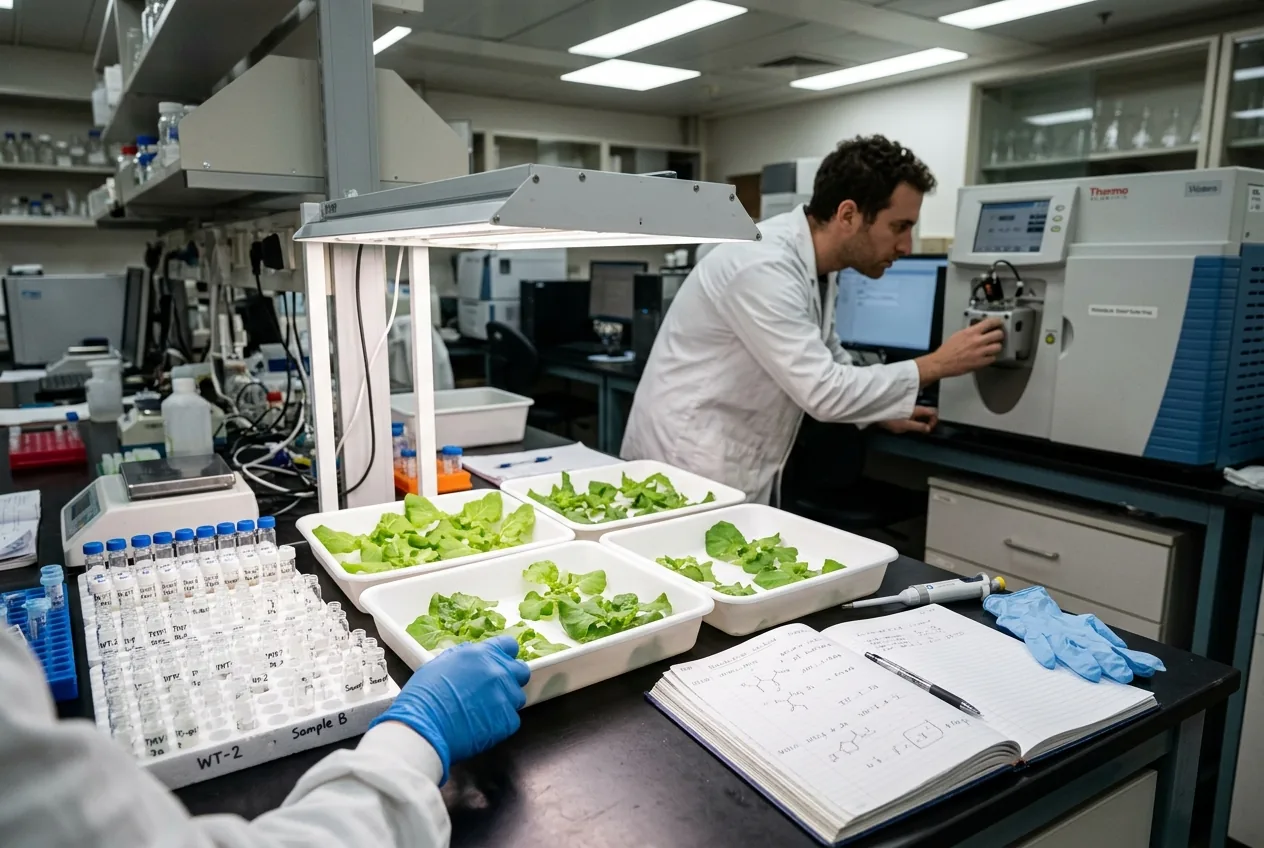
A lab bench that smelled faintly of nicotine and another kind of chemistry
On a Tuesday morning at the Weizmann Institute of Science, fluorescent lights picked out rows of tobacco leaves laid out like pale flags. The unusual thing — beyond the tidy Petri dishes and a mass spectrometer humming in the corner — was that the leaves held tiny amounts of molecules usually associated with mushrooms, toads and ayahuasca. In plain terms: scientists gene hacked plant tissue so a single tobacco leaf contained five different psychedelic tryptamines at once.
That odd tableau is more than a laboratory stunt. It crystallises an awkward trade‑off: a team led from Weizmann says the approach could reduce pressure on vulnerable species and offer a new route to therapeutic compounds, while critics point to low yields, legal grey zones and the ugly possibility of diversion. The tension now sits between a conservation argument and a regulatory reality — and neither side has a clear map for how to handle a plant that makes controlled drugs.
scientists gene hacked plant: the experiment as an unexpected proof‑of‑concept
The group, writing in Science Advances this week, reported inserting genes that enable production of five indolethylamine compounds into tobacco leaves. The list includes psilocybin and psilocin (the active pair in so‑called magic mushrooms), DMT (a component of traditional ayahuasca preparations), bufotenin and 5‑MeO‑DMT (compounds associated with certain toads and plants). Weizmann researchers framed the work as a proof‑of‑concept rather than a ready supply chain: the amounts produced in the leaves were low and deliberately prevented from passing to seeds or the next generation.
scientists gene hacked plant and the conservation argument
One strong thread in the public rationale for the experiment is conservation. The Sonoran Desert toad, known for secreting 5‑MeO‑DMT, has seen increased pressure from collectors and habitat loss. Similarly, increased demand for ayahuasca‑linked botanicals and wild mushroom harvests has raised sustainability alarms. By engineering a common agricultural species to synthesise multiple target molecules, the researchers argue they can offer an alternative that limits wild harvesting and animal exploitation.
That argument is persuasive on paper: fewer poached toads, fewer overharvested patches of rainforest. But conservation gains hinge on scale, traceability and who controls the plants. If yields stay minuscule and purification remains expensive, the replacement never materialises. If, instead, someone optimises the system and commercialises it, the ecological benefit could be real — but only if robust oversight prevents illicit diversion and ensures profits don’t drive new monocultures that bring their own biodiversity costs.
Regulatory tangle and the drug‑policy blindspot
Weizmann’s team intentionally retained control measures — the engineered traits were not inherited, and the researchers kept the work contained in leaves rather than seeds — but those are research precautions, not downstream policy fixes. Regulators will face questions about licensing, containment, transport and whether such plants can be cultivated outside certified facilities. Enforcement agencies also worry about the ease of producing novel supply lines that resemble ordinary crops until analysed in a lab. That mismatch between biotech oversight and drug policy could leave a dangerous interim period where neither system fully addresses the risks.
Therapeutic promise, economics and a practical shortfall
Proponents point to a potential win for drug development and therapy. Psilocybin, for instance, is being trialled for depression and other psychiatric conditions; reliable, scalable sources of pure compound could lower research costs and shorten supply bottlenecks. A green, plant‑based production route could also reduce reliance on complex chemical synthesis or harvesting endangered sources.
But the economic reality is gritty. The amounts produced so far are low, purification from plant biomass is technically challenging, and the cost to bring such a route through regulatory approval — manufacturing licences, Good Manufacturing Practice audits, clinical‑grade purity checks — is enormous. Pharmaceutical companies will weigh whether optimising engineered crops beats existing synthetic chemistry or microbial fermentation platforms, both of which already have regulatory pathways and industrial experience. Right now, the experiment reads as a technological demonstration with commercial potential that arrives only if a long, expensive development path is accepted.
A psychonaut fringe, biosafety worries and enforcement headaches
The other, darker angle is that any visible success invites misuse. If someone were able to iterate the work into a heritable trait or seed stock, ordinary fields could become clandestine labs. Weizmann’s team avoided that route, but the public disclosure itself primes a psychonaut fringe and opportunistic actors. Law enforcement historically lags behind technological shifts; small‑scale, decentralised production could be difficult to detect until it becomes a real supply source.
There are also biosafety considerations. Engineered pathways in plants can interact with local ecosystems in unpredictable ways: horizontal gene transfer, hybridisation with related crops, or metabolic byproducts that affect non‑target organisms are all possibilities regulators must review. The lab precaution of preventing inheritance is crucial, but it is not a long‑term guarantee in agriculture or commercial scaling.
What this means for science, agriculture and public health
At the intersection of synthetic biology and drug policy, this episode forces a choice: treat engineered psychoactive plants as purely agricultural biotech, or fold them into controlled‑drug frameworks with stringent oversight. The decision has broad consequences. A pathway that favours controlled industrial development could support therapeutic research and relieve pressure on wild species. A lax, agricultural treatment risks informal distribution and public‑health harms.
Public health officials must also wrestle with a less technical, more behavioural question: will easier access to plant‑derived psychedelics change patterns of use? That includes risks around unsupervised ingestion, contamination, dosing unpredictability and the potential for novel combinations of compounds — this tobacco, after all, produced five different tryptamines inside a single leaf. Those combinatorial effects are poorly characterised in clinical literature, and they raise real safety concerns that go beyond conservation or supply economics.
The Weizmann work is a striking demonstration that genetic tools can blur old boundaries: traits that used to live in separate biological kingdoms can now be stitched together in a single crop. The result is both an invitation and a warning — an invitation to rethink sustainable sourcing for molecules that have clinical promise, and a warning that policy, enforcement and ethical guardrails are not currently aligned to manage a future where ordinary plants double as chemical factories. If the leaves do leave the lab, the question of where they end up will be decided as much by regulators, lawyers and companies as by scientists.
Sources
- Science Advances (research paper on engineered tobacco producing multiple tryptamines)
- Weizmann Institute of Science (research team and press interviews)
- Miami University (external expert analysis and commentary)




Comments
No comments yet. Be the first!