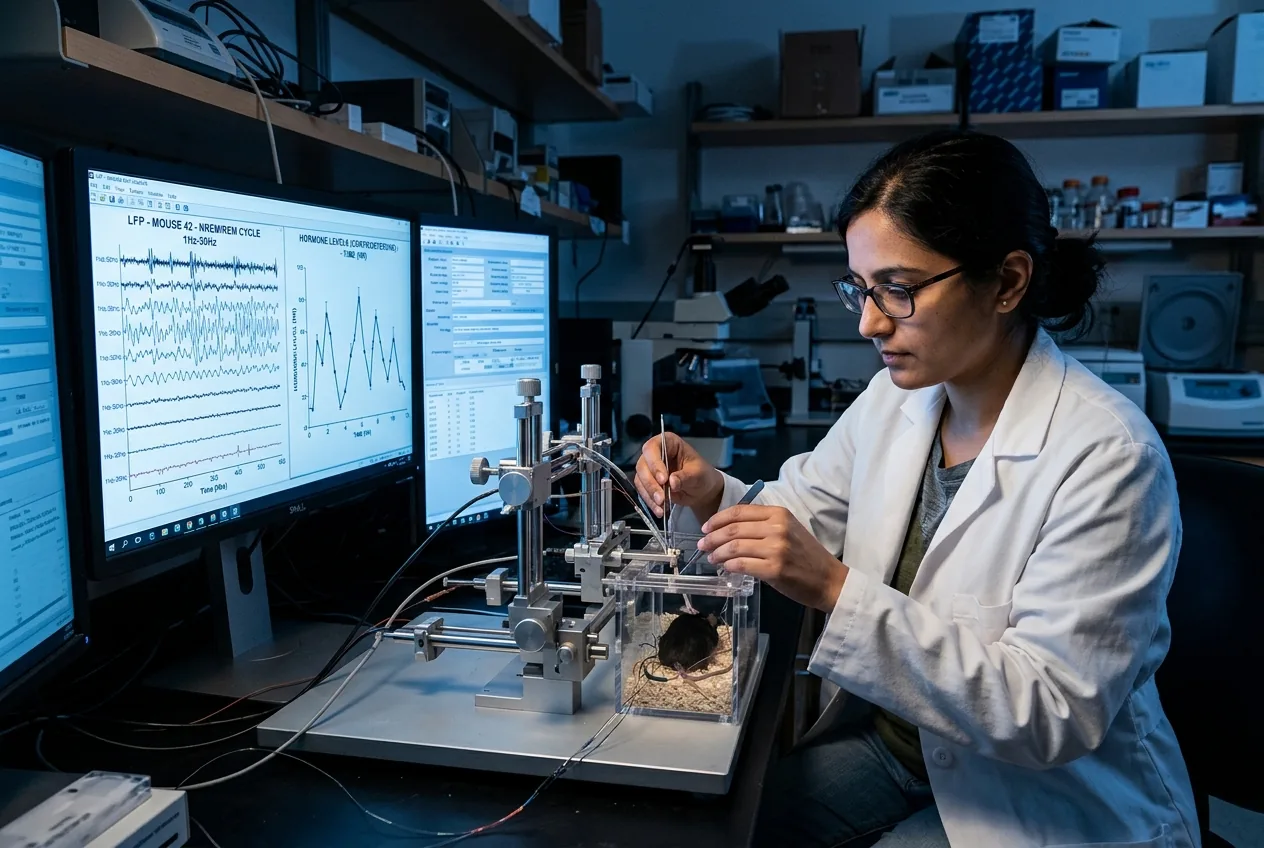
Night at the bench: an electrode, a mouse and a surprising feedback loop
In a dim neuroscience lab at UC Berkeley this week, researchers described a tidy piece of biology that has been hiding in plain sight. Using electrodes and light to probe sleeping mice, the team identified what reporters are calling a "sleep switch" — a neural circuit that times the nightly surge of growth hormone that helps build muscle, burn fat and sharpen the brain. The discovery, laid out in a 2025 Cell paper and amplified by a new university news release, links non-REM sleep stages to a precise neuroendocrine mechanism and then traces the feedback that nudges the brain back toward wakefulness.
Why the finding matters now
The practical stakes are immediate: growth hormone (GH) is central to metabolism, body composition and tissue repair, and its nocturnal peak has long been associated with the restorative powers of sleep. The map of this circuit gives scientists a mechanistic route between poor sleep and higher risks of obesity, diabetes and cognitive decline. It also supplies potential therapeutic handles — but with the usual caveat: what works as an optogenetic trick in mice is not the same as a safe human treatment. For clinicians, policymakers and industrial strategists in Europe, the result raises familiar questions about who will convert basic neuroscience into safe, affordable therapies.
How scientists discover sleep switch mapped the circuit
Crucially, the researchers saw a feedback loop: growth hormone accumulates during sleep and activates the locus coeruleus, which helps time the transition back to wakefulness. Paradoxically, when that brainstem area becomes overexcited it can promote sleepiness rather than alertness — a non-linear effect the authors argue helps keep the system in balance. In mice, the team recorded these dynamics across many short sleep bouts, revealing how REM and non-REM stages shape the hormone pulses.
Why scientists discover sleep switch matters for muscle, fat and the brain
Growth hormone is an old star in physiology textbooks — it drives muscle protein synthesis, bone growth and lipid mobilization — but the new work explains how sleep itself times GH so these processes happen when the body is least busy. The practical implication is straightforward: deep, well-timed sleep isn’t cosmetic rest, it’s a nightly biochemical engineering run that repairs tissue and shifts metabolism away from storing fat.
On cognition the link is more subtle. Because GH modulates the locus coeruleus, the hormone’s nocturnal rhythm may influence the brain’s arousal set-point on waking, and thereby affect attention and working memory. The authors suggest growth hormone may “promote overall arousal” after sleep, which helps explain the real-world experience of waking up both physically restored and mentally sharper.
What the experiments actually showed and their limits
But translation is the awkward next chapter. Mice sleep in short, fragmented bouts and their endocrine timing differs from humans. Optogenetics gives unrivalled control in rodents but cannot be deployed in people. The authors and commentators in the paper are cautious: this is a basic-circuit map and a potential ‘‘handle’’ for therapies, not a treatment yet. Any human application will have to navigate safety, delivery (drug, device or gene therapy), and the messy variability of human sleep patterns.
How sleep habits feed the switch — practical takeaways
The study adds experimental heft to what sleep researchers have advocated for decades: quality deep sleep matters. Growth-hormone release is concentrated in early-night deep (non-REM) sleep, so consistent sleep timing and sufficient total sleep are key to letting the circuit do its work. For most adults that means aiming for 7–9 hours and prioritising the first half of the night, when slow-wave sleep predominates. Teenagers, whose growth is ongoing, remain especially sensitive to disruptions.
Optimisation tips flow neatly from the mechanism: regular bedtimes to stabilise sleep architecture, avoiding late-night alcohol and caffeine that fragment non-REM sleep, and treating sleep disorders such as sleep apnea which blunt deep sleep and thus GH pulses. The exact ‘‘dose’’ of sleep to trigger maximal GH benefits is not a single number — it depends on age, baseline health and circadian timing — but the core message is unchanged: depriving deep sleep erodes the metabolic and cognitive advantages the circuit creates.
European angle: research, regulation and who will commercialise the discovery
From a Cologne desk the news reads partly as opportunity and partly as warning. Europe has strong academic groups in sleep medicine and neuromodulation, plus a manufacturing base for medical devices — which suits device-based approaches to modulate circuits. But translating a discovery like this tends to favour big translational ecosystems: deep-pocketed biotechs, venture capital, and an efficient regulatory pathway. The United States currently dominates that mix.
Next steps and the sober view
The credible near-term outputs are mechanistic: more mapping in larger animals, biomarker studies in humans correlating sleep architecture with GH pulses, and early device or drug candidates that gently tweak the hypothalamic nodes. The wilder possibilities — gene therapies that change excitability in select cells — face long safety, ethical and regulatory streets before becoming realistic options for patients.
In the meantime the practical advice is unglamorous but solid: protect your deep sleep. The circuit is not a magic bullet you can short-circuit with a pill; it’s a reasoned, biological explanation for why consistent, restorative sleep actually does what people claim it does: it helps you build muscle, lean down and think more clearly.
Europe can make a bet on that translation pathway — it has the hospitals and the device makers — but it will need political patience and investment to turn a UC Berkeley bench discovery into a therapy that is affordable under European health systems. Until then, the simplest, cheapest ‘‘intervention’’ remains an ordinary night of deep sleep.
And a final, slightly wry observation: Germany may have the machinery to build a sleep-modulation device, Brussels the paperwork to approve it, but someone still needs to invent a way to get people to keep their phones out of bed.
Sources
- Cell (research paper: "Neuroendocrine circuit for sleep-dependent growth hormone release", Xinlu Ding et al., 2025)
- University of California, Berkeley (research materials and press release)
- Cold Spring Harbor Laboratory (related research on hypothalamic rhythms and systemic health)




Comments
No comments yet. Be the first!