Radio sky, revealed: a decade of LOFAR observations
On 13 March 2026 the LOFAR surveys team published LoTSS-DR3, the largest low-frequency radio map of the northern sky to date, listing roughly 13.7 million hidden objects that ordinary optical telescopes miss. The catalogue covers about 88 percent of the northern sky and is the product of some 13,000 hours of observing, 18.6 petabytes of data and years of specialised processing. For astronomers this is not just a bigger list of numbers; it is a new way to see the Universe — one that highlights energetic processes, magnetic structures and dusty regions that are opaque in visible light.
13.7 million hidden objects: what the survey uncovered
The phrase "13.7 million hidden objects" refers specifically to sources that emit at low radio frequencies and were detected, catalogued and characterised in LoTSS-DR3. Many of these points on the map are distant galaxies powered by active supermassive black holes, visible as compact cores, extended jets or enormous lobes of radio emission. Others are nearby features inside our own Galaxy: supernova remnants, regions of star formation, and diffuse radio emission from the turbulent plasma in galaxy clusters. Because radio waves at LOFAR's frequencies can pass through dust and penetrate dense environments, the survey reveals structures that optical surveys either miss entirely or see only as faint, reddened smudges.
Beyond the familiar classes, the catalogue also contains rarer finds: faint radio halos and relics that trace shock waves in merging galaxy clusters, candidate radio emission from exoplanet-star interactions, and transient or variable sources that can help us study flaring stars and compact object activity. The scale of the dataset means researchers can now study statistical populations — how jet power correlates with galaxy environment, how magnetic fields vary across cluster mergers, or how low-frequency radio emission evolves over cosmic time — with unprecedented precision.
13.7 million hidden objects and the computational feat behind them
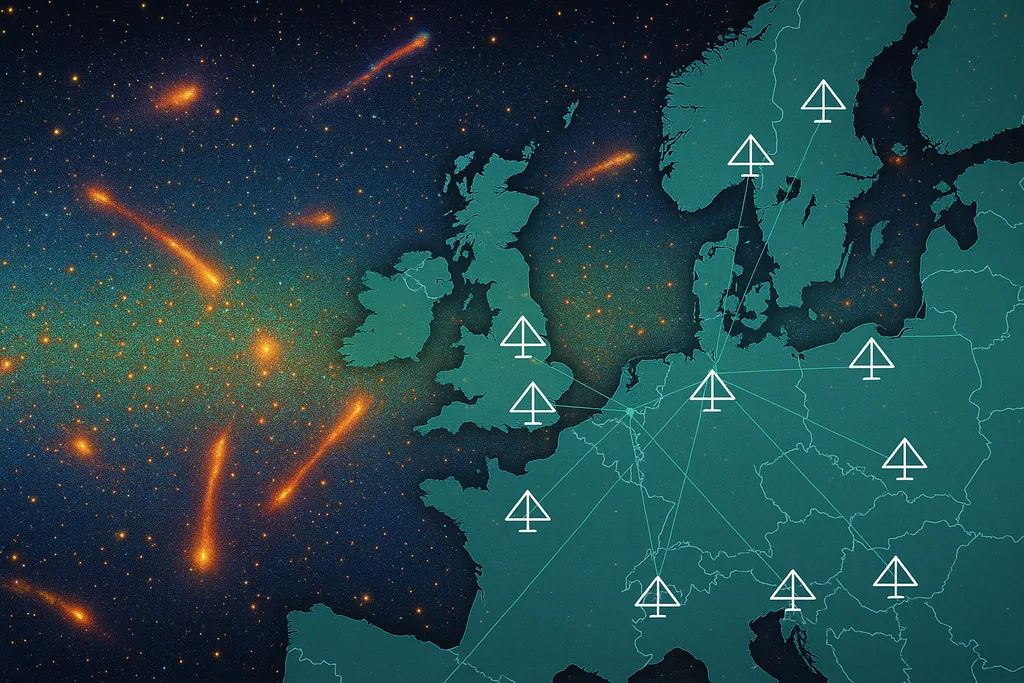
Releasing a catalogue of this size was as much an engineering achievement as a scientific one. LOFAR is not a single dish; it is an interferometer made of roughly 20,000 individual antennas grouped into about 52 stations across Europe. To make coherent images the team combined signals equivalent to a telescope with baselines spanning hundreds to more than a thousand kilometres. Producing each image required digitising and transporting terabits of data per second, then correcting for distortions introduced by the ionosphere and by the instrument itself.
Processing that raw stream consumed more than 20 million core hours on large European supercomputers, with a significant share handled at the Jülich Supercomputing Centre. The project pushed the development of calibration algorithms, pipelines for automated source extraction and classification, and data products that other astronomers can query. Those software innovations are deliberately designed to scale: they form a technical blueprint for larger upcoming projects such as the Square Kilometre Array Observatory, which will produce even larger data volumes and deeper catalogues.
Types of objects hiding in the radio sky
Not all "hidden objects" are exotic; many are ordinary galaxies whose central black holes or star-forming regions emit faint radio waves. A large fraction of the LoTSS-DR3 catalogue are active galactic nuclei (AGN) — galaxies where accretion onto a central supermassive black hole launches relativistic jets that glow brightly at radio wavelengths. These jets and lobes can extend for millions of light years and are often invisible in visible-light images that emphasise starlight instead.
Other categories represented in the catalogue include star-forming galaxies where cosmic rays and magnetic fields produce diffuse synchrotron emission, supernova remnants that light up the interstellar medium, and emission from the intracluster medium driven by shocks and turbulence. The survey also finds compact sources such as pulsars and transient emitters; although LOFAR's sensitivity and cadence are not optimised for every kind of transient, the data already contain candidates that warrant follow-up. In short, the 13.7 million hidden objects are a mixed population, from the local and familiar to the distant and powerful.
Techniques that reveal obscured radio sources
Why many objects were hidden and how estimates are made
Objects are "hidden" when their dominant emission is not in visible light or when dust and gas obscure optical wavelengths. Low-frequency radio waves can traverse dusty regions and reach Earth, revealing activity in galactic centers and behind veils of interstellar material. Estimating how many objects exist across the whole sky depends on the survey's sensitivity and coverage: the LoTSS-DR3 team counted sources above their detection threshold across 88 percent of the northern sky and compiled a catalogue that reflects both the instrument's depth and the chosen source-extraction criteria. Extrapolating a total sky population requires accounting for unobserved sky fractions, varying sensitivity, and source confusion limits at faint flux densities, which is why the 13.7 million number is best understood as a robust count within LoTSS-DR3's sensitivity and footprint rather than a final census of all radio-emitting objects in the Universe.
Implications and the path forward
The LoTSS-DR3 release immediately opens thousands of research projects: population studies of black-hole feedback, maps of cosmic magnetism, searches for rare transient phenomena, and targeted follow-up of unusual sources. Because the dataset is public, astronomers worldwide can test models against a much larger statistical sample than previously possible. The technical advances in calibration, data transport and automated analysis also provide a rehearsal for the data challenges of the Square Kilometre Array Observatory, which will operate at greater sensitivity and generate even larger catalogues.
Limitations remain: the survey covers the northern sky and has a finite sensitivity floor, so fainter populations still await discovery; classification of 13.7 million objects is an ongoing process that will sharpen with multiwavelength follow-up and spectroscopic campaigns. Nevertheless, the release marks a step change in how astronomers construct a layered, multiwavelength picture of the cosmos — a picture in which the familiar optical sky is only one face of a far richer electromagnetic reality.
The LoTSS-DR3 catalogue is not an endpoint but a resource. It will be mined for years, yielding insights into how black holes shape galaxies, how magnetic fields evolve on cosmic scales, and where to point higher-resolution instruments to study the most extreme objects in the Universe.
Sources
- Astronomy & Astrophysics (LoTSS-DR3 paper)
- LOFAR Surveys Collaboration (LoTSS)
- ASTRON and Leiden University (LOFAR survey leads)
- Jülich Supercomputing Centre (data processing)




Comments
No comments yet. Be the first!