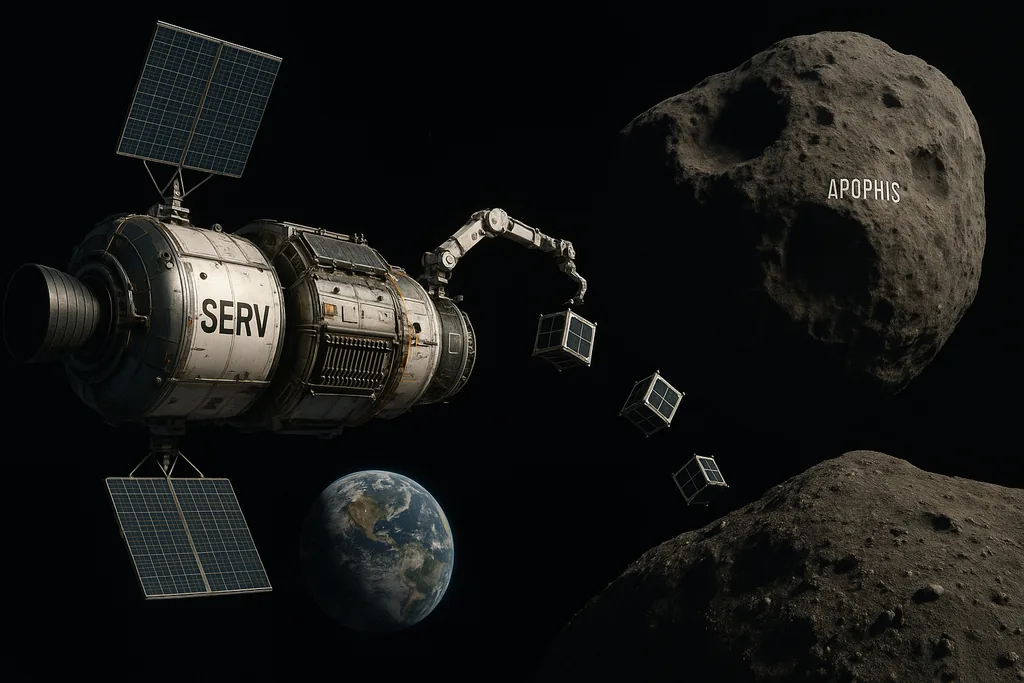
A small US-based company has unveiled plans to be the first commercial operator to deliver landers to asteroid Apophis as it flies unusually close to Earth in April 2029 — a bold demonstration of how a private company land asteroid effort might work in practice. ExLabs, working with Japan’s Chiba Institute of Technology and with operational support from NASA’s Jet Propulsion Laboratory, says its ApophisExL mission will rendezvous with the 340‑metre rock and deploy CubeSat‑scale landers to the surface, offering students and small teams an unprecedented opportunity to study an asteroid up close during its historic flyby.
private company land asteroid: a commercial rideshare to deep space
ExLabs bills ApophisExL as the world’s first commercial deep‑space rideshare: a modular spacecraft called SERV that will carry instruments, relays and small landers to Apophis and hold station nearby as the asteroid passes roughly 32,000 kilometres from Earth on 13 April 2029. The company’s public materials lay out an April 2028 launch and emphasise an open, hosted‑payload model that lowers the bar for universities and smaller national programmes to fly experiments beyond Earth orbit. That schedule puts months — not years — between delivery and the asteroid’s close approach, allowing the SERV vehicle to characterise Apophis, practise proximity operations, then release CubeLanders in time to collect data as the rock experiences Earth's gravitational tug.
private company land asteroid: students, partners and the mission architecture
The mission has already attracted academic partners and small‑sat vendors. ExLabs announced a formal partnership with the Planetary Exploration Research Center at Chiba Institute of Technology to fly student‑designed payloads and CubeLanders that will attempt surface contact and local science. Those student landers are being positioned as educational payloads with real flight heritage built on CubeSat technologies, and ExLabs says it will work with JPL for mission design and operations to align the commercial flight with established deep‑space practices. The arrangement is emblematic of a hybrid model: private funding and systems with academy and agency collaboration to spread cost and risk.
Why Apophis matters right now
Apophis is one of the best‑tracked near‑Earth asteroids and will make an unusually close pass on 13 April 2029, coming within a few tens of thousands of kilometres of Earth — inside the ring of geostationary satellites and close enough to be visible to the naked eye for many observers. That flyby will alter the asteroid’s spin and gravitational environment and offers a rare laboratory to test how small bodies respond to tidal forces, thermal cycling and surface migration. NASA, ESA and other agencies have planned observations and missions that will take advantage of this once‑in‑a‑lifetime geometry, which is why both national and commercial actors are racing to place instruments in useful vantage points.
Technical hurdles for any private company land asteroid attempt
Landing on a small asteroid is not like landing on the Moon: gravity is milligravity, surface cohesion is variable, and regolith may behave more like a cloud of coarse dust than a solid surface. For a private company land asteroid effort, the key engineering challenges are safe rendezvous and optical navigation in an environment with rapid relative motion; soft contact or anchoring mechanisms that work when a lander can easily rebound; autonomy for guidance, navigation and control so the lander can make decisions with minimal ground intervention; and ensuring reliable communications and data relay back to Earth through a mothership that may itself be managing multiple payloads. All of these problems are tractable — teams have solved many of them on missions such as Hayabusa, Hayabusa2 and OSIRIS‑REx — but they demand careful testing, conservative margins and often higher costs than small teams initially expect.
Feasibility: what a private company can and cannot do
Science, resources and planetary defence motivations
The motivations for a commercial lander on Apophis are multiple and overlapping. Science teams want to measure mechanical and spectral changes on the surface as Earth's gravity and the Sun’s heating alter the regolith and spin state. Planetary defence planners see value in high‑precision tracking and in-situ measurements that reduce orbital uncertainty and the role of subtle effects (like the Yarkovsky effect) in long‑term trajectory prediction. Commercial actors also flag prospecting goals — searching for concentrations of metals or volatiles that could inform future resource extraction — although that is speculative and would require follow‑on prospecting and economic analysis. The student payloads that ExLabs is flying add an extra public‑engagement and workforce‑development element: training the next generation on flight hardware that leaves Earth orbit.
Risks, regulation and the space‑traffic context
Private missions to Apophis also raise regulatory, safety and planetary‑protection questions. Any operation near an object that will pass inside geostationary altitudes must coordinate with satellite operators and regulators to avoid creating debris or unexpected close approaches. There are also concerns about forward contamination of a scientifically interesting body, and about ensuring that any commercial activity does not inadvertently alter a target’s orbit in ways that increase future uncertainty. International norms and licensing — from national launch authorities to communications and export control — will be critical to clear before launch, and agency partnerships can help smooth that process and provide technical oversight. The presence of national missions such as NASA’s OSIRIS‑APEX means commercial teams will be judged by existing scientific and safety expectations.
What happens next and why you should care
If the ExLabs plan stays on schedule, the launch window in 2028 and the 2029 flyby create a tight but achievable timetable for testing and rehearsal. For the public and for space policy, this mission will be an early test of a new model: private companies executing technically demanding deep‑space operations in partnership with universities and national labs. Success would lower barriers to future asteroid science and prospecting; failure would expose the real costs and operational pitfalls of turning complex planetary missions into commercial services. Either way, the project will sharpen debates about how public and private roles should be balanced for work that has both scientific and planetary‑defence consequences.
Sources
- NASA / Jet Propulsion Laboratory (Apophis facts and mission planning)
- ExLabs (ApophisExL mission materials and corporate announcements)
- Chiba Institute of Technology, Planetary Exploration Research Center (academic partnership)
- NASA OSIRIS‑APEX mission documentation




Comments
No comments yet. Be the first!