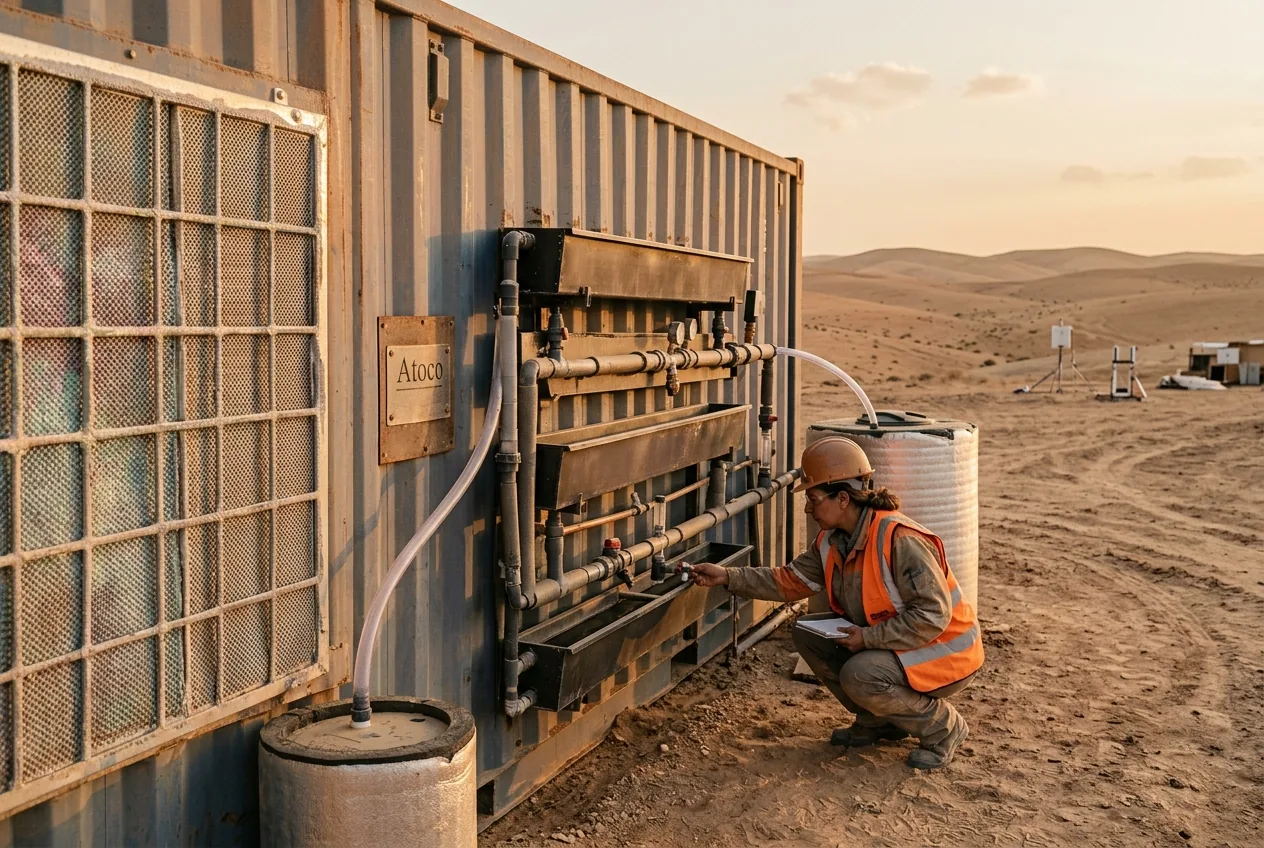
In the shadow of a shipping container in a dusty field, a scientist flips a switch and, slower than a tap but with equal ceremony, droplets gather into a collection tray. The unit — roughly the size of a 20‑ft container and plastered with an Atoco logo — does not have a well, a pipeline or a desalination plant attached. Its core is a crystalline powder with millions of microscopic pores: a metal–organic framework, or MOF, created over decades of chemistry work by Omar M. Yaghi and others. This is where this nobel prize–winning tech meets a practical test, and the promise is stark: up to 1,000 litres of near‑distilled water per day from the surrounding air, even in places where humidity dips into single digits.
The moment matters because the United Nations now flags global water systems as strained to the point of "water bankruptcy" for large parts of the world. If the lab‑scale trick that won Yaghi and colleagues a Nobel Prize in Chemistry can be industrialised, it changes how engineers think about supplying water to remote towns, disaster zones and hyperscale data centres that are already hunting for secure supplies. But the physics is only half the story: cost, energy, supply chains and European procurement rules will determine whether those containers become common tools or expensive curiosities.
How this nobel prize–winning tech actually pulls water from thin air
Metal–organic frameworks are crystalline lattices built from metal nodes and organic linkers. The structure is mostly empty space at the molecular scale — imagine a scaffold so porous that one gram can offer a surface area comparable to a football pitch. The trick for water harvesting lies in tailoring pore chemistry so that the MOF strongly adsorbs water molecules at low relative humidity and then releases them when slightly warmed.
Operationally the cycle is simple and clever. At night, when air temperature falls, the MOF soaks up water vapour into its pores. During the day, a modest temperature rise or a pulse of low‑grade heat causes the framework to desorb that moisture as vapour, which is then condensed in a cold surface and collected as liquid. Compared with mechanical dehumidifiers, MOF units rely on adsorption chemistry rather than brute‑force refrigeration, which can make them more efficient in low‑humidity environments.
That chemistry is not new — the foundational papers appear in venues such as Nature and ACS Central Science — but designing materials that are robust, fast, cheap to make and scaleable is the engineering challenge that Atoco and other startups are trying to close now.
Performance in deserts and humid climates: where MOFs shine and where they struggle
That flexibility means the technology is not binary — it is not simply "works" or "doesn't" in deserts. Yield scales with humidity and the amplitude of the daily temperature swing, so a coastal arid region with nighttime cooling will produce more water per unit than the hottest, most stagnant desert basin. Conversely, in very humid tropical climates the device will generally perform well, but the economics change: conventional condensation (refrigeration) can be cheaper where ambient vapour pressure is high and land power is cheap.
Energy and costs for this nobel prize–winning tech: the industrial tradeoffs
Atoco advertises units that can deliver up to 1,000 litres per day — a headline number that helps funding pitches and procurement conversations — but the real metric engineers care about is litres per kilowatt‑hour and cost per litre over the machine's lifetime. Producing the MOF itself requires organic precursors and metals; making those at scale without niche lab steps is the most immediate manufacturing hurdle.
Energy for the desorption step is lower than a full vapor‑compression chiller because the MOF needs only modest heating — often in the range of tens of degrees above ambient rather than the much larger delta a compressor creates. That opens the door to pairing units with waste heat sources: data centres, for example, have waste heat streams and an acute need for reliable water for cooling and humidification. Atoco’s early commercial targets reflect that logic: industrial customers who can supply low‑grade heat and pay a premium for on‑site security of supply.
Cost remains the stick in the spokes. Early MOFs are still comparatively expensive to synthesise and must meet industrial durability targets — thousands of cycles without significant capacity loss. The path to cheap MOFs runs through process chemistry, scale economics and regional manufacturing hubs. For Europe, that suggests a niche policy role: fund pilot fabs under industrial‑policy instruments so EU factories can produce frameworks under climate‑compatible supply chains rather than relying on overseas speciality‑chemical suppliers.
Water quality and safety: is the product safe to drink?
Developers report that the condensed output is near‑distilled water because the MOF captures only vapour; it does not pull dissolved salts or most particulates. That is an advantage over some portable desalination units. But near‑distilled water is also corrosive and flat; most drinking systems re‑mineralise water to meet taste and public‑health standards. Producers plan to run the MOF condensate through final polishing steps — such as mineral dosing, UV or low‑pressure membrane filtration and pH adjustment — before labelling it as potable.
Regulatory scrutiny will focus on two questions: can the MOF leach any organics or metals during long‑term operation, and are there microbiological risks in storage and distribution? Those are solvable engineering problems, but they require independent testing and certification before municipal procurement proceeds. The recent attention on disinfection byproducts in tap water is a useful reminder: any new supply method invites a different set of contaminants and therefore different monitoring regimes. Boiling or standard household filters remove many organic byproducts; similarly, standard post‑treatment will be used to ensure MOF water is safe.
Policy, procurement and Europe’s strategic angle
From a European industrial‑policy viewpoint the question is not only whether the material works but whether it fits regional aims: water security, semiconductor‑ and data‑centre resilience, and sovereignty over critical materials. The EU can finance pilot production through mechanisms such as IPCEI or Horizon follow‑ups, but Brussels will ask for environmental and lifecycle analyses, plus clear export‑control and procurement rules.
Germany, with its machinery makers and chemical clusters, is well placed to build MOF production lines — provided political will and targeted funding land before the manufacturing opportunities shift to lower‑cost regions. The European advantage is less about inventing MOFs (that work is global and pre‑dated the Nobel) and more about turning them into reliable, certifiable industrial products integrated into local energy systems — for example tying a MOF water‑harvester to a waste‑heat loop at a datacentre in Frankfurt.
There is also a sobering counter‑argument from climate and public‑policy experts: water from air is not a substitute for integrated water management. It solves supply at the point of use but does not address river basin over‑abstraction, nutrient runoff or the large infrastructure that supplies cities. Smart procurement should therefore prioritise niche, high‑value use cases — remote communities, disaster response, industrial sites with scarce municipal supply — rather than a wholesale pivot away from conventional water systems.
Where this technology goes next
The science behind MOFs is solid and award‑winning; the practical work is now industrial chemistry, systems engineering and public procurement. Expect a year of pilots aimed at paying customers with waste heat, followed by a slower scale‑out if manufacturing bottlenecks are solved. Independent certification, lifecycle carbon accounting and cost‑per‑litre transparency will be the milestones that separate demonstrations from deployments.
If the numbers add up, the device in the desert will cease to be a curiosity and become one of many modular tools for a world that needs water in places pipes do not reach. If they don't, the shipping containers will be expensive museum pieces and the moral of the story will be that Nobel prizes sometimes celebrate ideas long before industry can afford them. For now, Europe has the factories and the regulators; whether Brussels supplies the investment paperwork or lets someone else make the cheap MOFs is the policy decision to watch.
Progress without paperwork is a German joke that isn't funny when you need water. The science is years ahead of the contracts; turn the permits on and the machines might follow.




Comments
No comments yet. Be the first!