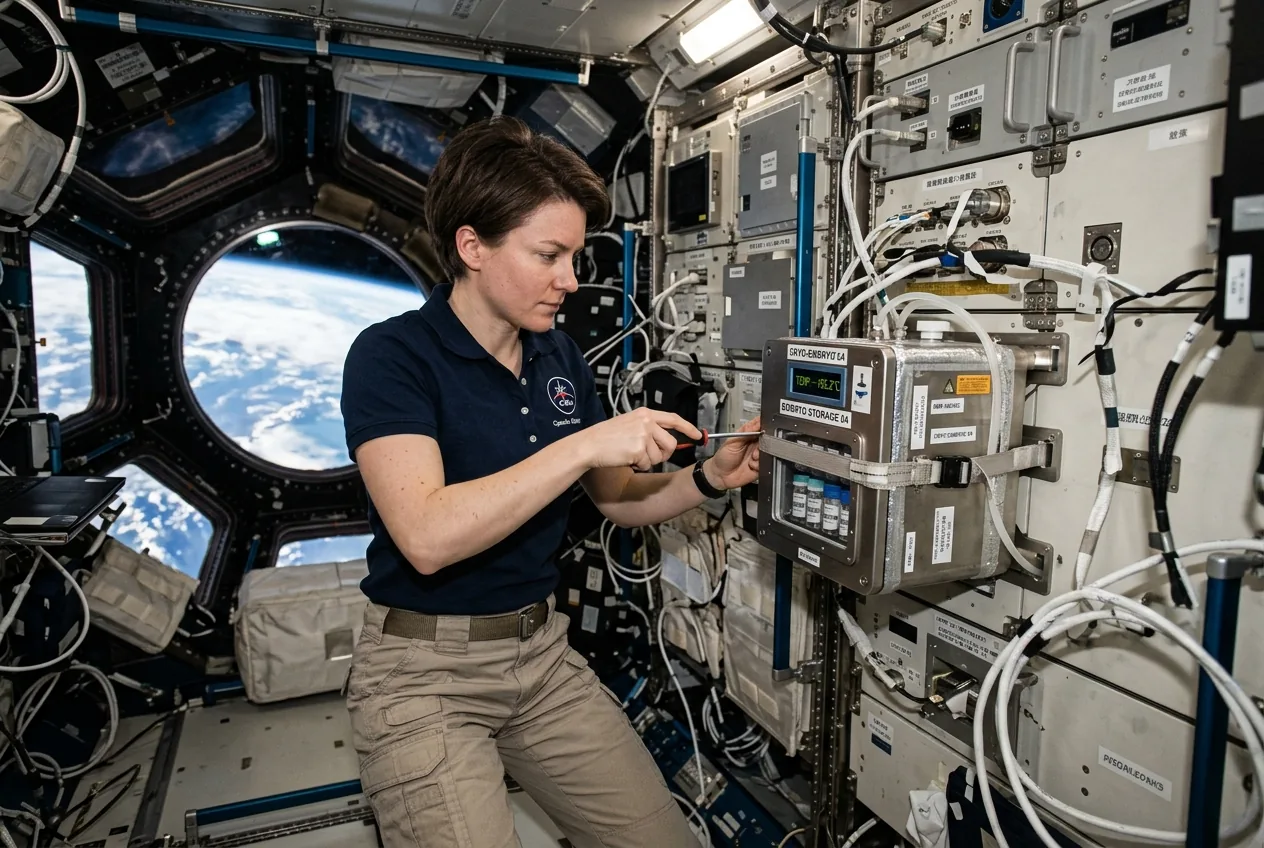
A frozen tray of mouse embryos, clipped into a small incubator on the International Space Station, came home in a soft plastic container and—months later—some of those embryos became healthy pups on Earth. That blunt, laboratory fact is the starting point for a question now moving out of the academy and into policy meetings and crew medical exams: can humans get pregnant in space?
The question matters because it is no longer theoretical. Space agencies are planning month‑long transports, month‑long stays on the Moon and multi‑year missions to Mars. If conception, pregnancy or childbirth ever becomes part of human spaceflight, it will affect mission design, crew selection, medical systems and international law. Scientists say the evidence so far is a tangle: mouse embryos can sometimes survive space exposure, sperm motility drops in microgravity, and cosmic rays shred DNA in ways that Earthbound clinicians rarely see. That combination turns a single biological curiosity into a policy problem with heavy engineering and ethical tails.
Can humans get pregnant in space? The short answer scientists keep repeating
Scientists describing the current record use three short sentences when they are being careful: conception is not obviously impossible, it is not routinely observed, and it is riskier than on Earth. That hedged response comes from three lines of work that now intersect — lab studies of sperm and eggs, animals flown to the ISS, and radiation experiments that measure DNA damage in reproductive cells. Each line nudges the conclusion in a different direction.
So the practical takeaways read like a contradiction on paper: at least some stages of mammalian reproduction can survive short trips into low Earth orbit, but other stages — especially sperm function and very early embryonic development in microgravity — look fragile. NASA’s own developmental and reproductive biology programme has flagged both sides of that ledger, which is why the agency treats the topic as a long‑term research priority rather than an operational capability.
Can humans get pregnant — why animal wins don’t translate neatly to people
The headlines that say "mice born after spaceflight" are true, but the headline hides detail that mission doctors worry about. Animal experiments usually test a single narrow condition: frozen embryos that are handled on Earth, briefly exposed to space conditions, then thawed and allowed to develop under normal gravity. Those protocols intentionally avoid the messy parts of real conception: intercourse, sperm navigation in a microgravity fluid environment, implantation into a living uterus and the shifting hormonal milieu of pregnancy.
In other experiments, embryos that encounter microgravity during the very earliest cell divisions show higher rates of abnormal development or arrest. That vulnerability is not a small footnote — it is the very stage when pregnancy either establishes or fails. Put bluntly: a frozen embryo surviving a ride is not the same thing as a live pregnancy starting and progressing entirely off‑Earth. The distinction matters for planners who might imagine colonies populated by Earth‑born babies versus births that actually occur off‑planet.
There’s also a cultural and ethical gap. No human has ever been documented to conceive or carry a pregnancy in orbit or on the Moon. Space medicine still prohibits crews from flying while pregnant; NASA and other agencies explicitly exclude pregnancy from mission profiles and require contraception during certain training and flight windows. That prohibition is not just medical caution — it reflects legal, insurance and logistical realities too. If an astronaut were to become pregnant on a mission, the mission would face immediate, unplanned medical and political complications.
Radiation: the invisible wildcard for fertility and developing embryos
If microgravity is a mechanical problem for cells and fluids, cosmic radiation is a chemical one: high‑energy particles create breaks in DNA strands and mutations that accumulate in germ cells. Studies from university groups have shown that charged particles common beyond Earth’s protective magnetic field can damage the DNA in sperm, eggs and early embryos, and also alter hormone levels in ways animal experiments tie to reduced fertility.
The radiation picture is not subtle. On Earth we have the atmosphere and magnetosphere that remove or deflect much of the dangerous radiation; in deep space, those shields are gone. To cut the risk to acceptable levels for a long pregnancy would require substantial shielding. For program managers that is an engineering problem with a budget line: more mass, more cost, more contingency medicine to carry on a trip that is already mission‑critical.
Researchers warn about two linked outcomes that planners often under‑estimate. First, even if conception is achieved, the fetus could be exposed to doses that increase the risk of neurodevelopmental damage or cancer later in life. Second, the pregnant body itself is exposed to stresses — immune modulation, cardiovascular shifts, bone loss — that are already problematic for non‑pregnant astronauts. In short: radiation amplifies and prolongs the hazards that microgravity creates.
Policy, cost and a question most programmes prefer to avoid
Once you accept that pregnancy in space is not simply an academic curiosity, the trade‑off calculus becomes uncomfortable. Do you design habitats with extra mass and shielding to protect the reproductive tract? Do you accept the ethical burden of deliberately supporting reproduction in an environment where we can’t yet guarantee a safe outcome? Or do you adopt strict no‑pregnancy rules that affect personnel selection, reproductive rights and family planning for the workforce?
Those questions are already being whispered in medical boards and mission architecture meetings. The legal and diplomatic dimensions — citizenship of a child born off‑Earth, liability for medical care, and who pays to evacuate a pregnant crewmember if something goes wrong — have received almost no public attention. Preparing for births off‑planet is not only about biology; it forces agencies and private companies to confront insurance, ethics and international law.
There is a practical cost, too. Shielding mass may be the single largest engineering penalty. Extra shielding for habitats and transit vehicles can shift launch profiles, increase fuel needs and change mission feasibility. Those are the sorts of trade‑offs that get left out of optimistic visions of permanent settlements.
Where research should go next and what planners must decide
Scientists are clear about the path forward: more targeted experiments, longer in‑flight exposures, and careful ground‑based analogs that mimic the combined stresses of microgravity, radiation and altered physiology. That will mean piggybacking reproductive biology onto more ISS experiments and funding studies that follow offspring over time for subtle developmental effects.
But there is a second, non‑scientific step: policymakers must set limits and rules before an awkward test case forces a hurried decision mid‑mission. Waiting until the first off‑Earth pregnancy occurs would be to prefer improvisation over planning. The conversation must include medical ethicists, engineers, insurers and — crucially — the crews themselves.
The practical answer to the simple question "can humans get pregnant" in space is therefore twofold. From a purely biological lab standpoint, some parts of mammalian reproduction can survive space conditions. From an operational standpoint, reproduction in space is not a capability agencies are ready to support safely — and it may demand significant changes to mission design if they ever intend to be.
Sources
- Communications Biology (study on sperm motility in microgravity)
- Proceedings of the National Academy of Sciences (PNAS) (mouse embryo flight experiments)
- NASA — Developmental and Reproductive Biology programme materials
- Harvard studies on cosmic radiation and reproductive cell DNA damage (PMC article)




Comments
No comments yet. Be the first!