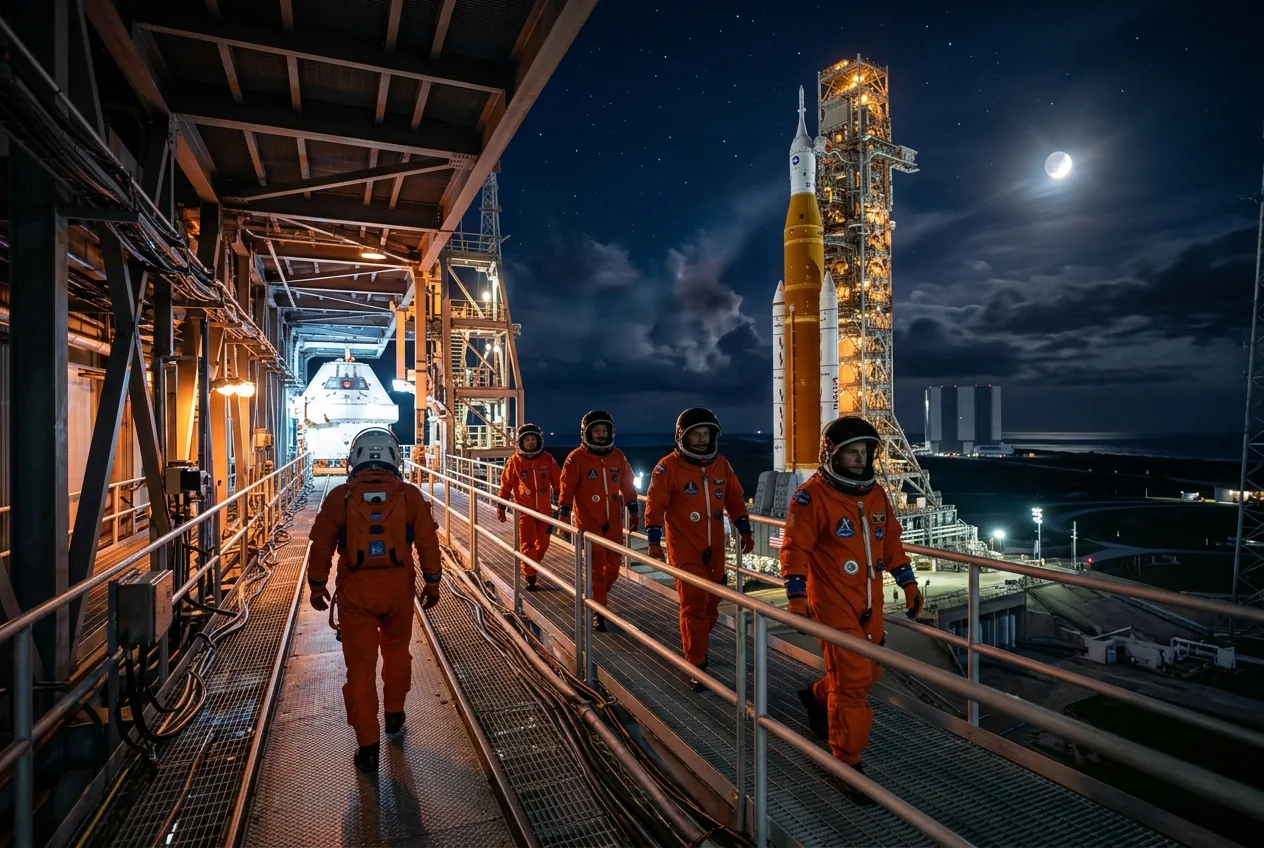

Artemis II represents a historic milestone as NASA’s first crewed mission to the Moon since 1972, designed to send four astronauts around the lunar far side. This mission will break the 54-year distance record for crewed flight set by Apollo 13 and serves as the definitive flight test for the Orion spacecraft before the agency attempts a human lunar landing later this decade.
Why is Artemis II a historic milestone for NASA?
Artemis II is a historic milestone because it marks the first time in over 50 years that humans will travel beyond low Earth orbit. By successfully completing a high-altitude flyby of the Moon, the mission validates the Space Launch System (SLS) and Orion’s life-support systems. This flight is the essential bridge between robotic testing and the establishment of a long-term human presence on the lunar surface.
The mission is poised to surpass the record-breaking distance from Earth achieved by the Apollo 13 crew in 1970. While Apollo 13’s trajectory was dictated by an emergency return, the Artemis II flight path is a deliberate "free-return trajectory" designed to test the limits of modern deep-space navigation. NASA Associate Administrator Amit Kshatriya emphasized the mission’s gravity, noting that this flight is the first step in a campaign that includes a permanent lunar base and eventually nuclear propulsion for Mars exploration.
Pushing these boundaries is not merely about records; it is about establishing a sustainable architecture for deep-space survival. During the nine-day journey, the crew will monitor how the Orion spacecraft handles the intense radiation environments found outside the protection of Earth’s magnetic field. These observations are critical for researchers at NASA and the Canadian Space Agency (CSA) as they finalize plans for the $20 billion Moon base project slated for the coming years.
Who are the four astronauts aboard Artemis II?
The four astronauts aboard Artemis II are NASA’s Reid Wiseman (commander), Victor Glover (pilot), and Christina Koch (mission specialist), alongside Canadian Space Agency astronaut Jeremy Hansen (mission specialist). This crew is historically significant, representing the first woman, the first person of color, and the first non-American to ever journey to the vicinity of the Moon.
- Commander Reid Wiseman: A veteran of the International Space Station, Wiseman leads the quartet and oversees the primary mission objectives.
- Pilot Victor Glover: Glover is responsible for the manual piloting demonstration, which involves maneuvering the spacecraft near the Interim Cryogenic Propulsion Stage (ICPS).
- Mission Specialist Christina Koch: Koch holds the record for the longest single spaceflight by a woman and will manage the spacecraft’s complex science and systems tasks.
- Mission Specialist Jeremy Hansen: Representing Canada, Hansen’s inclusion highlights the international partnership core to the Artemis Accords and global lunar exploration.
Preparation for this mission involved rigorous training in the Orion Crew Survival System (OCSS) suits, designed to protect the crew during launch and high-speed reentry. The crew will live and work inside the Orion spacecraft, which they have nicknamed 'Integrity.' The vehicle provides approximately 330 cubic feet of habitable volume—comparable to the interior of two small minivans—requiring the crew to maintain peak coordination during their high-stakes journey.
How can you watch the Artemis II launch live?
You can watch the Artemis II launch live on NASA’s official broadcast channels, including NASA+, the agency’s website, and its official YouTube page. Coverage is scheduled to begin on Wednesday, April 1, 2026, leading up to a two-hour launch window that opens at 6:24 p.m. EDT (2224 UTC) from Launch Complex 39B at the Kennedy Space Center.
The countdown to liftoff began at 4:44 p.m. EDT on the Monday prior, with Launch Director Charlie Blackwell-Thompson scheduled to authorize the fueling of the 322-foot-tall SLS rocket on Wednesday morning. Weather forecasts from the 45th Weather Squadron currently show an 80 percent chance of favorable conditions. Launch Weather Officer Mark Burger noted that while isolated showers are a possibility, the risk of lightning remains low, providing an optimistic outlook for the historic departure.
Key mission phases for viewers to track following the Wednesday evening launch include:
- Perigee Raise Maneuver: Occurring 49 minutes after liftoff to stabilize the initial orbit.
- Manual Piloting Demo: Wiseman and Glover will take manual control of Orion to test dexterity for future docking missions.
- Trans-Lunar Injection (TLI): The critical burn on Flight Day 2 that will officially propel the crew toward the Moon.
The successful execution of the Artemis II mission will signify a new era of "Goldilocks" exploration—missions that are far enough to test deep-space hardware but close enough to return to Earth relatively quickly if anomalies arise. Following the trans-lunar injection, NASA mission control will have several abort options, but as the spacecraft moves further from Earth, the focus will shift entirely to the lunar far side observations. This mission is not just a return to the Moon; it is the definitive proof of concept for the Orion spacecraft as a vessel for the next generation of human discovery.
Looking ahead, the data gathered during these nine days will inform the Artemis III mission, which aims to land the first humans on the lunar South Pole. By testing manual docking capabilities and the European Service Module’s power generation through its 23-foot solar arrays, NASA ensures that future crews will have the infrastructure necessary for multi-week stays on the lunar surface. The launch on April 1 is the starting gun for a decade of unprecedented lunar activity that will eventually lead humanity toward the Red Planet.





Comments
No comments yet. Be the first!