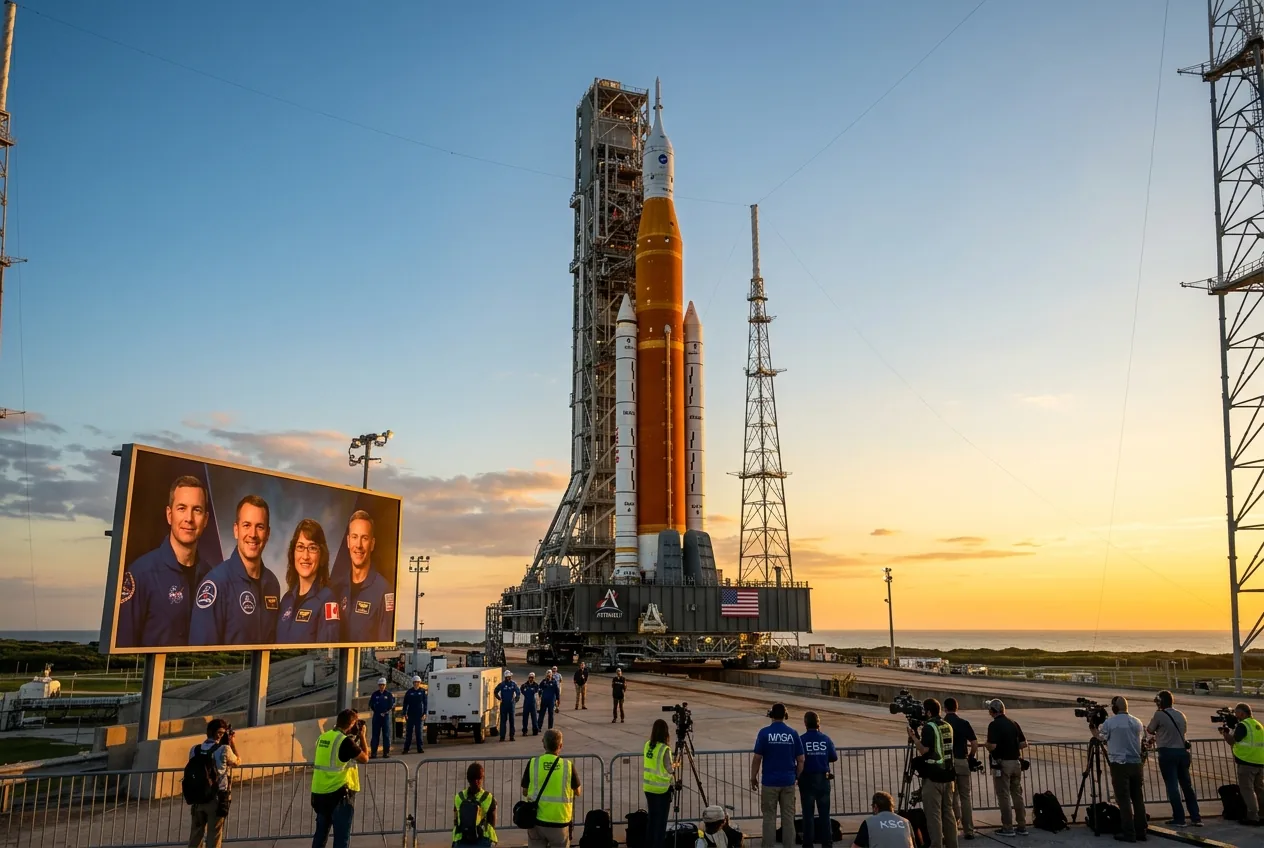
The crawlerway was almost empty at dusk, a single lamp catching the orange sheen of the SLS booster as technicians finished last-minute checks — and a crowd of journalists in the media center checked their watches. If you plan to watch nasa's artemis astronauts lift off from Kennedy Space Center on April 1, that moment — the first crewed lunar launch in more than half a century — will be what the world is tuned to see.
Why it matters is simple: this is the first time NASA will send people beyond low Earth orbit since 1972, and millions will want to know where to watch and what to expect. For ordinary viewers the practical questions are straightforward — what time to tune in, which feeds carry the launch, who is aboard, and how long the trip will take — but the build-up has been shaped by technical checks, late-stage repairs and tightly scheduled backup windows that keep mission managers and the public on edge.
How to watch NASA's Artemis astronauts: exact time and the official window
The launch window for Artemis II opens on April 1, 2026, at 6:24 p.m. Eastern Daylight Time (22:24 UTC), with a roughly two-hour window for liftoff — NASA lists April 1 at 6:24 p.m. EDT as the earliest available opportunity and a 120-minute launch window.
Plan to start watching well before that: NASA’s live coverage typically begins at least two hours ahead of the opening of the launch window with briefing segments, pad cameras and commentary from mission control. Coverage will run through the ascent phase and into the initial Orion separation and in-orbit milestones, so staying on the official feeds will carry you from prelaunch checks up to the first on-orbit messages from the crew.
Where to view and livestream — watch NASA's Artemis astronauts from home or the Cape
If you’re watching from home, NASA will provide the principal live feeds: NASA’s streaming platforms and the agency’s YouTube channel host the official launch commentary and multiple camera angles. These are the place for the expert play-by-play and the agency’s own mic’d-up commentary. Third-party sites and trackers will often embed the NASA streams, but the agency’s feeds are the authoritative source.
For people who want to see the rocket in person at Kennedy Space Center, the Visitor Complex and several public viewing areas typically offer ticketed vantage points. Expect heavy traffic and lengthy security checks on launch day; realistically, the safest way to guarantee a view of the launch is to arrive very early and follow official KSC guidance about permitted viewing zones and road closures. If weather or technical issues force a scrub, NASA lists backup dates within April and has several alternate windows identified.
The crew manifest and the mission’s arc
Artemis II will carry four astronauts: NASA’s Reid Wiseman (commander), Victor Glover (pilot) and Christina Hammock Koch, plus Canadian Space Agency astronaut Jeremy Hansen. The quartet will fly a roughly 10-day free-return loop around the Moon and back — a human-tended test of Orion and SLS with people aboard, rather than the uncrewed Artemis I mission that flew an extended distant retrograde lunar orbit.
The profile is not an Apollo-style landing; the spacecraft will swing out past the far side, come within thousands of miles of the lunar surface, then return to Earth for a high-speed reentry and splashdown in the Pacific. Recovery forces will be staged and ready off the coast of San Diego for recovery operations following splashdown. Those details shape how long viewers should expect to follow live reporting: launch night through splashdown is the headline arc, but the mission’s key televised milestones will be concentrated around liftoff, translunar injection, and reentry.
Launch-day logistics, backups and the tension behind the schedule
From the pad, the narrative has been a sprint. NASA rolled the 11-million-pound stack out to the pad in a carefully paced procession that can take up to 12 hours, the crawler moving at roughly 1 mph along the four-mile route — a slow-motion spectacle that was itself streamed live. That deliberate choreography is a reminder of how many moving parts still have to behave perfectly, and why the agency holds multiple backup windows across March and April should anything force a postponement.
The mission’s timeline has been trimmed and rechecked after earlier technical problems in the program; managers have been explicit that a launch date is a target, not a guarantee. The blunt shorthand you’ll hear from some engineers — that launches are never 100% certain until the clock reads T‑0 — is a deliberate, conservative posture. Expect late changes if weather, a ground system fault or an instrument reading warrants a scrub; NASA has already published alternate dates and a set of contingency windows.
What to expect from the broadcasts — commentary, clean feeds and additional sources
On launch night the official feeds will switch between mission control commentary, pad cams, wide shots of the stack and telemetry displays. NASA typically offers both the full-commentary feed and a “clean” feed — the latter is the raw video without narration for outlets that want their own voiceover. Expect prelaunch briefings and post‑launch news conferences to be streamed on the same channels; for international viewers, the Canadian Space Agency will also provide material focused on Jeremy Hansen’s participation.
If you want a richer online experience, several mission trackers will overlay telemetry and mission timelines on top of the NASA livestream, showing where Orion is relative to Earth and the Moon in near real time. These trackers are handy if you plan to follow orbital milestones rather than raw commentary. But for official timestamps — when the flight reaches translunar injection or when splashdown is expected — stick with NASA’s announcements.
Little details that matter to viewers
There are a few small things that trip up viewers every launch: the launch time is given in local Kennedy Center time (EDT) and also in UTC, so be sure you’ve converted correctly if you’re elsewhere; the broadcast will begin earlier than the listed launch window; and scrubs often result in a quiet hour or two before the agency confirms a new attempt date. Those practicalities make the difference between catching the ignition and watching a replay.
One other note — network coverage can differ. While NASA’s own channels are guaranteed to stream the event, major cable and streaming networks often carry portions of the launch or rebroadcast NASA’s feed. If you’re relying on a third-party aggregator, check that it’s actually carrying the official NASA livestream and not just commentary.
Sources
- NASA — Artemis II mission availability (mission availability PDF and press materials)
- NASA press releases and coverage advisories
- Canadian Space Agency — Artemis II crew participation




Comments
No comments yet. Be the first!