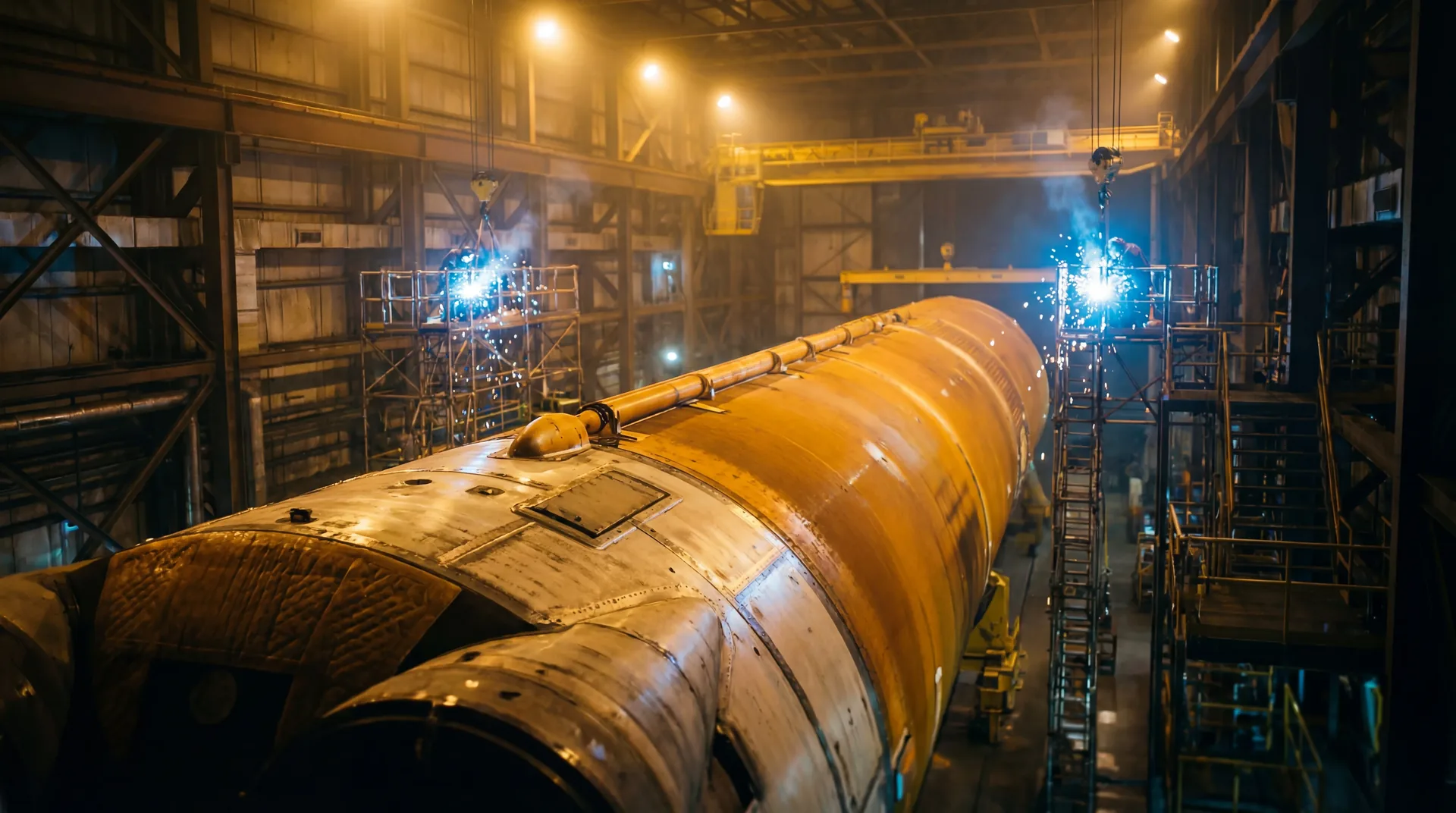

NASA's Space Launch System (SLS) supports deep space exploration through its super heavy-lift capability, delivering over 27 metric tons to trans-lunar injection in a single launch for crewed Artemis missions. By generating 8.8 million pounds of thrust from four RS-25 engines and two solid rocket boosters, the SLS enables direct lunar trajectories and the delivery of heavy cargo, including habitats and secondary payloads. This architecture provides the foundational power necessary for human expansion into the solar system, specifically targeting the Moon and eventually Mars.
The Michoud Assembly Facility in New Orleans, often called "America’s Rocket Factory," has emerged as the industrial heart of the Artemis program. Originally constructed in the 1940s, this massive 832-acre site previously manufactured the first stages of the Saturn V rockets and the iconic orange External Tanks for the Space Shuttle. Today, the facility has come full circle, transitioning its specialized infrastructure to produce the 212-foot-tall SLS Core Stage, the largest rocket stage NASA has ever built. This transition represents a strategic pivot toward deep space, utilizing decades of manufacturing expertise to meet the rigorous demands of modern lunar exploration.
How does the SLS rocket configuration support deep space exploration?
The SLS rocket configuration supports deep space exploration by providing unprecedented heavy-lift capacity and high-energy trajectories required for missions beyond low Earth orbit. Utilizing a core stage powered by four RS-25 engines and twin five-segment solid rocket boosters, the vehicle generates the 8.8 million pounds of thrust needed to propel the Orion spacecraft and its crew toward the Moon. This configuration ensures that NASA can transport both human explorers and significant lunar infrastructure in a single launch event.
Engineering the SLS Core Stage at Michoud involves a complex assembly process centered on five major components: the liquid hydrogen tank, the liquid oxygen tank, the forward skirt, the intertank, and the engine section. These structures are joined using Friction Stir Welding, a state-of-the-art technique that uses frictional heat and pressure to join metal without melting it. This method creates exceptionally strong, defect-free seams, which are critical for withstanding the immense cryogenic and aerodynamic pressures experienced during ascent. The structural integrity of these tanks allows the Artemis missions to carry the massive fuel loads necessary for long-duration space flight.
Advanced upgrades to the SLS configuration are already in development to enhance its deep space utility. While the initial Block 1 variant is currently the workhorse for early missions, the future Block 1B configuration will introduce the Exploration Upper Stage (EUS). This upgrade is expected to increase payload capacity to more than 38 metric tons to the Moon. Such an increase in mass-to-orbit capability allows for "comanifested" payloads, meaning the rocket can carry the Orion crew capsule alongside large habitat modules or lunar gateway components, significantly reducing the number of launches required for complex missions.
What makes Artemis II a critical test for human lunar flight?
Artemis II serves as a critical test for human lunar flight as the first crewed mission of the SLS and Orion, validating life support and navigation systems in deep space. Following the uncrewed success of Artemis I, this flight will carry four astronauts on a high-energy trajectory around the Moon to ensure all integrated systems function safely with humans aboard. It is the final "check-out" mission before NASA attempts a crewed lunar landing.
Human safety systems are the primary focus of the Artemis II mission profile. For the first time, the Orion spacecraft will be fully pressurized and its Environmental Control and Life Support System (ECLSS) will be taxed by the presence of a crew. Engineers at the Kennedy Space Center and Michoud have spent years refining the spacecraft's heat shield and abort systems to ensure that astronauts can survive both the vacuum of space and the intense heat of re-entry at speeds exceeding 24,500 miles per hour. The mission will also test manual piloting capabilities and deep space communication arrays, which are vital for future autonomous operations.
Operational validation during Artemis II extends to the ground teams and launch infrastructure. The mission will test the Mobile Launcher and the ground software required to manage a crewed countdown, which differs significantly from uncrewed protocols. By flying a "free-return" trajectory, the crew can use the Moon's gravity to swing back toward Earth, providing a fail-safe return path while still achieving the mission's goal of reaching deep space. This flight is the essential bridge between proving a rocket can fly and proving it can safely sustain human life during a multi-day journey to another celestial body.
Is the Michoud Assembly Facility meeting the demands of the Artemis schedule?
The Michoud Assembly Facility produces the SLS core stage but currently faces significant challenges in meeting the Artemis schedule due to production delays and high manufacturing costs. As of March 2026, NASA has standardized on the Block 1 configuration to maintain launch cadence while navigating uncertainties regarding the development of advanced upper stages. While structural fabrication continues to advance, logistical pressures remain high.
Manufacturing throughput at Michoud is currently a focal point for NASA leadership. The facility has successfully completed the core stages for Artemis II and is in the final stages of assembly for Artemis III and Artemis IV. However, the sheer scale of the hardware means that any minor supply chain disruption or technical anomaly can result in months of delay. To combat this, the facility has integrated automated welding cells and robotic inspection tools that have significantly reduced the time required to join major barrel sections, aiming to transition from "custom builds" to a more standardized production line.
Logistics also play a major role in meeting the Artemis timeline. Once a core stage is completed at Michoud, it must be loaded onto the Pegasus barge for a 900-mile journey across the Gulf of Mexico to the Kennedy Space Center in Florida. This maritime transport is highly dependent on weather conditions and the availability of specialized handling equipment. Despite these hurdles, the facility remains the only site in the United States capable of manufacturing such large-scale cryogenic stages, making its continued optimization essential for maintaining a consistent human presence on the Moon.
- Location: New Orleans, Louisiana
- Core Stage Height: 212 feet
- Manufacturing Tech: Friction Stir Welding (FSW)
- Transport Method: Pegasus Barge to Florida
- Current Milestone: SLS Core Stage entering pad flow for 2026 missions
The Future of Deep Space Production
The strategic importance of maintaining a domestic heavy-lift rocket supply chain cannot be overstated as the global space race intensifies. By centralizing SLS production at Michoud, NASA ensures that it retains the specialized workforce and industrial tools necessary to sustain the Artemis program long-term. This domestic capability is a key signal of American expertise and commitment to lunar residency, providing a reliable alternative to commercial launch providers for high-mass, high-security payloads.
Looking ahead, the evolution of the Michoud Assembly Facility will likely mirror the increasing complexity of Artemis missions. Plans are already in place to support the production of the Exploration Upper Stage, which will require new tooling and a shift in assembly workflows. As NASA moves toward the Artemis IV mission and beyond, the goal is to reach a production rate of one SLS core stage per year. If successful, this "Rocket Factory" will ensure that the path to the Moon remains open, secure, and powered by American industrial might for decades to come.





Comments
No comments yet. Be the first!