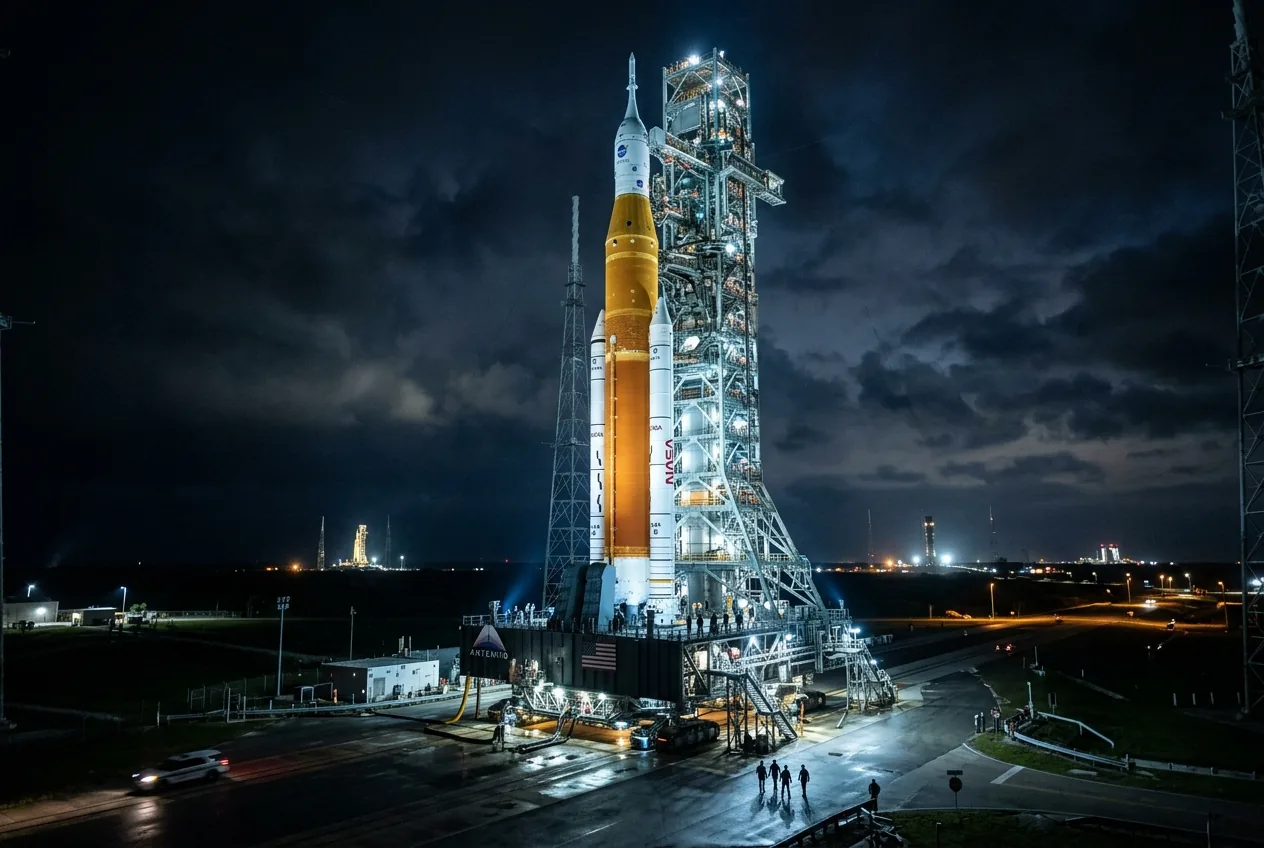
Night lights, a hazmat tent and the quiet of a pad that already knows delay
On Monday afternoon, nasa begins countdown launching Artemis II — a nearly 50‑hour preflight clock that will culminate in a planned Wednesday evening liftoff from Launch Complex 39B at Kennedy Space Center, if all goes to plan. The vehicle sits illuminated against a Cape Canaveral night sky while four astronauts remain in quarantine a few miles away. It is an image that blends theatre and engineering: flight controllers in Houston, technicians checking valves and a crew that has rehearsed for months but is prepared to be patient if the rocket decides otherwise.
NASA has publicly pegged the probability of favourable weather at about 80 percent for the nominal Wednesday slot, but agency officials and flight directors are explicit about the fragility of that figure. The countdown will include the final tanking of supercold liquid hydrogen and oxygen — the exact operations that have previously tripped engineers up on this mission — and every preparatory step has to be ticked off in sequence for launch day to remain the launch day.
Why this moment matters now
Artemis II is the first crewed mission to the moon in more than fifty years and a test of systems and organisational memory as much as hardware. It will not land; instead the Orion spacecraft and its four‑person crew will fly a looping figure‑eight around the moon and back over roughly ten days. Success would be NASA's most visible demonstration yet that the Artemis programme can move from hardware development into regular crewed operations — a prerequisite for the agency's longer‑term goal of building sustained presence on the lunar surface.
The stakes are both technical and political. NASA has already reworked mission planning in the past months, delayed once to repair a helium flow anomaly and then cleared at a flight‑readiness review to aim for an April launch. At the same time, the agency is having a public budgeting and scheduling conversation: internal audits and watchdog reports show the SLS, Orion and ground systems have cost tens of billions and that Congress, industry and international partners are watching closely.
nasa begins countdown launching: the 50‑hour checklist
The immediate countdown is procedural and unforgiving. Over roughly two days teams will verify avionics, load software, run heaters and valves, and finally perform cryogenic tanking — filling the core and upper stages with liquid oxygen and hydrogen. Tanking is the moment when small faults become big problems; it was during a full rehearsal in February that engineers discovered a troublesome interruption in helium flow to the interim cryogenic propulsion stage (ICPS), which ultimately required the vehicle to be rolled back to the Vehicle Assembly Building for repairs.
Having fixed that issue, NASA leaders chose not to repeat another full dress rehearsal before the April attempt. That decision reduces time and cost, but it raises the pressure that the single tanking for launch must go smoothly. Mission managers have described their confidence as cautious: they say systems are ready, but acknowledge that the previous rollback revealed supply‑chain and procedural fragilities that still lurk in complex cryogenic plumbing and flight‑termination electronics.
Flight managers have also pointed to a practical rhythm: the next time the rocket will be fuelled is on an actual launch attempt. If any component shows out‑of‑tolerance readings during the countdown, the launch will be scrubbed and teams will have to decide whether to recycle the clock or wait for the next window.
nasa begins countdown launching — weather, windows and scrub options
Each scrub carries operational costs and schedule ripple effects. The crew enters a medically monitored quarantine to minimise infection risk; additional scrub days extend that quarantine, tack onto crew fatigue, and impose logistical shifts for recovery ships and tracking assets that will support Orion's return to Earth. The countdown choreography — from flight‑termination system batteries to helium and hydrogen line checks — is therefore not just a technical checklist but a schedule lever that affects the agency's wider cadence of missions.
Crew and mission priorities: how Artemis II differs from Artemis I
Artemis II will carry four astronauts: commander Reid Wiseman, pilot Victor Glover, mission specialist Christina Koch and Canadian Space Agency astronaut Jeremy Hansen. The flight is a clear generational milestone: Glover would be the first Black astronaut to travel to lunar distance, Koch the first woman, and Hansen the first non‑American on an outward lunar mission. Those firsts are historically salient, but the mission itself is deliberately conservative in profile — it is a crewed verification rather than a landing attempt.
Artemis I, in contrast, was an uncrewed test that validated the integrated performance of SLS and Orion in a similar lunar free‑return trajectory. Artemis II adds humans to this environment and will test life‑support systems, crew interfaces and communications during a mission that includes a roughly 40‑minute passage behind the moon — a period of planned radio silence. It is also expected to travel farther from Earth than any previous crewed mission, surpassing an Apollo‑era record, and to return via a high‑speed reentry and ocean splashdown near San Diego.
NASA has framed five mission priorities for Artemis II that amount to a single question: can people and systems survive and operate reliably beyond low Earth orbit? That simple formulation hides a complex list of verification tasks — from emergency abort modes to spacecraft performance at tens of thousands of kilometres away.
Policy, money and the lunar‑base scramble
The Artemis II countdown unfolds against a shifting policy landscape. Recent agency announcements include a pause to Gateway station procurement in favour of committing roughly $20 billion over several years toward a permanent lunar base architecture. Those choices are political: NASA must balance a decade‑long industrial base, international partnerships and a public that has already funded decades and tens of billions of dollars of development.
International partners matter practically: Jeremy Hansen's presence reflects Canada’s role, and NASA has named Italy, Japan and others as contributors to future lunar infrastructure. For Europe, the Artemis programme is a reminder that the transatlantic partnership in space requires sustained industrial commitments — rockets, payloads and tracking networks — and political will in capitals that often measure returns in jobs and contracts rather than headlines.
What could go wrong — and what happens if it does
The mission's recent history offers a short catalogue of plausible failure modes: cryogenic plumbing anomalies, batteries in flight‑termination systems, weather scrubs, and the inevitable human factor of schedule pressure. NASA's flight‑readiness review acknowledged these risks and concluded there were no outstanding, dissenting objections — which is different from saying the mission has zero risk. Managers said they are not seeking to bury statistical risk in a single number; rather, they emphasised operational discipline and conservative go/no‑go decision points.
If Artemis II cannot launch in April it will wait for the next available window, with all the attendant logistical and political consequences. A successful demonstration, conversely, unlocks the next phase of Artemis planning — more missions, more commercial lunar landers and a convincing demonstration to partners that the United States can shift from development to routine exploration.
A modest, slightly wry forecast for Europe and NASA
For now the story is simple: teams in Florida and flight controllers in Houston are running a tight, public rehearsal of how NASA intends to get humans back to the moon. Europe and other international partners are watching because a reliable cadence of missions is how industrial contracts turn into lunar bases. The hardware has been expensive and the choreography remains fragile, but the programme is finally operating on human time — and humans are notoriously good at making the impossible routine, one scrubbed countdown at a time.
Expect more scrub drama before a clean lift‑off; expect more political debates about money even if the mission succeeds; and expect the moon, once again, to be both a scientific destination and a geopolitical stage. Germany can supply precision engineering, Brussels the grants, and someone else will supply the lunar ice — but for now, NASA has rolled the vehicle back to the pad and started the clock, and that particular tension is impossible to fake.
Sources
- NASA (mission briefings and Artemis programme public materials)
- NASA Office of Inspector General (audit of Artemis programme spending)
- U.S. Government Accountability Office (GAO) report on Artemis programme cost and schedule)
- Johnson Space Center (flight‑readiness review and crew coordination materials)




Comments
No comments yet. Be the first!