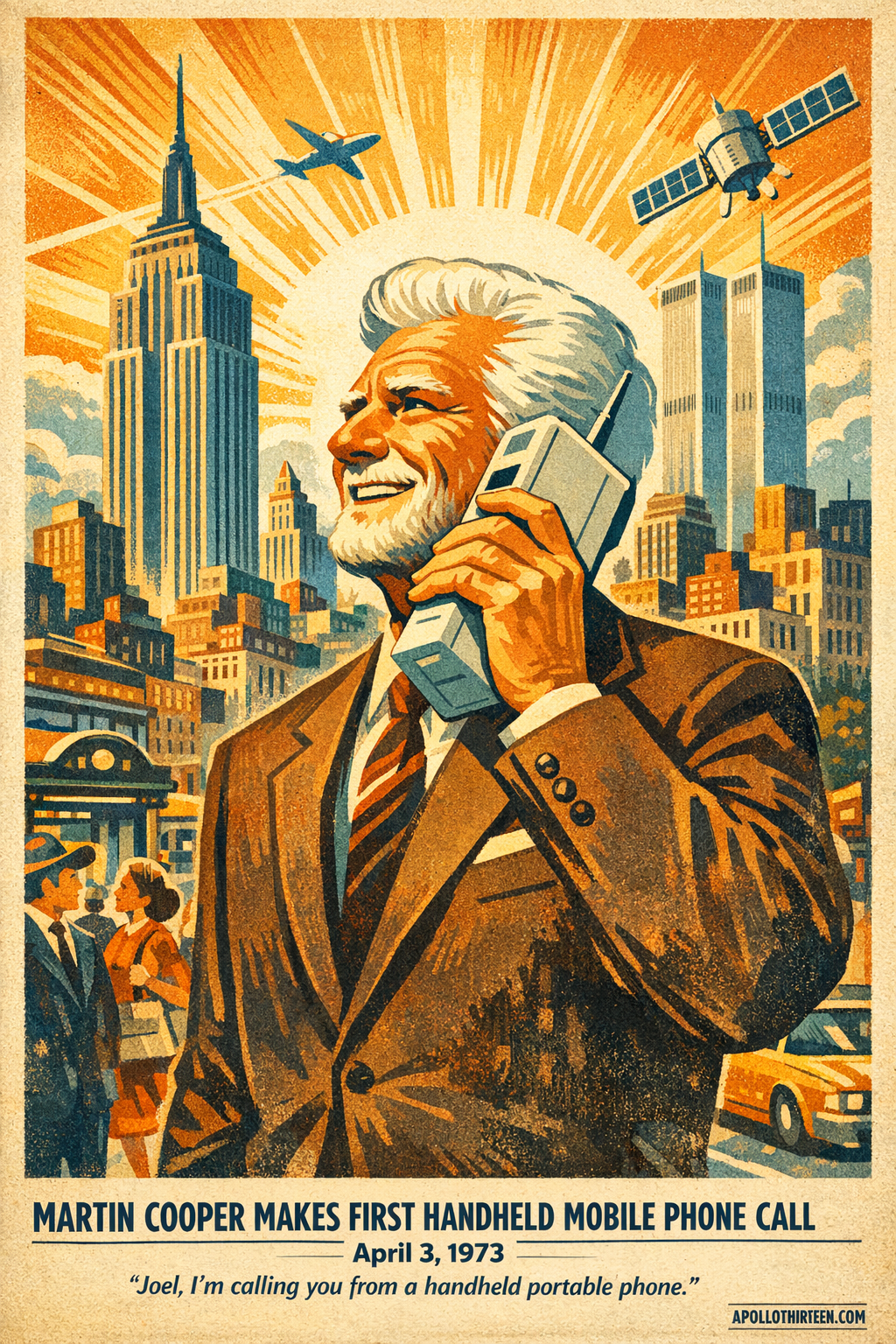
The Day That Changed Everything
Fifty-three years ago today, a man in a dark suit walked down Sixth Avenue in Manhattan carrying what looked, at first glance, like a small brick. It was a warm April morning, the kind that makes New Yorkers quicken their pace and taxis even more frenzied. Between 53rd and 54th Streets, with the city’s noise and commotion as his soundtrack, Martin Cooper took the device from his pocket, held it to his ear and spoke across a few city blocks into the future.
“Joel, this is Marty. I’m calling you from a cellphone, a real handheld portable cellphone.”
It was less a sentence than a dare. When the man on the other end—Joel S. Engel, head of Bell Labs’ research division and Cooper’s corporate nemesis—fell silent, Cooper knew he had done more than make a technically impressive call. He had punctured a prevailing belief about the limits of communication. The era when phones were anchored to walls or dashboards had just met its improbable challenger: a shoebox-sized promise of untethered conversation.
That simple, audacious act played out in public with little of the fanfare we imagine for groundshifting moments today. No live-streamed feed. No flashing headlines that same afternoon. But those few minutes on the sidewalk altered the invisible architecture of modern life. Fifty-three years on, we still live in their shadow—constantly connected, pocket-sized screens keeping us in touch with one another and the vast infrastructure that now powers science, commerce and daily life.
What Actually Happened
On April 3, 1973, at roughly 11:35 a.m., Martin Cooper—then a lead engineer in Motorola’s communications systems division—stepped onto the sidewalk and made history with a prototype that weighed about 2.5 pounds. The device was large by today’s standards, closer to the size of a shoebox than a slim slab. It would later be known as the DynaTAC, shorthand for “Dynamic Adaptive Total Area Coverage,” and its early form was heavy and ungainly: about the weight of a paperback stack, but this was a practical miracle packed with radio engineering.
Cooper dialed Joel Engel at Bell Labs, and the call was as deliberate as it was theatrical. Motorola and AT&T were locked in fierce competition over how mobile telephony would evolve. For AT&T’s Bell Labs, the future had looked like car phones—big, fixed in vehicles, reliant on infrastructure that assumed telephony would travel with automobiles. Cooper believed differently. He had for years pushed the idea of a “personal telephone,” a device people would carry with them, not something that lived in their car trunk or kitchen drawer.
When Engel answered, Cooper delivered his line and left the rest to the drama of the moment. According to Cooper’s retelling, Engel was stunned—reports say the Bell Labs executive fell silent, perhaps trying to process both the technological implications and the humiliation of being called out. Cooper then placed a series of additional calls, demonstrating the device’s practicality and, in doing so, drawing defensive stares and curious smiles from New Yorkers passing by.
Technically, the prototype allowed about 35 minutes of talk time and required roughly ten hours to recharge. It used early forms of radio frequency modulation, miniaturized circuitry and the nascent ideas of cellular architecture—concepts that had been theorized decades earlier but had not been pushed into a true handheld shape. The prototype was as much a political statement as an engineering one: it said, unmistakably, that telephony would not remain welded to the car or the wall.
The call itself was a demonstration, not a commercial release. It took another ten years of technical refinement, regulatory wrangling and infrastructure investment before a market-ready DynaTAC appeared in 1983. That unit, lighter and dimensioned for a user’s hand, sold for around $3,995—a luxury item for executives and wealthy early adopters. But the April sidewalk call was the seed, the public proof that the seed could grow.
The People Behind It
This story is less a tale of a lone genius than a contest of teams, tempers and visions.
Martin Cooper was the public face and the doer. He had worked within Motorola for years, convinced that personal, portable telephony was not merely possible but inevitable. Cooper’s background was in electrical engineering and communications, and he had the temperament of a provocateur: competitive, confident, willing to test boundaries. He later recounted that the goal was to create communication “wherever they are, unfettered by the infamous copper wire.” The Manhattan call was as much a show of technical prowess as it was a strategic provocation aimed at Bell Labs.
Joel S. Engel represented the other major axis of mobile telephony at the time. As head of research at Bell Labs—then part of AT&T—Engel led teams that had conceptualized much of what underpins modern mobile systems. Bell Labs’ engineers had described cellular systems as early as 1947, articulating the benefits of dividing regions into small areas, or “cells,” to reuse frequencies and manage limited spectrum. Yet AT&T’s business model and infrastructure focus leaned toward integrating mobile systems with existing telephone networks in a way that favored car-bound phones and centralized control. When Cooper called Engel, it was, by Cooper’s own account, an “epic troll”: a deliberate act to expose a strategic blind spot in AT&T’s approach.
Around Cooper were other Motorola engineers who translated theory into the prototype clutched in his hand—men and women whose work rarely appears in the popular retellings. They labored on miniaturizing components, arranging power-efficient circuits, creating antennas that worked without the vehicle’s metal body and ensuring the device could handshake with the limited base stations of the day. Their work was as much about engineering craft—heat dissipation, battery chemistry, connector reliability—as it was about radio theory.
Bell Labs itself cannot be portrayed as bungling or backward. It was a crucible of innovation, producing foundational ideas about cellular systems that later informed the networks Cooper and Motorola would build upon. The rivalry, then, was not one of capability so much as vision—whose future would win out, and which mode of thinking would prevail in the real world of regulators, carriers and consumers.
There were no astronauts involved in this moment—no space mission heroes touched the handset on that sidewalk—and that absence is telling. Mobile telephony was not a spectacle of national grandeur; it was an engineering coup. The people who built the phone were technicians and tinkerers, managers and dreamers. Their stage was an urban sidewalk, and their audience was everyone with a pocket.
Why the World Reacted the Way It Did
To someone in 1973, the image of a person speaking privately into a small device while walking down a city street was both intimate and strange. The public reaction, in the immediate sense, was curiosity. Bystanders on Sixth Avenue paused to stare, to wonder if the man was radioing a friend or making a theatrical gesture. There was amusement in seeing a person converse while clearly unencumbered, but there was also skepticism. Phones were still associated with cords, with offices, with cars. A handheld that worked anywhere struck many as a charming oddity rather than an imminent revolution.
Politically and regulatorily, the path from a bold demonstration to ubiquity was far from smooth. Wireless spectrum is finite and regulated; those who hoped to build networks needed permission and frequency allocations from authorities. In the United States, that meant engaging the Federal Communications Commission. The institutional gatekeepers were cautious: spectrum had to be managed to avoid interference, and the economics of building out networks were daunting.
AT&T’s dominance complicated matters. For decades, the company had a near-monopoly on telephony and was deeply invested in infrastructure that favored centralized, networked, landline-based systems and car telephones. Motorola’s demonstration was a public challenge to that orthodoxy. The FCC’s eventual approval of cellular services in 1983 was a critical turning point, effectively sanctioning and opening the market for handheld devices and the private carriers that would roll out cellular networks. That decision did not happen overnight; it was the culmination of technological proof, political negotiation and market pressure.
Public interest in mobile phones only grew slowly at first. When the commercial DynaTAC debuted in 1983 it was a symbol of elite mobility—a costly accessory bought by business people who could justify its price with convenience or image. The networks themselves were primitive by modern standards: the very first commercial cellular systems in New York supported a tiny number of users on limited channels. But the human appetite for untethered communication was immediate and expansive. Once regulation and economics aligned, demand soared.
The reaction to that April day reveals something about how societies adopt innovations. Great technical feats often require public proof—acts of demonstration that reframe what is possible. Cooper’s phone call did precisely that; it reframed the phone from a place-bound utility into a companion. Once the idea shifted, policy and markets followed in a race to catch up.
What We Know Now
Today, making a phone call from the sidewalk is mundane. But the ease we feel masks enormous complexity and a century of accumulated engineering. The modern mobile phone is the end product of several layered breakthroughs: radio engineering that allows devices to share scarce spectrum, network architectures that manage seamless movement, miniaturized electronics that fit vast capability into a hand, and batteries that balance energy density with safety.
The core scientific idea that made mobile networks efficient is frequency reuse through cellular architecture. Instead of assigning each conversation a unique frequency across a city, engineers divide coverage into small geographic units—cells—each served by a base station. Cells can reuse the same set of frequencies at sufficient distances without creating destructive interference, dramatically multiplying the number of simultaneous conversations possible in a given band. When a user moves, the network hands the call—or the data session—off from one cell to another, a process called handoff. Handoff requires timing coordination and fast communication between base stations; it’s the invisible choreography that keeps a call from breaking as you move down a street.
Spectrum scarcity remains a central constraint. Radio waves are a limited natural resource; regulators allocate bands for different uses, and engineers strive for efficiency. Over the decades, technologies like digital modulation, more sophisticated channel coding, and later the adoption of packet-switched data networks have improved spectrum utilization. The move from analog voice channels to digital signals allowed networks to cram much more information into the same airwaves, paving the way for mobile data and the smartphone revolution.
Another quiet revolution is component miniaturization. The circuits in Cooper’s prototype filled board space that, today, would be a fraction of the chip. Advances in semiconductor manufacturing let us pack billions of transistors into chips the size of a fingernail. Sensors—accelerometers, gyroscopes, magnetometers, light and proximity sensors—turned the phone into a rich portal to the physical world. GPS chips and radio modules turned handheld devices into global locators and network nodes.
Power and battery technologies have lagged behind but improved. The original prototype required ten hours to recharge for thirty-five minutes of talk. Today’s devices are far more efficient, though energy remains a limiting resource, especially as phones have become miniature data centers in our pockets. Wireless carriers, infrastructure companies and device manufacturers now coordinate closely—standards bodies and international agreements smooth out interoperability and guide how networks evolve.
We also understand now that mobile networks and phones are platforms—not just for voice but for computation, sensing and social connection. They serve as tools for commerce, health, emergency response and scientific observation. From enabling real-time data from remote sensors to giving citizens a platform for reporting environmental change, mobile devices have become integral to the modern scientific apparatus in ways Cooper could scarcely have imagined standing on that sidewalk.
Legacy — How It Shaped Science Today
The legacy of that improvised Manhattan call is enormous and layered. At a basic level, it rewired the social fabric: conversations could now drift off the fixed points of landlines or dashboards and become part of continuous, mobile life. But the technological ripples run deeper and into unexpected corners of science.
First, mobile networks transformed data collection. Sensors connected via cellular networks can now stream environmental measurements from remote locations, feed real-time epidemiological data, and support distributed scientific experiments. Mobile phones themselves doubled as cheap, pervasive sensors: accelerometers and GPS units have been repurposed for seismic monitoring, crowd-sourced environmental tracking and biodiversity reporting. The ubiquity of the phone made it possible to crowdsource scientific data at scales previously impossible.
Second, the miniaturization and power-efficiency challenges that drove mobile engineering accelerated advances in electronics that benefited scientific instruments. High-performance, low-power chips developed for phones found uses in portable medical devices, field instruments for ecology and geology, and unmanned aerial systems. The bar set by consumer expectations—thin, light, battery-efficient—pushed industry to make smaller and better components that scientists could also adopt.
Third, the networking principles that undergird cellular systems—scalability, frequency reuse, distributed control—have informed other kinds of scientific infrastructure. Radio astronomy, for instance, builds vast arrays that borrow concepts from distributed radio networks. The idea of coordinating many small receivers to create a large virtual aperture resonates with how cellular networks stitch together coverage with many base stations. And the software-defined radio revolution—enabled by powerful, cheap processors in mobile devices—has democratized access to the radio spectrum, enabling novel research and education efforts.
Finally, the cultural and economic consequences of mobile telephony shaped how science is funded, communicated and practiced. The same platforms that let scientists share papers and data instantly also gave rise to citizen science. Projects that rely on crowd-sourced observations—of birds, of light pollution, of ambient noise—often depend on mobile devices for data capture and transmission. In emergencies, mobile networks allow scientists and public health officials to track and coordinate responses in near real time. For better or worse, the phone transformed the pace and reach of scientific dialogue.
The march from prototype to ubiquitous platform also restructured industry. Companies that once competed in analog car phones pivoted to new markets or were left behind. Standards emerged—first regional and later global—allowing devices to interoperate and networks to scale. The industry that grew out of that moment created entire ecosystems of apps, services and research, altering the technological landscape for good.
Fast Facts
- Date: April 3, 1973 — 53 years ago today.
- Time: Approximately 11:35 a.m.
- Location: Sixth Avenue, between 53rd and 54th Streets, Manhattan, New York City.
- Caller: Martin Cooper, lead engineer, Motorola Communications Systems Division.
- Recipient: Joel S. Engel, head of research, Bell Labs (AT&T).
- Prototype: Early DynaTAC handheld portable phone; prototype weighed about 2.5 pounds and was shoebox-sized.
- Performance: Roughly 35 minutes of talk time; about 10 hours to recharge.
- Commercialization: The commercial Motorola DynaTAC debuted in 1983, priced around $3,995.
- Early network: New York’s first commercial network supported just a few dozen subscribers on limited channels.
- Regulatory milestone: FCC approved cellular service frameworks in 1983, enabling commercial roll-out.
- Cultural note: Cooper’s call is widely recognized as the first public handheld mobile phone call and is a touchstone in the history of telecommunications.
Why It Still Matters Today
On that narrow stretch of Manhattan sidewalk, Martin Cooper did something simple and defiant: he made a prototype into a promise. It was a promise that communication would not be defined by where we were anchored but by how we carried ourselves. That promise has reshaped cities, economies and intimate lives. It has created new modes of sociality and commerce, complicated privacy and politics, and built the technical scaffolding on which modern science now relies.
The phone’s evolution from a bulky prototype to a pocket computer has taught engineers and policymakers an important lesson: technology and society are co-authors. A device in a hand changes infrastructure demands; infrastructure changes what devices can do; and collectively, those shifts change how people live. Cooper’s call catalyzed that feedback loop.
There are ironies in the story that are worth holding onto. Bell Labs—the place where many foundational ideas were born—did not rigidly fail to see mobile’s future so much as it saw it differently. The story is less about one side’s rightness than about how public proof, competition and regulatory nudges converge to favor particular visions. And there’s a human truth in the image of the brash engineer dialing a rival: sometimes a little theatricality is the lever that pries open change.
Fifty-three years on, standing in any city, you can watch the legacy in motion. People speak, type and stream through devices that would have seemed impossible to the commuters of 1973. Behind those conversations sits an invisible lattice—cell sites, spectrum policy, semiconductor factories, software standards—built from decades of incremental ingenuity and occasional leaps of imagination. The handset that Cooper bore was clumsy and extravagant compared to today’s devices, but its heart was the same: the yearning to be connected without cords.
That yearning is itself a scientific force. It has driven research into better networks, smarter power systems, more efficient use of spectrum, and sensors that turn every pocket into a potential data source. It has also raised questions that science must grapple with: how to secure mobile communications, how to protect privacy, how to ensure that the benefits of connectivity reach more people and don’t deepen divides.
On April 3, 1973, a man walked down Manhattan carrying a contraption and lit a fuse. The fire has been anything but contained: it spread into commerce and culture, into laboratories and living rooms, into the very way we think about presence and absence. Fifty-three years later, the handset in our pocket is the heir to that day—a reminder that technology’s most potent magic often begins with a small, stubborn act of imagination on an ordinary street.



Comments
No comments yet. Be the first!