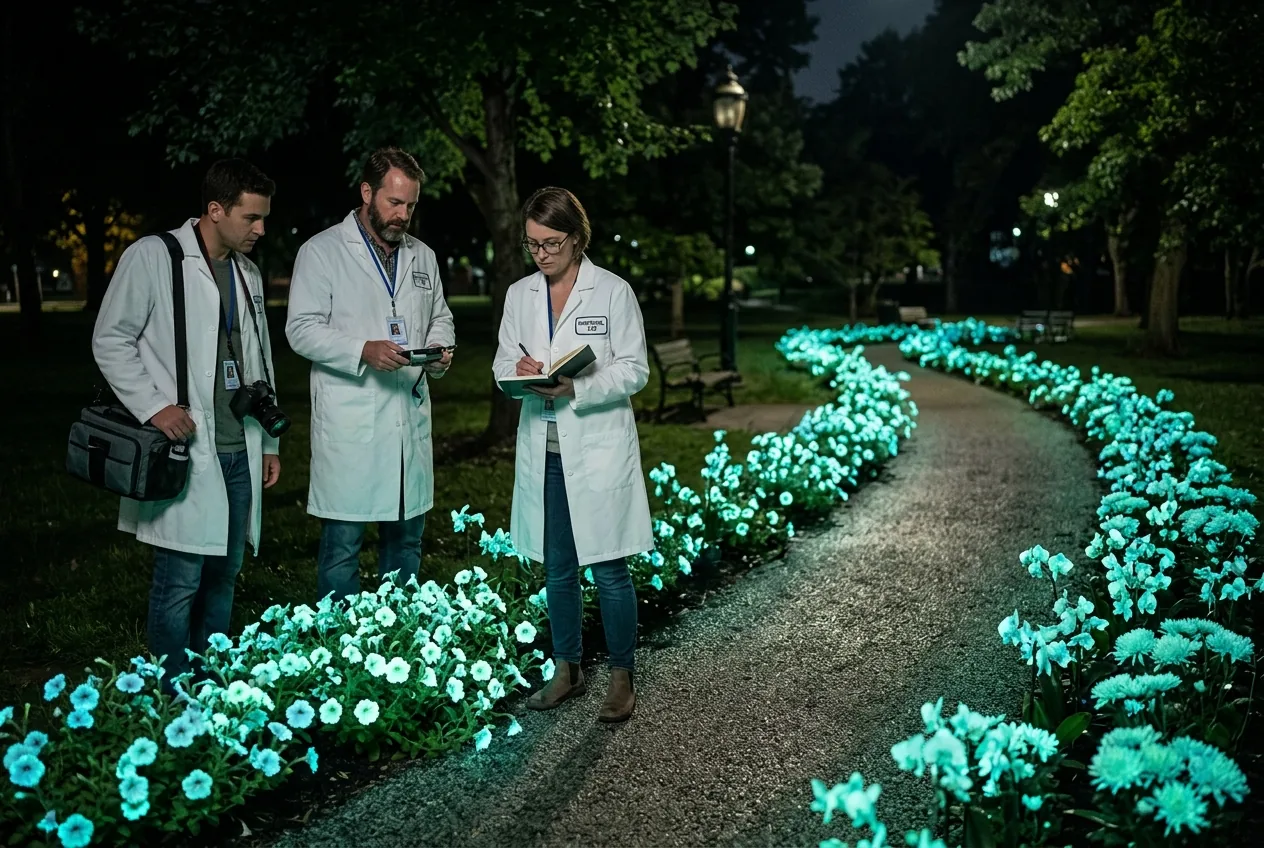
An engineered garden and a sales pitch: a soft green glow in a Beijing lab
In a dim room lined with tissue-culture racks and LED panels, a group of researchers and company founders flipped the lights and let the plants speak for themselves: orchids and sunflowers, chrysanthemums and petunias, each emitting a faint, otherworldly glow. The result — presented by Li Renhan and his company Magicpen Bio — is the kind of visual you see in tourism brochures: botanical beds that shimmer after dusk without running a wire to the mains.
chinese scientists bioengineering plants — the demonstration and the claim
chinese scientists bioengineering plants — brightness, biology and the limits of glow
At the heart of practical skepticism is a simple physics and biology problem: luminous intensity. Street lighting is designed to deliver tens to hundreds of lux at footpath level; even the brightest engineered plant so far emits a gentle luminescence suited to ambience and spectacle rather than illuminating a pavement for safety. That doesn’t mean plants can’t be made brighter, but it does impose trade-offs.
Bioluminescence requires chemistry. Firefly-based systems rely on luciferase enzymes acting on a small-molecule substrate (luciferin), usually in the presence of oxygen and ATP. Some fungal systems are more self-contained because the biochemical pathway for their light-emitting pigment overlaps with plant metabolism, which is why the Firefly Petunia and similar demonstrations used fungal genes. In practical terms, that difference matters: systems that depend on a substrate not native to plants need either constant metabolic investment or additional engineered pathways, adding complexity and potential growth costs.
That metabolic cost translates to a biological limit. Continuous, high-brightness glow requires energy and metabolites that would otherwise go to growth, flowering or stress tolerance. The plants so far are ornamental feats of molecular biology, not mass-market replacements for LED luminaires. For now, the glow is adequate for nighttime gardens, low-light promenades and tourism spectacles; it is not yet a drop-in substitute for the engineered, regulated luminance of municipal lighting systems.
Ecological uncertainty and the regulatory gauntlet
Beyond technical brightness, the next questions are ecological. Could glowing genes affect pollinators' behaviour, night-time predators, or soil microbiomes? Could engineered luminescence alter plant–insect communication or extend activity of nocturnal animals, with cascading effects in urban green spaces? Scientists warn these are legitimate unknowns: light at night is already an ecological stressor, and adding biological light sources with novel spectral characteristics complicates predictions.
There are also cross-border regulatory hurdles. In the European Union and in Germany, genetically modified organisms face strict oversight — field releases and public plantings require environmental risk assessments, containment plans, and often run into strong public resistance. Municipalities in Europe have traditionally separated ornamental horticulture from ecosystem protection; introducing intentionally luminous GM plants into public parks would trigger lengthy approvals and likely public consultation. In short, even if Magicpen Bio’s plants were imported tomorrow, deploying them across European streets would be a slow policy process.
Alternatives, niches and the economics of mood lighting
Not all of the innovation bets on editing genomes. The nanoparticle afterglow approach offers a different compromise: existing plants are dosed with charged materials that glow after exposure to sunlight. That sidesteps some genetic concerns but raises materials-safety questions about metals in the urban environment. Which approach wins will depend on cost, durability, and governance — and on how cities value ambience versus measurable illuminance.
There are realistic niches where glow plants make sense. Botanical gardens, theme-park installations, curated walking routes and certain tourism-driven regenerations can pay the premium for novelty. For municipal streetlighting the economics are tougher: LEDs are cheap, durable, predictable, and already integrated with smart-city grids. Any energy-savings claim needs to account for planting, irrigation, replacements, and the social cost of reduced visibility. Investors and procurement officers will compare capital and operating costs, not just the prettiness of a glowing valley.
Safety, public acceptance and the path to deployment
Questions people often ask — can plants be genetically engineered to glow, how do firefly genes make plants bioluminescent, and are they safe for ecosystems — have partially answered, but not settled, replies. Yes, plants can be engineered to glow: researchers have used both fungal and firefly-derived genes to give plants luminescent properties. Firefly genes provide luciferase enzymes; fungal genes sometimes integrate more smoothly with plant metabolism. Safety is an open question that requires case-by-case risk assessment: effects on pollinators, gene flow to wild relatives, and long-term ecosystem consequences are all legitimate concerns regulators and ecologists will demand to see addressed.
As for timing — when might glow-in-the-dark plants become a practical urban lighting option? Expect staged rollouts. Short-term (1–5 years) deployments are plausible in controlled ornamental settings and private attractions. Widespread municipal adoption that replaces conventional streetlights is a longer prospect — a decade or more — because of regulatory reviews, ecological studies, maintenance logistics, and the low cost of existing lighting technologies.
What this means for Europe — and for German urban planners
From a European policy perspective, the story touches several sensitive chords: industrial strategy, biosafety, and cultural heritage. The EU’s demanding GMO framework will slow any rapid import of these organisms — which may be a feature, not a bug, for planners worried about unknown ecological impacts. German municipalities in particular will weigh the novelty against liability and conservation obligations for protected urban habitats.
That dynamic gives Europe a choice: treat glowing flora as a protected novelty for curated spaces — the kind of funded, high-profile installations that boost tourism — or try to develop domestic capabilities through research funding and structured trials. The former is politically easier; the latter would require coordinated funding, transparent safety trials, and a willingness to accept that the technology may remain ornamental rather than infrastructural.
In the meantime, the competition of ideas is healthy. China’s labs and companies are running bold demonstrations; other teams are pursuing chemical afterglow and designer LEDs remain the reference technology for reliable illumination. The real contest isn’t whether plants can be made to glow — they can — but whether that glow fits municipal needs, satisfies regulators, and survives in windy, wet, root-tangled reality.
For cities craving a little nocturnal romance, glowing plants offer something genuine: a soft, biological alternative to sodium glare, promising atmosphere more than lumen counts. For engineers and procurement officers, they’re a curiosity that will need convincing data on safety, cost and longevity before being considered for anything larger than a park bench.
Europe has the nurseries and the urban design offices; Brussels has the paperwork and the regulations; someone — perhaps a tourist board — will end up buying the first glowing valley. It will be beautiful, slightly impractical, and thoroughly photographed.
Sources
- Magicpen Bio press materials and interviews (company demonstration)
- South China Agricultural University (nanoparticle afterglow plant research)
- Light Bio (Firefly Petunia demonstrations and fungal bioluminescence work)




Comments
No comments yet. Be the first!