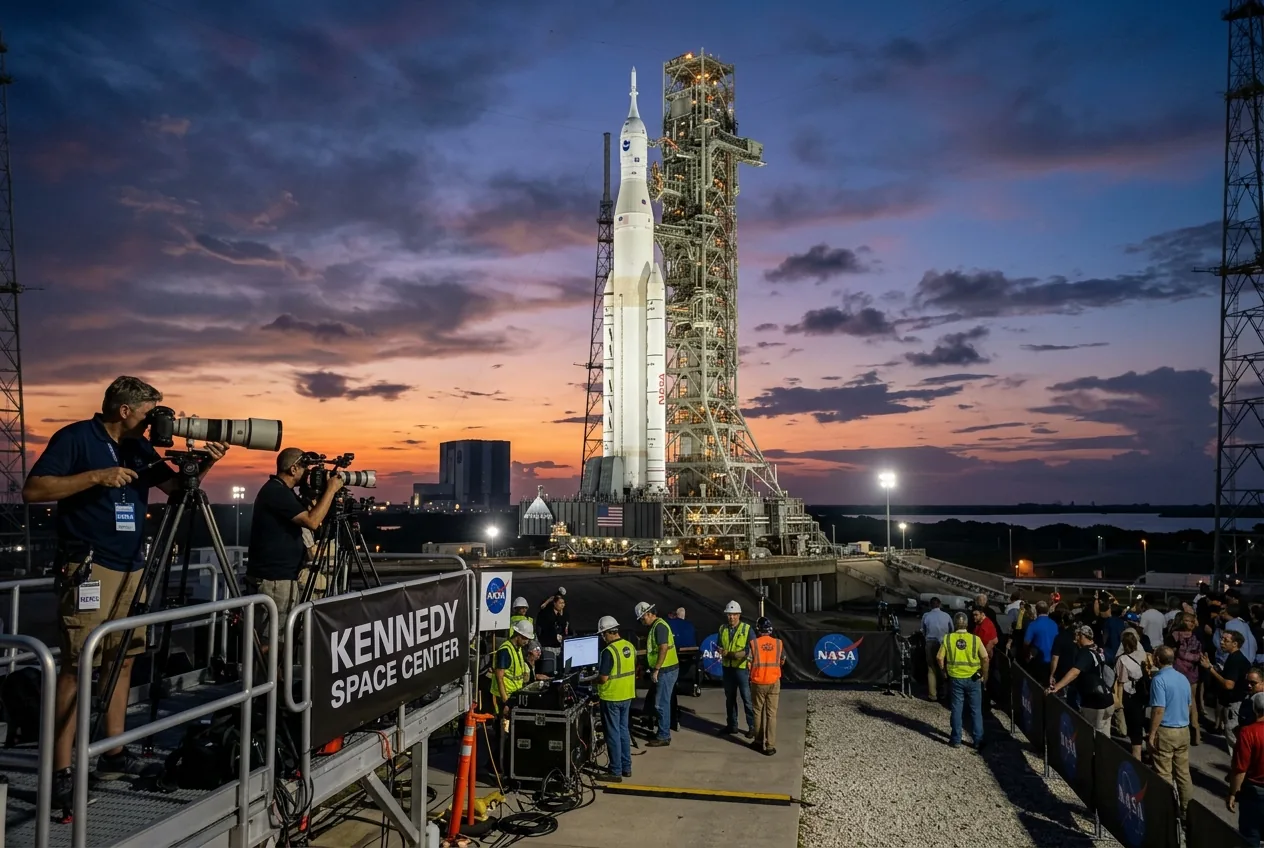
kennedy space center set for liftoff: a tense scene on the Space Coast
The vehicle sat like a cathedral on the pad as crews ran final checks, while a small phalanx of journalists and officials shuffled under Florida sun and salt air. At Kennedy Space Center officials have set a tentative launch attempt for Wednesday, April 1, 2026, for Artemis II — a 10‑day, crewed lunar flyby that will swing four astronauts around the Moon and back. The atmosphere is part pageantry, part checklist: a rocket that has already suffered schedule setbacks, a capsule full of humans, and a narrow early‑April window before NASA pauses operations for maintenance.
The phrasing matters. For the local press and NASA PR, this is a return to an old narrative — the first human lunar mission since 1972 — but the technical reality is different. Artemis II won’t try to land; its brief is to validate life‑support, navigation and communications systems while carrying people deeper into space than any human has gone since Apollo. That contradiction — farther than Apollo, yet no surface contact — is the practical hinge of this mission.
Nut paragraph: why this launch is more than a photo op
If Artemis II succeeds, NASA gains confidence that Orion, the Space Launch System (SLS) and the ground systems can support crewed missions beyond low Earth orbit. Success keeps a 2028 lunar landing target viable and sustains a politically charged narrative of U.S. leadership in space. Failure, or even repeated slips, would reverberate beyond Cape Canaveral: program costs, international partners’ schedules, and the commercial ecosystem that has clustered around Florida’s Space Coast would all be affected. In short, what happens at Kennedy Space Center this week has budgetary and geopolitical consequences as well as technical ones.
kennedy space center set: A launch poised — and fragile
NASA’s Space Launch System has flown only once with Orion on an uncrewed test in 2022; since then engineers have chased fuel leaks and other anomalies. Artemis II’s rollout to the pad was delayed twice and required repeat testing. Commander Reid Wiseman and his crew have trained for months, but even they acknowledged publicly that a launch in early April is not guaranteed and could slide into May or June.
The fragility is not theatre. SLS is a large, federally procured rocket with complex cryogenic plumbing. A single marginal valve or a helium pressure irregularity can scrub a launch and trigger weeks of rework. NASA’s new administrator, Jared Isaacman, has pushed for a quicker cadence of launches, but operational tempo will be set by hardware — and hardware is notoriously indifferent to political deadlines.
That reality sits uneasily next to public expectations. Local communities on Florida’s Space Coast are primed for spectacle, state legislators are nudging incentives for commercial players, and international partners are watching for signals about U.S. reliability. A smooth launch would be a public relations godsend; a slip would be expensive, but familiar to engineers.
What Artemis II must prove on a 10‑day loop
Artemis II is explicitly a test mission. The Orion capsule will carry four crew members — Commander Reid Wiseman, Pilot Victor Glover, Mission Specialist Christina Koch, and Mission Specialist Jeremy Hansen of the Canadian Space Agency — on a roughly 10‑day trip that will take them farther from Earth than any humans since Apollo. The flight plan calls for a lunar gravity assist and then a Pacific splashdown on return.
On board, the crew will exercise life‑support hardware, navigation and guidance through deep‑space windows, and communications relays that are crucial for later surface operations. Engineers will be watching telemetry for radiation exposures, micrometeoroid impacts, thermal control performance and the interaction between Orion and SLS. The mission’s explicit refusal to attempt a landing is intentional: NASA wants to de‑risk the vehicle and the human factors before committing to a descent and ascent sequence on later missions.
Artemis I in 2022 was an uncrewed proof‑of‑concept; Artemis II is the human step. If Orion behaves, Artemis III and subsequent missions can focus on lander demos and the logistics of a sustained lunar presence. If it doesn’t, the program faces hard choices: more uncrewed tests, a shift in timelines, and political fallout.
Why timing matters: geopolitics, budgets and market signals
NASA’s acceleration push is in part geopolitical. The U.S. wants to reassert leadership in manned lunar operations amid China’s growing ambitions. Public reporting from the agency and NASA officials frames Artemis as a strategic programme: a gateway to resource access at the lunar south pole and a rehearsal for Mars. That raises a practical question — can the U.S. keep to a high launch cadence while managing costs?
Budget pressure is real. Congress funds the SLS and Orion architectures alongside commercial partnerships and science payloads, and any high‑profile failure invites scrutiny. Meanwhile, Florida’s state government and Space Florida see launches as economic engines; local legislators are proposing tax and leasing incentives to keep more of the commercial space economy clustered around the Space Coast. The cadence of Artemis missions is therefore both a technical schedule and an economic signal for private industry.
Industry players such as SpaceX and Blue Origin operate on different business models, but all watch NASA’s schedule closely. A successful Artemis II improves investor confidence for lunar logistics companies, robotics vendors and ground‑services firms. A delayed or aborted launch slows contracts, delays payload manifests and risks political appetite for further large appropriations.
European perspective: industrial bets and supply‑chain limits
Across the Atlantic, ESA and European industry will be watching the Artemis II outcome for reasons beyond curiosity. Europe has its own plans for a lunar economy — robotics, surface science and contributions to orbital infrastructure — but lacks a matched heavy‑lift launcher of SLS’s class. That makes timely and reliable U.S. launches strategically important: they are the current lift line for many international collaborators.
German aerospace firms and research institutes are meanwhile trying to secure slices of the downstream market: components for habitats, robotics and lunar instruments. Brussels has been explicit about industrial policy — funding through instruments such as IPCEI and Horizon clusters — but the reality is a patchwork. European states can build high‑quality hardware and sensors, yet they remain dependent on partnerships for crewed heavy‑lift and for the political architecture that governs sharing lunar resources and operations.
Put bluntly: Europe has engineering and capital; the U.S. still has the big rocket. That asymmetry shapes how German and EU policymakers approach procurement, export controls and participation in multinational lunar architectures.
kennedy space center set: How to watch, who’s flying, and what to expect next
If you want to follow the countdown from home, NASA will livestream the event with mission commentary and technical briefings; local viewing on Florida’s Space Coast will be heavy, and media will congregate near the Kennedy Space Center’s viewing areas. For people asking practical questions: yes, the public can watch the launch from beaches and designated public parks along the Space Coast, but expect traffic, security perimeters and short‑notice scrubs.
The crew manifest is simple and multinational: Reid Wiseman commands, Victor Glover pilots, Christina Koch and Jeremy Hansen serve as mission specialists — Hansen representing the Canadian Space Agency. Their tasks are operational rather than scientific: test the spacecraft and demonstrate crewed operations in deep space. The flight is scheduled for about 10 days with a Pacific Ocean splashdown at the end.
What comes next depends on performance. A clean mission keeps 2028 lunar landing plans intact and opens the door to lander demos and greater commercial involvement. A problem will force re‑evaluations: more tests, deferred landings, and a reminder that in aerospace the schedule follows the hardware, not the calendar.
Sources
- NASA (Artemis program and Kennedy Space Center mission materials)
- Canadian Space Agency (statements on Artemis II crew participation)
- Space Florida (state space policy and economic incentives)




Comments
No comments yet. Be the first!