Scientists alter asteroid’s orbit — a fingertip on a cosmic clock
On 6 March 2026 researchers published the first direct evidence that humans have measurably changed the path of a natural object around the Sun: a tiny but detectable shift in the Didymos–Dimorphos binary asteroid system caused by NASA’s Double Asteroid Redirection Test (DART) collision in September 2022. The new analysis finds the pair’s 770‑day heliocentric lap around the Sun shortened by roughly 0.15 seconds, a change equivalent to a velocity tweak of about 11.7 micrometres per second. That fractional shift is the kind of tiny nudge that, given time and early warning, could be scaled up to keep a hazardous rock off a collision course with Earth.
scientists alter asteroid’s orbit: the DART hit and its punch
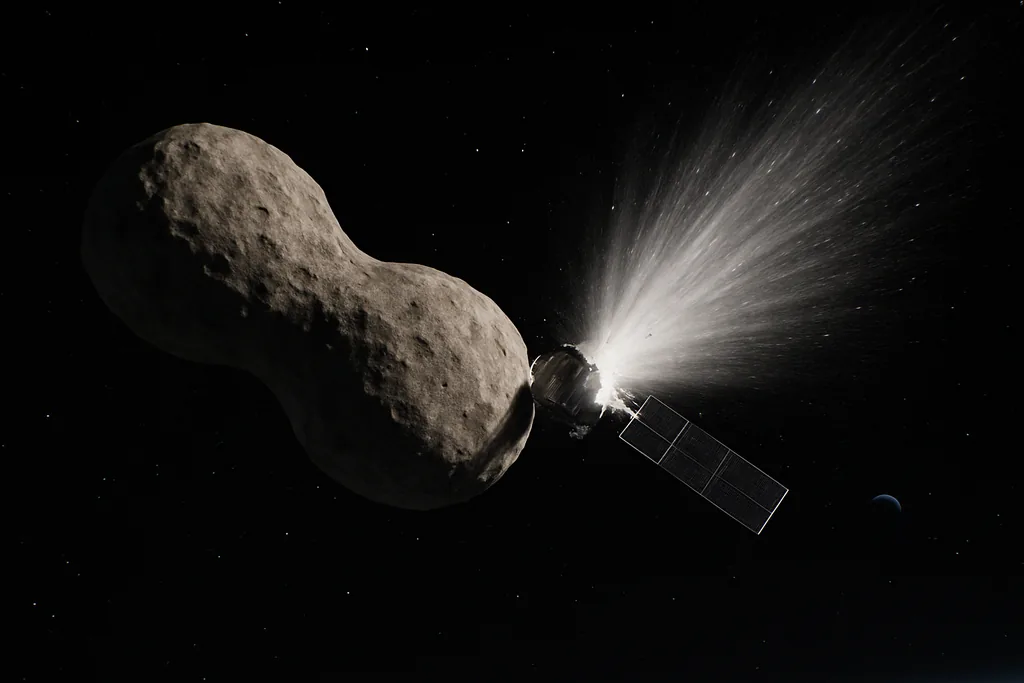
The DART mission was designed as a blunt but straightforward experiment: accelerate a 570‑kilogram spacecraft to more than 22,000 kilometres per hour and slam it into Dimorphos, the 170‑metre moonlet of the larger asteroid Didymos, to see whether a kinetic impactor can change an asteroid’s motion. When DART struck on 26 September 2022, it created a dramatic plume of ejecta and shortened Dimorphos’s 12‑hour orbit around Didymos by roughly 33 minutes — from 11 hours, 55 minutes to about 11 hours, 22 minutes and 3 seconds. The new study shows that the collision expelled enough debris that the momentum carried away by that material doubled the effect of the strike itself: the so‑called momentum enhancement factor came out near two. That extra push is what allowed even the larger two‑year solar orbit of the binary system to register a measurable change.
scientists alter asteroid’s orbit: how researchers measured the shift
Measuring a 0.15‑second change in a 770‑day orbit is a precision task that combined radar, space telescope imagery and a global network of volunteer observers. The team relied on 22 stellar occultations — occasions when the asteroid passes in front of a star and briefly blocks its light — recorded between October 2022 and March 2025. Those occultation timings, together with decades of prior ground‑based astrometry and radar, let researchers pin down the system’s heliocentric motion to exquisite accuracy. The analysis that appeared in Science Advances ties those observations together to show the minuscule but real alteration in the binary’s orbit.
Momentum, ejecta and the physics behind the nudge
The effect that made the heliocentric change detectable is largely mechanical: DART’s kinetic energy excavated and accelerated material from Dimorphos. When that ejecta escaped the local gravity of the two bodies it carried momentum away, amplifying the spacecraft’s direct impulse. Scientists quantify that amplification with the momentum enhancement factor, labelled β; the DART analysis finds β ≈ 2, meaning the departing debris roughly doubled the effective push delivered by the spacecraft alone. Models and follow‑up observations also indicate Dimorphos’s internal structure is “rubble pile”‑like, a loosely held aggregate of rock and voids — a structure that makes ejecta production efficient and complicates simple one‑body collision models. Those physical details are crucial for turning this single demonstration into reliable prediction tools for future deflection missions.
Planetary defence and next missions
The DART result is the first practical demo that kinetic impact can alter both a moonlet’s local orbit and, very slightly, the pair’s heliocentric motion. That success does not, however, mean we can relax. The scale of change needed to redirect a truly threatening near‑Earth object depends on warning time and the body’s size, composition and rotation. The key takeaway for policy and mission planners is simple: early detection multiplies options. A micron‑per‑second change now can translate to thousands of kilometres over decades if we spot a hazardous object far enough ahead of impact.
To turn demonstration into defence capability, one thread runs through many recommendations: find danger early. NASA’s planned Near‑Earth Object (NEO) Surveyor space telescope and improved ground surveys are aimed at discovering dim, low‑albedo objects long before they become imminent threats. Meanwhile, Europe’s Hera mission — launched in 2024 and scheduled to arrive at Didymos in late 2026 — will inspect the DART crater, measure the mass and interior properties of Dimorphos and collect ground‑truth data that will refine models of how real asteroids respond to impacts. Those in‑situ measurements are the kind of follow‑up that converts an elegant physics demonstration into operational readiness.
Limits, risks and why the change won’t make Earth less safe
What methods could be used beyond kinetic impactors?
Kinetic impact is the simplest and now proven tool, but it is not the only conceptual approach for planetary defence. Other proposed techniques include gravity tractors — long‑duration spacecraft that use mutual gravitational attraction to slowly tug an asteroid — and, for very late‑notice scenarios, nuclear options to vaporize or alter a body’s momentum. Each technique has trade‑offs: kinetic strikes are fast and relatively low‑complexity; gravity tractors require long lead times and precise station‑keeping; explosive options carry political, legal and debris risks. The DART result does not choose a single winner, but it gives planners an experimentally validated entry in the toolkit and a better empirical basis for choosing among methods when specific threats arise.
From experiment to preparedness
DART’s impact and the subsequent measurements move the field out of thought experiments and into operational science. The mission proved that a human‑built object can change the motion of a natural celestial body in measurable ways; the Science Advances paper turned that proof into a quantified result that mission designers can use. Yet turning a single demonstration into a robust planetary defence architecture will require systematic investment: improved detection, more interceptors, international legal frameworks, and more test missions across a range of asteroid sizes and structures. The coming months and years — especially Hera’s close‑up survey later this year — will be critical for turning DART’s dramatic footage and tiny solar‑orbit shift into reliable, repeatable defence capability.
Sources
- Science Advances (research paper: Direct detection of an asteroid's heliocentric deflection: The Didymos system after DART)
- NASA / Jet Propulsion Laboratory (DART mission reports and press release, Mar 6, 2026)
- Johns Hopkins Applied Physics Laboratory (DART spacecraft team)
- European Space Agency (Hera mission overview and operations)




Comments
No comments yet. Be the first!