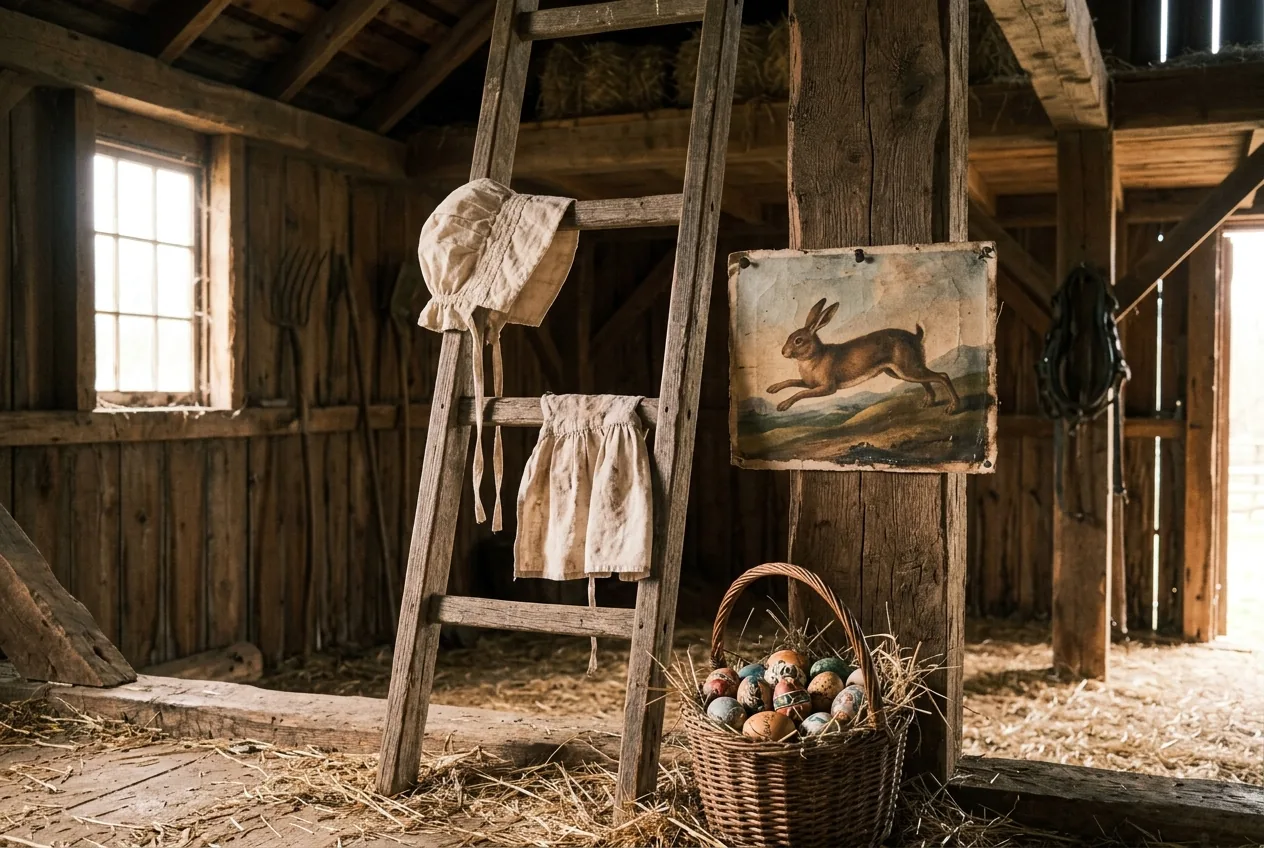
They left their caps in the hay
One spring morning in a Pennsylvania barn a child’s bonnet sits on a ladder while a wicker basket of painted eggs waits below — a small, domestic tableau that helps explain how the easter bunny hopped its way into American life. That quiet image conceals a long travel route: not from the North Pole, but from central Europe, carried in trunks and tongues by immigrants who kept customs that made surprisingly good neighbors with an already solemn Christian holiday.
The detail matters because it shows how ritual moves: objects and habits, not doctrine, often travel fastest. Here, children built nests from caps and bonnets and left them in secluded spots in hope of treats. That practice, recorded among Pennsylvania German communities, is the connective tissue between the Osterhase, a German egg-laying hare, and the raucous, mall-friendly Easter Bunny increasingly visible across America.
How the easter bunny hopped its way out of German villages and into Pennsylvania
Historians who study folklore point out a contradiction here: a symbol linked to pagan spring rites slipped comfortably into the calendar of one of the most solemn Christian observances. The integration was not a theological merger but a folk one — seasonal symbols and rituals layering onto the liturgical calendar until both sat side by side at table and altar.
When the easter bunny hopped its way from hare to bunny — and from nests to department stores
Language and imagery shifted in the 19th and early 20th centuries. The German-language Osterhase became, in English-speaking communities, the Easter Hare, then the Easter Rabbit and, finally, the more child-friendly Easter Bunny. That linguistic softening accompanied a visual and commercial transformation: the hare’s wild edges were domesticated into cartoonish figures and plush toys.
The public visibility peaked in odd ways: the Easter Bunny is now sometimes staged in formal civic moments — there’s a press photograph of a mock Easter Bunny news conference at the White House in April 2024 — an image that would have struck an 18th-century observer as curious, if not sacrilegious. It is a measure of how thoroughly the figure has been retooled into a piece of national theatre.
Eggs, Eostre and the tangled reasons the easter bunny hopped its way into Easter
The quick answer people ask is simple: why eggs and why a rabbit? The longer, messier answer sits at the intersection of symbols. Eggs have a long history as emblems of rebirth, used in spring rites and later folded into Christian symbolism of resurrection. Hares and rabbits, abundant and fertile in spring, offered a natural companion symbol. That convergence — eggs for rebirth, hares for fertility — provided a ready-made seasonal metaphor that fit easily onto Easter’s themes without requiring doctrinal endorsement.
Yet nuance is important. The association of a rabbit with Easter is not a direct inheritance from early Christian practice; it is a folk accretion. Folklorists emphasise that the holiday calendar is porous: seasonal customs often migrate into religious observance because they supply familiar rhythms — food, decoration, and communal acts — that religions can repurpose or coexist with. That pragmatic overlap explains why the easter bunny hopped its way into American Easter rather than being formally adopted by church authorities.
How depiction and practice have changed over time — from bonnet nests to the modern Easter hunt
Visuals and rituals have not stayed still. Early accounts focus on hares, sometimes depicted in art with baskets. Nests and hidden eggs were private, domestic practices. Over time the hare’s role softened into a rabbit for children’s books, greeting cards and retail. Public egg hunts and mall photo-ops replaced the quiet, improvised nests that once hid under hedgerows and in barns.
This shift matters because it reshapes ownership of the tradition. Where once a single immigrant community guarded and passed on holiday customs, national media and commerce now standardise the image. That standardisation can erase variation: regional recipes, local superstitions and the odd old customs stored in family memory risk disappearing under a nationwide Easter script dominated by chocolate, plush toys and staged appearances.
Surprises, contradictions and the unnoticed costs of a national tradition
There are tensions baked into the story. A symbol that began in a relatively small set of communities now sits at the center of mass-market festivities; that expansion encourages both familiarity and flattening. The bunny’s migration into malls and municipal events is also a lesson in how traditions gain power: visibility plus repetition equals legitimacy in the public eye, but not always depth of meaning.
Another contradiction: Americans often treat the Easter Bunny as a harmless children’s pastime, yet its commercialization has real economic stakes — seasonal merchandising drives significant revenue for confectioners and retailers. That trade-off between cultural meaning and market value is easy to miss when you’re hunting for painted eggs on a damp April morning.
Where the tradition stands today and what gets left behind
Today the Easter Bunny ranks among the country’s most recognisable fictional figures, trailing only Santa Claus in seasonal prominence and sometimes outpacing the Tooth Fairy. Its present form — a cuddly, obliging visitor at photo booths and parades — obscures a complex migratory history grounded in German folklore, immigrant community practice and gradual commercial adoption.
What remains easy to recover are the small, human details: the bonnet on a ladder, the hand-painted egg tucked into a nest, a mid-Atlantic family telling an origin tale about a great-grandparent who first taught them to set out a cap for the hare. Those fragments keep alive the uneven journey by which an old European motif was reinvented into an American institution.
Sources
- Pennsylvania German Cultural Heritage Center (archives on Osterhase and Pennsylvania Dutch traditions)
- Johann Conrad Gilbert, painting (circa 1778) — historical depiction of the Easter Hare
- Getty Images (photographic archives referenced for visual history)



Comments
No comments yet. Be the first!